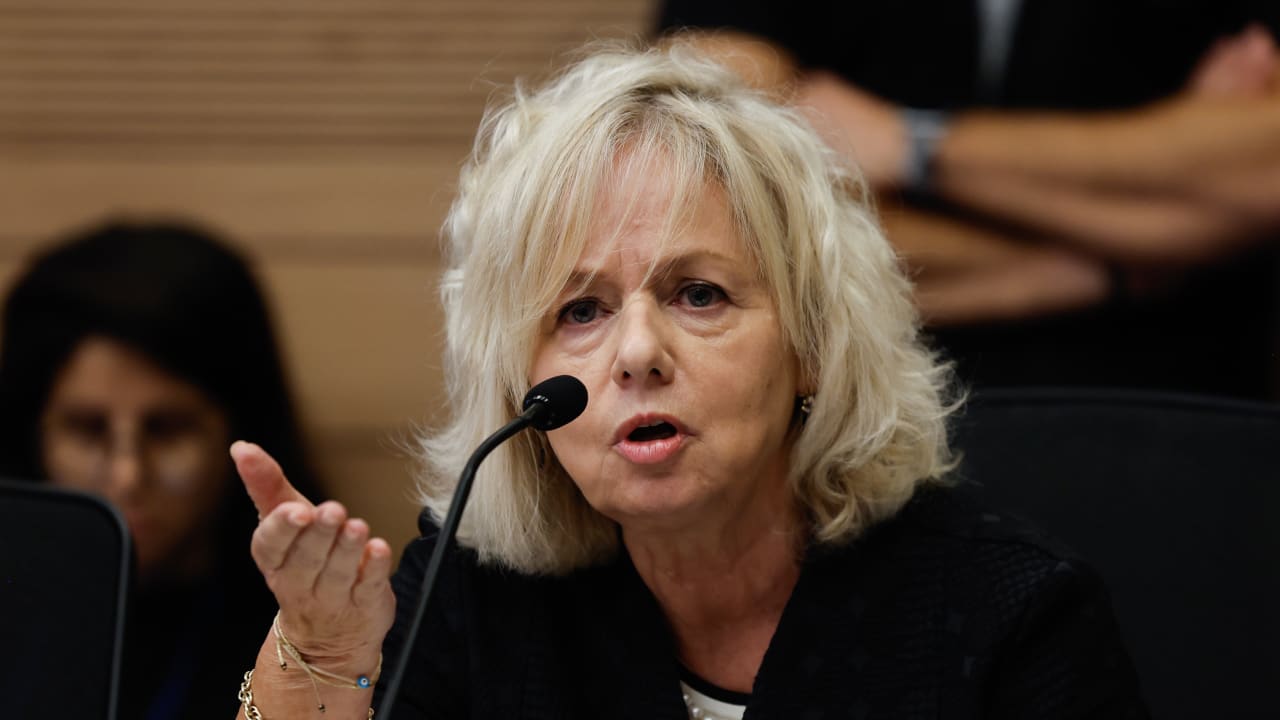
In a sweeping and unanimous ruling on Sunday, the High Court of Justice struck down two government resolutions that sought to change the mechanism for ending the term of Attorney-General Gali Baharav-Miara, effectively nullifying her dismissal and confirming that she remains lawfully in office.
The seven-justice panel ruled that the government’s June decision to eliminate the long-standing requirement to consult the public-professional committee prior to dismissing an attorney-general was procedurally flawed and legally invalid. Since that altered mechanism served as the legal basis for the government’s August decision to terminate Baharav-Miara’s tenure, the court determined that both resolutions were void.
As a result, the justices declared that Baharav-Miara “continues to serve in her position, with all that this entails,” a decision that further entrenches the judiciary’s role in Israel’s escalating constitutional confrontation with the government.
Supreme Court Chief Justice Isaac Amit authored the ruling, citing “serious procedural defects” in the government’s conduct and emphasizing the importance of established checks and balances governing the appointment and dismissal of senior legal officials.

Repeated challenges to judicial norms lead to threats to the attorney-general's position
The decision comes amid a prolonged institutional standoff, in which the government has repeatedly challenged judicial norms and sought to reshape the legal advisory system of the state – moves critics have warned risk undermining the independence of Israel’s legal institutions.
Under existing rules, the attorney-general serves a six-year term. Any appointment or early dismissal requires the involvement of a five-member public-professional committee, chaired by a retired Supreme Court justice and composed of representatives from the government, the Knesset, the Israel Bar Association, and academia. Early termination is permitted only in exceptional circumstances, such as severe and sustained disagreements that render continued cooperation impossible, and only following a formal hearing process.
The current framework was established in the aftermath of the 1997 Bar-On-Hebron affair, in which Prime Minister Benjamin Netanyahu appointed Roni Bar-On as attorney-general despite his lack of qualifications. Bar-On resigned within days amid allegations that the appointment was part of a political deal linked to Arye Deri’s corruption case.
The Shamgar Commission, formed in response, warned explicitly against concentrating the power to appoint or dismiss an attorney-general solely in the hands of the political echelon, a warning the court cited in Sunday’s decision.
The justices noted that the government failed to justify deviating from the Shamgar framework and emphasized that the procedural changes were adopted retroactively, after the government had already publicly declared its intention to remove Baharav-Miara.
The ruling was issued after multiple petitions were filed challenging the government’s actions. The attorney-general sided with the petitioners, while the government submitted what the court described as a “brief and perfunctory” response affidavit that failed to address the legal arguments in detail. The government also declined to appear for oral arguments, prompting the court to decide the case based solely on the written record.
Political reactions were swift and sharply divided.
Opposition Leader Yair Lapid welcomed the decision, saying, “I congratulate the High Court of Justice for unanimously accepting the petition submitted by Yesh Atid to prevent the illegal dismissal of the attorney-general. We will continue to fight for the rule of law in Israel.”
Communications Minister Shlomo Karhi condemned the ruling and called on the government to defy it. “This is a moment of testing for all of us,” Karhi said, accusing the court of acting unlawfully. He urged the government to “dismiss the attorney-general in practice, block her entry to government offices, and immediately appoint an acting replacement,” arguing that only by rejecting what he termed “illegal rulings” could Israeli democracy be preserved.
Justice Minister Yariv Levin also denounced the decision, describing the court as dominated by “activists and extreme activists.” He argued that no court elsewhere would force a government to work with a legal adviser it no longer trusts and claimed that the timing of the ruling was intended to interfere with ongoing investigations involving Baharav-Miara.
Observers, however, noted that the panel included Justice Noam Sohlberg, widely regarded as conservative, and stressed that the ruling did not prevent the government from seeking to end the attorney-general’s tenure – provided it follows the procedures it is legally bound to observe.
The ruling leaves the government facing a clear choice: comply with the existing legal framework for addressing disputes with the attorney-general, or deepen a constitutional crisis that continues to test the boundaries between Israel’s branches of government.