With Israel now well into an election year, the political picture emerging on the horizon looks depressingly similar: a logjam.
The country’s major polls for months have been predicting a scenario very similar to what struck the country during that dizzying period of five elections between 2019 and 2022 – the inability of either the pro-Netanyahu or anti-Netanyahu camps to form a coalition.
The polls are consistently showing that, were elections held today, the Likud would easily win the most seats – with its current coalition partners, the Religious Zionist Party, Otzma Yehudit, Shas, and United Torah Judaism – but fall short of being able to form a government. According to Friday’s Maariv weekly poll, this coalition would only garner 51 seats.
The Jewish center-right, center, center-left, and left-wing parties – Yesh Atid, Yisrael Beytenu, The Democrats, Blue and White, and Gadi Eisenkot and Naftali Bennett’s new parties – would pull in 59 seats but also be unable to form a government.
The two Arab parties, Mansour Abbas’s Ra’am (United Arab List) and Ayman Odeh’s Hadash-Ta’al, would each get five seats.

While the “change” government of Bennett and Yair Lapid from 2021-2022 included Ra’am, in the post-October 7 massacre reality, Bennett and Yisrael Beytenu chairman Avigdor Liberman have said, with varying degrees of finality, they would not form a coalition with Abbas’s party.
Lapid indicated he would not want Ra’am to be the 61st seat in the coalition. Eisenkot said he would sit in a majority government set up with Ra’am’s support from the outside. The Democrats chairman Yair Golan said he has no problem with Ra’am in the governing coalition.
Granted, a lot can happen between now and the next elections – with a decision by President Isaac Herzog on a pardon for Prime Minister Benjamin Netanyahu likely to have a dramatic impact. But as things stand now, Israel appears headed toward yet another electoral deadlock, with no clear or natural governing majority in sight.
Gantz's revolutionary idea: 'Anybody but extremists'
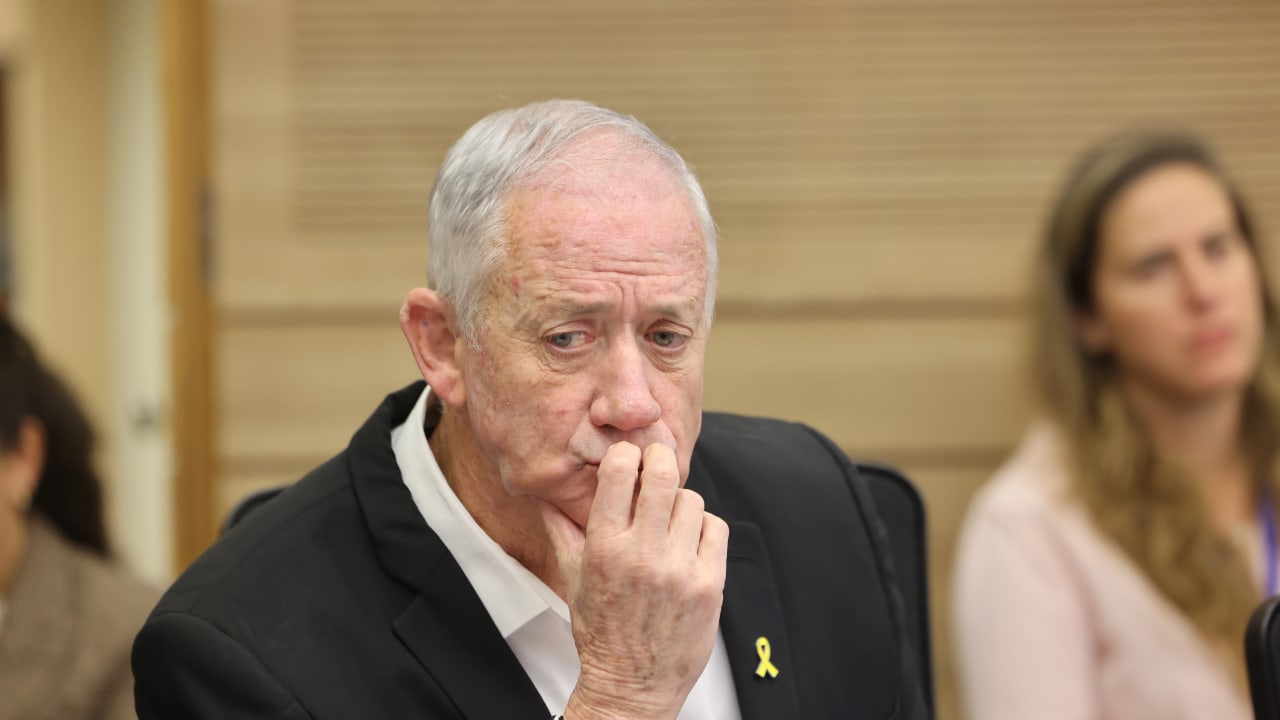
Enter Blue and White chairman Benny Gantz with a “revolutionary” idea. In an interview earlier this week, Gantz said he does not rule out sitting with Netanyahu in a unity government.
“It’s time to abandon the ‘anybody but Bibi’ idea and shift to ‘anybody but extremists,’” he said, meaning setting up a government without Bezalel Smotrich’s Religious Zionists and Itamar Ben-Gvir’s Otzma Yehudit far-right parties. He didn’t say it expressly, but – considering where he stands on the haredi conscription issue – Gantz’s intent seems also to be a coalition without the haredi parties.
Such a government, according to Friday’s Maariv poll, would garner 86 seats. But this government would also include an extreme element in the form of The Democrats.
If Gantz truly wanted to “exclude the extremists,” it would also mean excluding the Jewish far Left as well. That government would be one of 76 seats, the type of majority needed to settle new ground rules on the foundational issues bedeviling the society: judicial reform and haredi conscription.
After Gantz was pilloried for this idea by his erstwhile allies on the center and Left, he said: “They want to win the civil war; I want to prevent it. To hate Bibi more than you love the country, to sit on the sidelines shouting instead of driving change – that’s weakness.”
But there is a catch: Gantz, according to every major poll since October 2025, does not garner the 3.25% of the vote needed to get his party across the electoral threshold and into the Knesset.
The man who, according to a Maariv poll on November 24, 2023, was polling at 43 seats has not registered in that paper’s weekly surveys since September 19, 2025, and even then, only barely clearing the electoral threshold with four seats.
That has led some to dismiss his recent message as a desperate act of a failing politician. They might be right, but still, that does not disqualify the message.
Gantz soared to 43 seats in the polls two years ago precisely because he joined a national unity government with Netanyahu – what the people, these numbers proved, wanted to see following the trauma of October 7. He is returning to that same message now, hoping it resonates again.
It might, at least, be enough to get him back into the Knesset. Except for The Democrats, there is little, in terms of policy, that distinguishes the four other anti-Netanyahu parties currently in the mix: Bennett’s and Eisenkot’s parties, Yesh Atid, and Yisrael Beytenu.
They are vying among themselves to snatch one or two more seats from another party in their bloc. But the real political contest is not which party is bigger in which bloc, but who can move voters from one bloc to the other. These parties are rearranging the furniture in their own living room, not bringing in another sofa from next door.
Gantz’s message could conceivably do that. By signaling a willingness to form another unity government with Netanyahu, he may be able to draw voters from the pro-Bibi bloc who – after October 7 and in light of the ongoing investigations – want to vote for a party other than Likud, but they are not ideologically or emotionally opposed to working with Netanyahu if it means a government without the haredi parties or the extremists on both sides.
But how dare he, wrote a Haaretz reporter in an analysis on Tuesday, arguing that Gantz’s “implicit preference” for Netanyahu is “not only morally wrong but also politically irrational. After all, the prime minister routinely tramples on the rule of law, is tearing apart Israeli society, and, most of all, refuses to take any responsibility for the October 7 massacre.”
What the author conveniently overlooks is that Netanyahu is also, according to the polls, likely to receive more votes than any other candidate. That means a significant portion of the public does not share her diagnosis.
It also suggests that what continues to tear the country apart is not only Netanyahu himself, but the refusal of his opponents to reckon with this political reality.
Addressing core issues such as haredi conscription and the judicial-legislative balance may ultimately require working with him in a broad government, rather than persisting in a boycott strategy that, according to some critics, amounts to little more than cutting off the country’s nose to spite its face.