
When the Knesset passed the 2026 budget in the early hours of Monday morning, most Israelis were asleep. So, apparently, was the opposition.
Because when the votes were counted, opposition MKs had joined the coalition to approve additional funding for haredi educational institutions – precisely the type of allocation they had spent months railing against.
The money itself is unlikely ever to be transferred. The High Court of Justice, which has already blocked funding for haredi (ultra-Orthodox) yeshivot whose students do not serve in the army, is expected to intervene again, and Attorney-General Gali Baharav-Miara has already put a block on transferring the funds.
In practical terms, then, the vote may amount to nothing. But politically, it says a great deal about how the opposition is operating.
What happened in those early morning hours was more than a technical slip. It was a revealing moment – one that encapsulates a broader problem: an opposition that is not only struggling to stop the government but also, at times, to keep up with it.
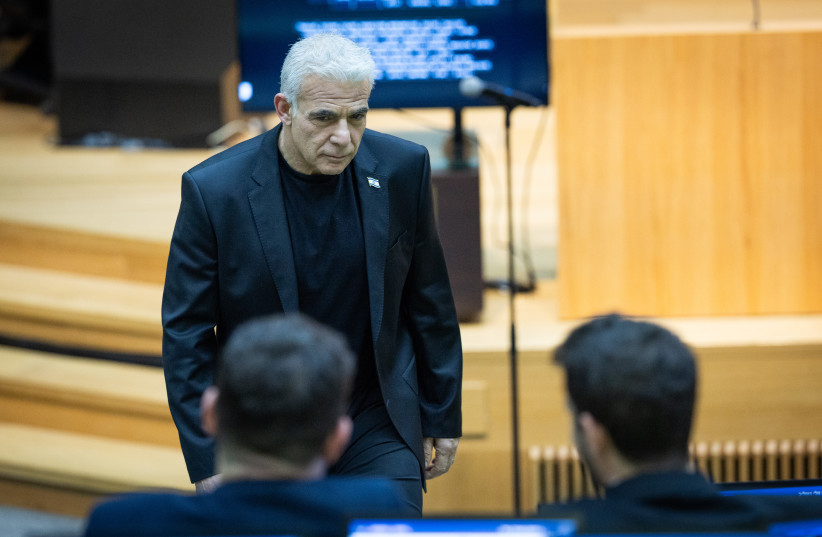
The clause on the haredi institutions was buried among thousands of budget reservations – the kind the opposition routinely votes against as a matter of course. This time, however, they weren’t paying close enough attention. The result: a vote that ran directly counter to their own messaging.
Symbolic? Yes. But symbolic in more ways than one.
Symbolic not only because the funding is unlikely to materialize, but because it reflects an opposition that has been repeatedly outmaneuvered – procedurally, politically, and rhetorically.
This was more than an isolated misstep. It reflected a broader pattern: an opposition struggling not only with messaging but with execution. And that, in turn, points to a deeper issue.
The problem with the Israeli opposition's absolutist argument
FOR MONTHS NOW, opposition leaders have argued that the government has failed across the board – in security, governance, building unity, and war. Turn on the television or the radio, and you will hear versions of the same refrain from figures ranging from leaders of veteran parties like Yair Lapid to Avigdor Liberman, as well as from heads of new factions such as Naftali Bennett and Gadi Eisenkot.
It is a powerful argument. It is also an absolute one. And that is where the problem begins.
That absolutism was on display outside the Knesset this week as well.
As the budget was being approved, a small group of protesters gathered nearby, issuing a statement that after two and a half years of war, “the October 7 government has not achieved a single victory” – not against Hamas, not against Hezbollah, and not against Iran.
It is a stark claim.
It is also a sweeping one – and one that underscores the gap between political messaging and a much more complex reality.
Because while there is no shortage of criticism to be leveled at this government – and much of it justified – the opposition’s broader claim of total failure is hard to reconcile with reality. At the same time, the opposition itself has struggled in what it has long defined as its central mission: bringing down the government.
That failure is not theoretical. It is measurable.
From the moment this government was formed, opposition leaders declared that it would not last. Lapid, speaking in November 2022 at the last cabinet meeting he chaired as prime minister, said, “We’ll be back in this room, sooner than you think.”
Yet here we are, years later, with the coalition having just passed a budget – all but ensuring it will complete its full term, no small achievement considering that only six of the country’s 37 governments have done so.
And this is not just any government.
This is the government under whose watch October 7 occurred – an event that shattered public confidence, upended assumptions about security, and, at the time, seemed politically fatal for Prime Minister Benjamin Netanyahu.
The expectation, widely shared in the days and weeks after the attack, was that Netanyahu’s political era was over – that the scale of the failure would be too great to withstand.
Yet he withstood it.
Not only that, but polling suggests that if elections were held today, his party would still emerge as the largest, trailing its 2022 result by only a handful of seats.
That reality does not speak only to Netanyahu’s political acumen – though that is certainly part of the story. It also speaks to the opposition’s inability to translate what should have been a moment of maximum vulnerability into political change.

Is Israel really 'not winning anywhere'?
AND THAT brings us to the second part of the problem: the argument the opposition has chosen to make.
Bennett captured it succinctly in an interview last month, arguing that Israel is “not winning anywhere” – not in Gaza, not in Lebanon, and not in Iran.
It is a striking line. But is it accurate?
Was October 7 a catastrophic failure? Undeniably.
Has the war, since then, waged on different fronts, been long, costly, and deeply painful? Without question.
But does that mean that nothing has been achieved?
Is Hamas today what it was on October 7? Does it possess the same capabilities, the same freedom of operation, the same capacity to threaten Israel in the way it did then?
Is Hezbollah the same organization it was before the current round of fighting – operating with the same arsenal, the same confidence, and the same posture along the northern border?
Is Iran the same as it was before October 7 – with powerful proxies surrounding Israel, projecting power throughout the region, the same weapons capabilities, and a nuclear program intact?
Obviously not. And that goes to the heart of the opposition’s narrative.
Take Hezbollah. The organization continues to harass the North, disrupt daily life, and pose a real and ongoing threat. That is undeniable. But to suggest that nothing has changed is to ignore the cumulative impact of months of fighting.
If Hezbollah once possessed an arsenal estimated at around 150,000 rockets and missiles, and that number has been significantly reduced – even if tens of thousands remain – that is not insignificant. Nor is the fact that its elite Radwan force is no longer positioned along Israel’s border communities in preparation for an October 7-style attack.
This is not total victory. But neither is it failure.
The same holds for Iran. No one is suggesting that every last ballistic missile launcher will be destroyed, or that every site in its nuclear program will be completely obliterated. But the damage to the country’s military infrastructure after more than a month of relentless bombing is highly significant.
The regime’s responses – even as it fights for its survival – have been far more limited than they were last June during the 12-day war, reduced largely to sporadic missile fire rather than sustained barrages. That, alone, suggests the extent of the damage.
And Hamas? The organization has not been eradicated. It remains present in Gaza, attempting to regroup. But it is not operating in the same way it did before October 7. Its infrastructure has been heavily degraded, its leadership decimated, and its freedom of movement curtailed.
Between total victory and total failure lies a wide spectrum, and Israel is operating somewhere along it – with real achievements, though far from absolute victory.
The Israeli imbalance that shapes perception
SO WHY, then, does the perception of failure remain so strong?
Part of the answer lies in how the war is experienced, and part in how those opposed to the government are presenting it.
Israelis encounter the conflict in immediate, concrete ways: sirens, safe rooms, damage to homes, funerals for fallen soldiers. These are tangible, visible, and deeply personal.
What they do not see – at least not in comparable terms – is the damage being inflicted on the other side.
The disparity in visibility is significant: Israeli losses are extensively covered in immediate, human terms, while the damage inflicted on Iran is reported in far more limited and abstract ways.
And that imbalance shapes perception. It makes it easier to believe that little is being achieved, even when that is not the case.
The opposition has tapped into that perception – but in doing so, it may also be overreaching.
By framing the government’s record during this war as one of broad failure, it risks disconnecting from a significant part of the public that, while critical and often frustrated, does not necessarily see the situation in such black-and-white terms.
That disconnect is not only in the argument – it is also about tone.
Over the past week, the opposition has been consumed not only with criticizing the government but also with internal jostling over who will lead it – Bennett, Eisenkot, Lapid – each staking a claim and warning
against the others.
This is natural in politics. But coming at a time when much of the country is still living under the strain of war – running to shelters, absorbing losses, adjusting to an unsettled routine – it can come across as out of step with the public mood.
And when a political camp appears out of step, its message – no matter how sharp – carries less weight. Credibility in politics rests not only on criticism, but on the ability to reflect reality as people experience it.
This is not to suggest that the government has succeeded across the board. It has not. The failures of October 7 remain profound. The war continues to exact a heavy toll. The deep societal divisions that preceded the conflict have not disappeared.
But not everything since October 7 has been an abject failure – not the campaigns against Hamas, Hezbollah, or Iran. An opposition that insists otherwise risks weakening not the government, but its own credibility and the case against it.