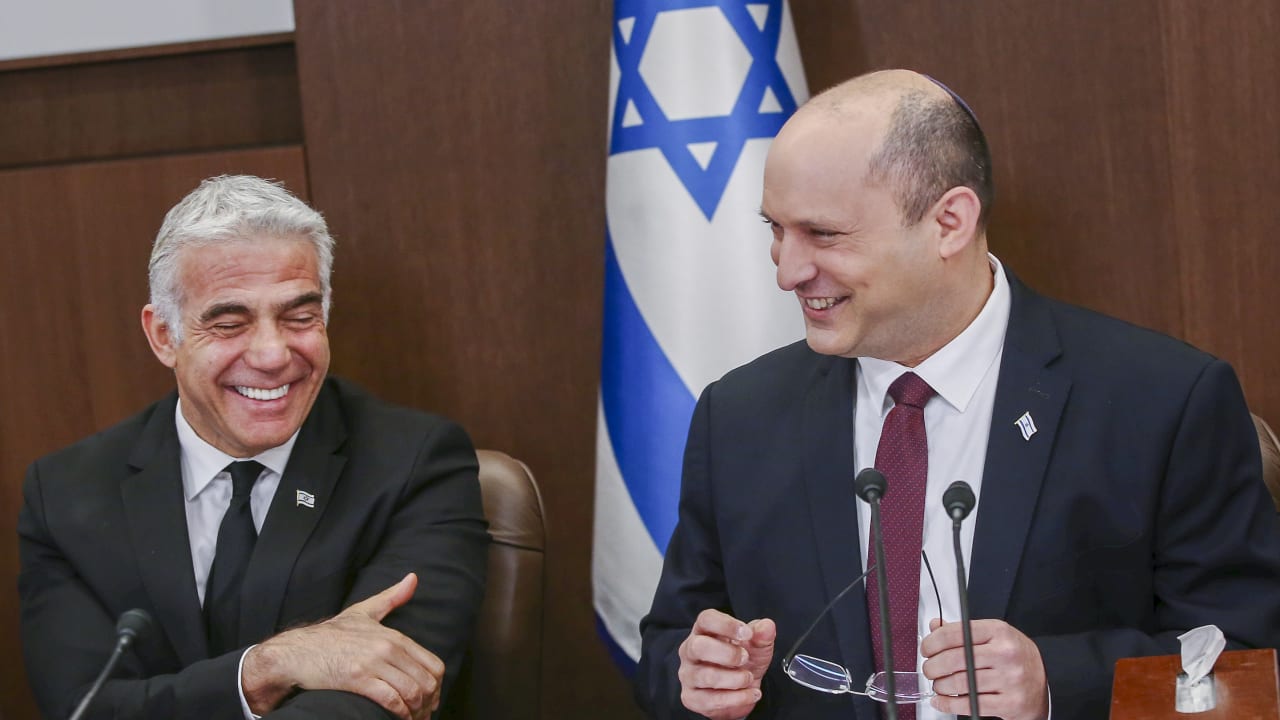
Naftali Bennett and Yair Lapid called it the brit ha’achim (the covenant of brothers) years before Sunday night’s stage in Tel Aviv. The phrase has held up. Two prime ministers, one rotation, three years of opposition apart, and the trust between them is still the through line.
Both men entered the Knesset in the same cycle, the January 2013 election that returned Benjamin Netanyahu to office. Lapid arrived as a television presenter-turned-political phenomenon. His Yesh Atid took 19 seats out of nowhere and walked into the Finance Ministry.
Bennett arrived, having reinvented Mafdal as Bayit Yehudi (Jewish Home) and took the Economy and Religious Services portfolios. Within weeks, they were running coordinated votes inside Netanyahu’s cabinet, pushing religion-and-state and conscription reforms neither could have passed alone. The friendship was operational from week one.
On paper, they had no business being allied. Lapid’s base was secular, urban, Tel Aviv. Bennett came in straight from running the Yesha Council (the umbrella body for Jewish communities in Judea and Samaria). State Department officials operated under standing guidance about engagement with settlement leaders.
The idea that Bennett would, less than a decade later, become prime minister at the head of a coalition that included Meretz and Ra’am, the Arab Islamist party, was inconceivable to nearly everyone. Including, almost certainly, Bennett himself.

The bromance has held
Israeli politics does not produce many bromances, and the ones it produces rarely survive. The genre tends toward betrayal: rotation agreements broken, coalition partners knifed at midnight, friendships dissolved over portfolio assignments. Bennett and Lapid are the exception.
Political reporters in this country have spent five years waiting for the betrayal to arrive. It hasn’t.
In May 2021, Lapid had 17 Knesset seats, and Bennett had six. The larger party normally leads. Lapid handed Bennett the prime minister’s chair anyway. Bennett kept the promise: when the coalition collapsed in June 2022, he handed the keys to Lapid and walked out, stepping away from political life for nearly three years rather than maneuvering against his partner.
The Netanyahu-Benny Gantz rotation of 2020 collapsed precisely because Netanyahu had no intention of rotating. Bennett-Lapid is the inverse case: a deal kept, at real personal cost, on the strength of nothing but a handshake. Sunday night was the third time Lapid has stepped aside.
Israelis are exhausted. The country has been at war for two and a half years, and the politics they remember from before October 7 is what they associate with a class of politicians who could not function as a team. Bennett and Lapid are running, in part, on the proposition that they can. The personal trust between them is the central campaign promise.
What Bennett actually believes
The attack line being pushed by Likud and the Religious Zionist Party, that Bennett has drifted left, is mostly wrong. Bennett has been the same person all along. He was always more liberal on religion and state than the parties he led, including Ayelet Shaked – his political partner for nearly a decade – a secular woman by every measure that does not involve coalition arithmetic.
Bennett was the religious Zionist who quietly favored a more flexible draft law, who said out loud that he wanted to be the first prime minister to wear a kippah and meant it. The arrogance some heard in the line at the time turned out to be self-assessment.
Bayit Yehudi was a vehicle. Bennett used it because it was the route into the Knesset open to him, and he was frank about the destination. The project was always a broader, mainstream right-of-center government that could function without Netanyahu. That has not changed.
What has changed is the country. The map after October 7 and the Iran war is not the map of 2013. A two-state solution, in any operational sense, is supported by a small minority. Security policy commands close to 90% agreement across the Zionist parties; the disagreements are tactical, not ideological. When Likud calls Bennett a leftist, voters are entitled to ask which left-wing security positions he holds. The honest answer is none of them.
The positioning problem
The policy gap between Bennett and the mainstream right is narrower than the rhetoric admits. The arithmetic gap, the path to 61 seats without depending on Arab parties or the left flank of The Democrats, is the harder problem. That is the bet Bennett made on Sunday night, and the bet Lapid accepted when he gave up the top of the list.
The bet has a cost. Until Sunday, Bennett’s slate had three publicly revealed names: former director-generals Keren Terner and Liran Avisar Ben-Horin, and 23-year-old Yonatan Shalev of the Shoulder to Shoulder reservists’ movement. Capable people, all of them. Recognizably right-wing politicians, none of them. The “repair team” label has worked because the names underneath it were technocratic and centrist, which is how a candidate trying to win soft-right voters who feel betrayed by Netanyahu wants the slate to read.
Now add Lapid and Yesh Atid’s MKs. The pictures from Sunday’s press conference were being cropped into Likud campaign material before the speeches finished. Every right-wing politician with a microphone, from Bezalel Smotrich to Itamar Ben-Gvir to the Likud bench, will spend the next several months calling this a left-wing slate dressed in Bennett’s clothes.
They are wrong on substance, but in Israeli campaign politics, being wrong on substance has never been a serious obstacle.
The immediate beneficiary is Avigdor Lieberman. Yisrael Beytenu has been polling around nine seats for months, a small secular-right party with no obvious lane. That lane just opened. Lieberman is now the only opposition leader in this election who is unambiguously right-wing, not Netanyahu, and not running on a joint slate with Lapid. He has spent 20 years preparing to be this kind of fallback. He will work it.
Bennett’s counter is the rest of his list. A Bennett-Lapid list with three or four serious right-wing names in the top ten reads as a coalition. A list whose right flank is Bennett alone reads as a takeover. The reveals will be the campaign’s most-watched story.
What Lapid brings beyond himself is what the operatives will discuss most. Yesh Atid receives state party financing at a scale Bennett 2026 cannot match, and it has an organized activist base built across the country for more than a decade. Lapid is handing Bennett a functioning machine. That, more than the personal trust, is why this deal closed now.
Netanyahu’s arithmetic problem
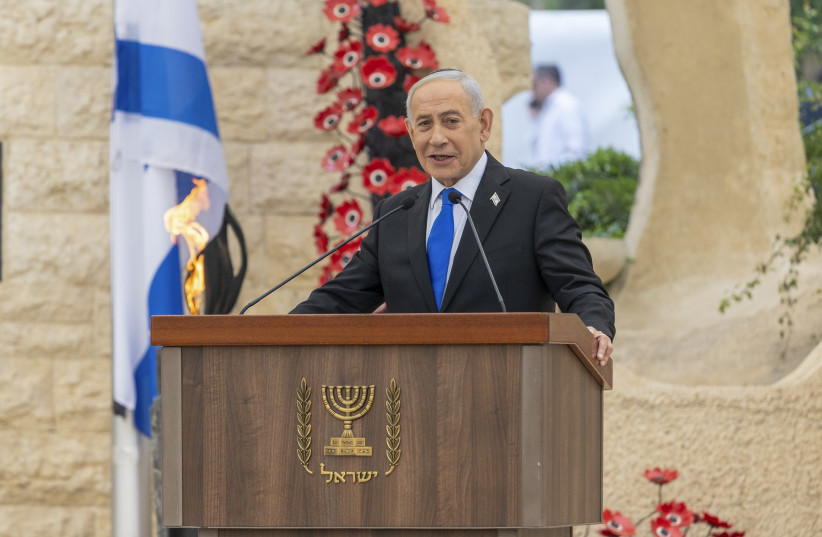
Netanyahu’s response will not start with rhetoric. It will start with party arithmetic. He has been pushing Likud’s central committee to grant him a larger personal allocation of shiryonim – the leader-reserved slots on the party’s Knesset list that bypass the primary.
Likud’s image among its own veteran voters is in the worst shape it has been in its political lifetime. A class of longtime Likud voters now says, in private and increasingly in public, that they cannot vote for the party as it stands. They are not flipping to Bennett because they like Lapid. They are flipping because they want a Likud they recognize, and the current list does not contain one.
Netanyahu’s plan to win them back depends on bringing in soft-right names who can reassure liberal-leaning Likudniks (Likud supporters) that the party is not a wholly owned subsidiary of Smotrich and Ben-Gvir. He cannot do that through the existing primary, where the activist base that nominates is the same one that drove the party rightward. He needs the shiryonim. Whether he gets enough is one of the decisions that will determine this election.
One number from the latest Maariv poll is worth holding alongside this entire conversation. Likud and Bennett 2026 were tied at the top, with 25 and 24 seats. Yesh Atid had seven. That is the number Yamina had in 2021, when Bennett walked into a coalition with Lapid as the leader of a seven-seat party and emerged as prime minister.
The roles are reversed. Lapid is now playing Bennett’s old hand. He has done the arithmetic, recognized that a stand-alone Yesh Atid run produces no path to power, and accepted the position Bennett accepted from him five years ago. Each man has been the smaller partner. Each has agreed, when his turn came, to let the bigger partner lead.
The math beyond the merger
Bennett has ruled out two natural coalition partners on principle. He will not bring Arab parties into a government he leads, and he will not sit with parties whose voters do not serve in the IDF, which closes the door on Shas and United Torah Judaism. Both rules tighten the coalition arithmetic to a degree few people have publicly worked through.
The path to 61 runs through some combination of Gadi Eisenkot’s Yashar!, possibly Yoaz Hendel’s Reservists if the party crosses the threshold, and perhaps a remaining centrist faction. Eisenkot turned down Bennett’s merger offer in March, but he has said he wants Netanyahu out, and a post-election mandate calculation is not the same conversation as a pre-election slate negotiation. None of this is guaranteed. All of it is plausible, which is more than could be said for any opposition arithmetic six months ago.
If the final numbers leave Bennett at 58 or 59 seats, with the haredi parties or the Arab parties as the only path to 61, he will face the decision Lapid faced in 2021. Lapid built a coalition with Ra’am and broke a taboo. Bennett has said in public that he will not. Whether that holds under the pressure of being one or two seats short is the question that hangs over the entire campaign.
Five years ago, Bennett walked through this door with seven seats and walked out as prime minister. Lapid is walking through it now. The friendship will hold; it has done the work three times. What it cannot do by itself is produce 61 seats out of a fragmented Zionist opposition that has yet to decide whether it can act like one. The next six months will answer that. Sunday night was part of the answer Bennett and Lapid could give. The rest is not up to them.