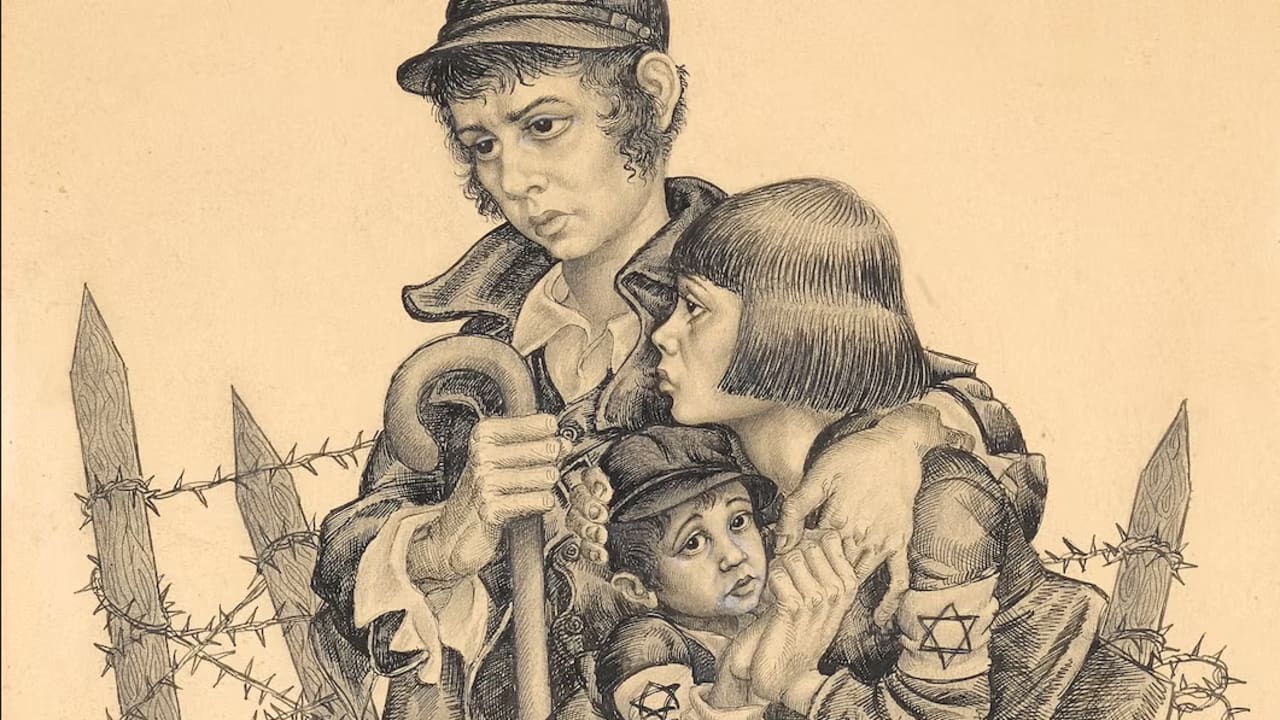
I remember being freaked out and fascinated by my parents’ copy of Hans Christian Andersen's fairy tales. It featured these especially lurid illustrations; I can still see a little girl in a red coat, trapped in a spider’s web and tormented by lizards, bats, and a huge black spider with a skull and crossbones on its head.
I didn’t know then that this was the work of Arthur Szyk, a Polish-born Jew who was famous for his vivid and grotesque caricatures of Nazi and Japanese leaders and his heroic depictions of American soldiers and the country’s founding fathers. His work appeared in popular magazines, part of a national effort to move hearts and minds in support of the war in Europe and the Pacific.
Szyk’s propaganda is at the center of an exhibit at New York’s Museum of Jewish Heritage, “Art of Freedom: The Life & Work of Arthur Szyk.” It brings together more than 100 works, including cartoons, miniatures, illuminations, and political ephemera.
Art as a form of warfare
In its time, Szyk’s wartime work was recognized as an effective means of stirring public sentiment. First Lady Eleanor Roosevelt praised his contribution to the war effort, saying his art “fights the war against Hitlerism as truly as any of us who cannot actually be on the fighting fronts.”
Viewed through today’s lens, however, the show raises timely questions about how art functions as a political instrument. Can works of art still rally the masses to fight authoritarianism? Or is propaganda more likely to be used as an instrument of tyranny? Szyk drew mocking caricatures; what happens when politicians lean into their caricatures and call it a brand?

The exhibit also features Szyk’s work on Jewish themes, from idealized paintings of shtetl life to plates from his popular haggadah to the propaganda he produced on behalf of the Zionist cause before and after the founding of Israel. Throughout his life, the exhibition emphasizes that Szyk saw his Jewish identity not as a background fact but as a moral mandate: his work linked the fate of Jews to universal ideals of freedom, democracy, and resistance to oppression, using his brush to persuade and commemorate.
“He fought passionately against tyranny and oppression directed toward the Jews, and for freedom and justice, and translated these values into democratic ideals for humankind,” Irving Ungar, Szyk’s biographer and an advisor for the exhibition, told an interviewer.
Szyk (1894-1951) was born in Łódź and trained as an artist in Kraków and Paris, absorbing medieval illumination, caricature, and modern political satire. A formative visit to Palestine in 1914 sharpened his Zionist commitments, and the rise of fascism in Europe transformed his art into an explicit weapon against tyranny.
After spending much of the 1930s in Poland, France, and then London, Szyk was deeply alarmed by the rise of Nazism and the threat it posed to Jews across the continent. After Germany invaded Poland in 1939, Szyk and his family fled London for North America, with encouragement from the British government and the Polish government-in-exile to help rally support for the Allied cause against Nazism. He and his wife and daughter arrived in Halifax in July 1940 and by December of that year had reached New York City.
Once in the United States, he threw himself into political caricatures that appeared in magazines, wartime exhibitions, and fundraising materials, helping to shape American public sentiment in a crucial period. Szyk remained in the United States after the war and became an American citizen in 1948.
Taken on its own terms, Szyk’s work is admirable and even audacious. His heroes are irreproachable; his tyrants grotesque. He believed deeply that art should not be neutral in the face of atrocity.
And yet the exhibit also acknowledges the dark side of propaganda. A typical Szyk illustration features a stereotypical American cowboy being stabbed in the back by an even more stereotypical Japanese soldier, while a buffoonish Goebbels and knock-kneed Hitler look on. The Japanese assassin has a simian, gap-toothed grimace, crossed eyes, and pointed ears. The wall label next to the illustration acknowledges that Szyk “seized on long-standing myths of the ‘Yellow Peril,’ depicting Japanese people as primitive, threatening, and even subhuman.” Szyk’s drawings may indeed have helped boost morale. But as the wall label reminds us, “These kinds of prejudices helped to justify the imprisonment of over 120,000 Japanese Americans” between 1942 and 1945.
Still, the kid in me longs for the moral certainty represented by Szyk’s political art, where it is easy to distinguish the good guys from the bad guys and assume that most of your neighbors agree with you about who is which. But the exhibit also reminds you that political consensus is fleeting. Szyk’s art champions movements that would later be contested, none more so than Zionism. In a one pro-statehood illustration, he depicts handsome, idealized Jewish soldiers representing the three main factions of Jewish defense, the Irgun, the Haganah, and the “Sternist” , in stalwart unity. Even during his lifetime, the methods and legacies of the militant Zionists and underground movements would prove controversial. You can only imagine Szyk’s surprise were he to have seen the very legitimacy of a Jewish state being widely debated 75 years after its founding.
His Israel work is just one of many aspects of the show that underline the difference between his time and ours. In the 1940s, Szyk’s imagery moved audiences in a world of print media and propaganda posters, media that still dominated public discourse. His “Four Freedoms” series , medieval knights depicting concepts like free speech and religious freedom , traveled with wartime exhibitions and was widely reproduced, helping to shape American ideas about what Allied victory would mean not just militarily but morally.
In our own times, earnest renderings like “Four Freedoms” seem hopelessly dated. As critics from George Orwell to David Foster Wallace have suggested, the modern habit of irony and media-savvy skepticism has made the kind of earnest, morally unambiguous propaganda that flourished in World War II harder to sustain.
Or has it? Donald Trump, for one, regularly creates caricatures of immigrants, of his political opponents, of the “demonic” and “evil” Democrats, to dominate American politics in ways that few presidents ever have. Trump seems to realize that by acting as a caricature, rarely deviating from his signature look, draping his office in gold, posting on Truth Social almost exactly what the most gifted satirist would expect him to post, he subverts his critics and reinforces his brand. Similarly, the social media accounts of the Department of Homeland Security have repeatedly posted 19th- and 20th-century paintings, often featuring white pioneers or settlers, with captions like “Remember your Homeland’s Heritage” and “A Homeland Worth Defending,” co-opting the bluntness of an earlier era’s unironic propaganda.
Today, the metrics for influence look very different from those in Szyk’s day, when most people encountered news, images, and ideas through a limited number of media. Today’s attention economy is hyper-competitive and atomized. X threads, TikTok videos, and partisan cable news channels vie for attention in a crowded marketplace of ideas.
The Museum of Jewish Heritage’s exhibition is an invitation to compare the certainties of one era with the fractured media and political landscape of our own. Appearing at a time when Americans are debating the limits of freedom and the future of democracy, it asks whether art can still carry the moral weight that Szyk hoped it could.
“Art of Freedom: The Life & Work of Arthur Szyk” is on view at New York’s Museum of Jewish Heritage through July 26, 2026.
The views and opinions expressed in this article are those of the author and do not necessarily reflect the views of JTA or its parent company, 70 Faces Media.