
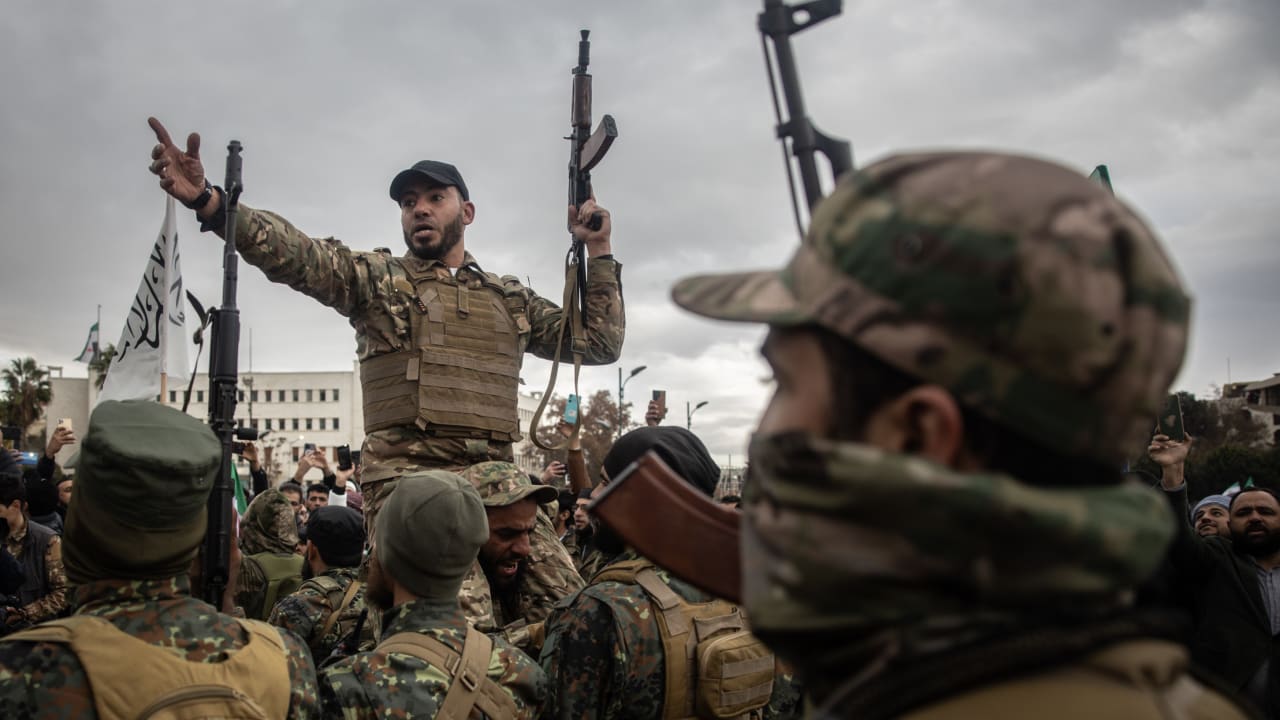

As someone who has spent decades studying the conflicts in the Middle East, there is little that can shock me, but some of the videos now coming out of Syria have left me sickened. In one, footage shows Syrian jihadists executing Kurdish civilians, scalping young women, and piling the bodies of victims whose throats had been slit. These were not battlefield engagements. They were acts of ideological violence intended to terrorize minorities into submission.
My colleague Jonathan Spyer wrote recently in the Middle East Forum: “I have seen the footage – desecrated corpses, abused female prisoners, and attempted beheadings of Kurdish women. The jihadists themselves posted it online, proud of their crimes.”
I recount this graphic reality deliberately. American policymakers, along with much of the Western human rights community – particularly organizations that claim to advocate for women and minorities – have been conspicuously silent as jihadist forces consolidate power in Syria.
Who are the forces?
The victims are not abstractions. They are Alawites massacred along the coast, Druze communities ethnically cleansed from their villages, and Kurds now facing displacement and eradication from areas they have inhabited for generations. Notably, Israel has been virtually alone in taking tangible steps to protect the Druze when they came under attack.
To understand where Syria may be headed, one must first ask a basic question: Who, exactly, is now being legitimized by the West?
Many of the militias operating across Syria today are either directly affiliated with, or only one degree removed from, President Ahmed al-Sharaa and his power base. At the core of this constellation is Hay’at Tahrir al-Sham (HTS), an organization with a long and well-documented jihadist pedigree.
HTS is not a reformed movement. It emerged from Jabhat al-Nusra, al-Qaeda’s former Syrian franchise, and has never credibly renounced its Salafi-jihadist ideology. While it has rebranded itself to gain Western acceptance, its worldview remains rooted in the same ideological ecosystem that produced ISIS and al-Qaeda – an ecosystem derived from Muslim Brotherhood ideology and revolutionary Sunni Islamism.
Other armed actors include militias embedded in the Turkish-sponsored Syrian National Army (SNA), which operates primarily in northern Syria. These forces answer, either directly or indirectly, to Ankara. Turkey views virtually all Kurdish political and military organizations as a threat, fearing that Kurdish autonomy in Syria could inspire Turkey’s own Kurdish population. This fear drives Ankara’s aggressive posture and its willingness to empower Islamist proxies to crush Kurdish self-rule.
Islamic ideology
Turkey’s role cannot be divorced from the ideological orientation of President Recep Tayyip Erdogan himself. Erdogan is not a secular nationalist; he is deeply influenced by Muslim Brotherhood beliefs, which see political Islam as the organizing principle of the state.
Turkey has become the movement’s principal patron and enforcer – the “muscle” of the Brotherhood – while Qatar has played the role of financier. This axis now looms large over Syria’s future.
Against this backdrop, Washington’s behavior has been marked by what can only be described as tactical amnesia. With remarkable speed, and without demanding clear benchmarks or measurable reforms, both Republicans and Democrats rushed to legitimize al-Sharaa’s government and ease sanctions on Syria. These sanctions included relief on financial transactions, reconstruction assistance, energy-related restrictions, and limits on engagement with Syrian state institutions.
Prescription for failure
The rationale was familiar: that reconstruction and engagement – effectively appeasement – would moderate behavior. However, projecting Western naivete onto the Middle East’s multi-dimensional political and strategic environment is a prescription for failure.
No credible metrics were required, no enforceable commitments were made to protect minorities, no verifiable dismantling of jihadist command structures, and no prohibition on integrating jihadists into the new military. Nor were reforms of educational or religious institutions demanded. In effect, sanctions relief was immediately granted to a leadership with a well-documented ISIS and al-Qaeda lineage.

Equally troubling has been America’s abandonment of one of its most reliable regional partners: the Syrian Kurds. The Syrian Democratic Forces (SDF), dominated by Kurdish fighters, were instrumental in defeating ISIS territorially and in imprisoning thousands of jihadists. Without the SDF, the United States and its allies would likely still be fighting ISIS at great cost. Kurdish fighters absorbed the brunt of ISIS’s violence so that Western soldiers did not have to.
That partnership has now been discarded.
In January 2026, with encouragement from US Ambassador to Turkey Tom Barrack, who has closely followed Ankara’s recommendations, Washington officially signaled that the SDF was no longer necessary. This decision delighted Erdogan. Soon after, al-Sharaa-aligned forces, and Turkish-backed militias moved aggressively against Kurdish areas, including near Kobani, and advanced toward Kurdish population centers in Syria’s northeastern Hasakeh province. Under intense US pressure, Kurdish forces are now being compelled to dissolve as a collective entity and integrate individually into a Sunni-led Syrian army.
This would be alarming under any circumstances. It is far more dangerous, given the composition of that force. Research by the Alma Center for Education and Research indicates that HTS-linked jihadists occupy command and training positions within the emerging Syrian military structure. In this context, “integration” does not constitute reconciliation; it represents subjugation, with a credible risk of ethnic cleansing and genocide.
Ignoring reality
Washington appears to be fixated on recreating a strong, centralized Syrian state – one that will inevitably hold minorities at its mercy. This obsession ignores both history and reality. Syria itself is a colonial construct, born of the 1916 Sykes-Picot Agreement, when Britain and France carved the region into artificial states to serve their own interests. Many of today’s conflicts are direct consequences of those decisions.
The Kurds, numbering roughly 40 million, were promised a homeland by the great powers after World War I – promises that ultimately evaporated. Today, Kurdish populations face repression in Turkey, Iran, and Syria; only in Iraq have they achieved limited autonomy.
Extending comparable autonomy to Syrian Kurds could have stabilized northeastern Syria and preserved a pro-Western, anti-jihadist enclave. Instead, Syrian Kurds are being coerced into submission by Sunni Islamist forces backed by Turkey.
The implicit message to Iraqi Kurds is equally stark. Their autonomy may be next, particularly should a pro-Iranian Iraqi president emerge alongside Iranian-controlled militias poised to challenge Kurdistan in northern Iraq.
Syria’s future
If one seeks to forecast Syria’s future, its education system is a critical indicator. The Alma Center in Israel has identified at least 70 HTS-affiliated schools operating with the support or acquiescence of Syria’s new authorities. These institutions promote a jihadist curriculum that glorifies martyrdom, delegitimizes minorities, and embeds Islamist ideology in the next generation. Western governments have largely ignored these findings because acknowledging them would complicate prevailing policy assumptions.
They should not be surprised if, 10 years from now, Syria functions as a Turkish vassal state, with Erdogan replacing Iran as the dominant external power. Nor should they feign shock if a generation educated under jihadist doctrine produces the next wave of ISIS, al-Qaeda, or Salafi fighters – this time, with state backing and international legitimacy.
All of this was avoidable. Sanctions relief should have been tied to concrete reforms, enforceable protections for minorities, and the preservation of Kurdish, Druze, Alawite, and Christian autonomy. Instead, America took its cues from Erdogan, rewarded al-Sharaa without meaningful conditions, and chose short-term diplomatic convenience over long-term security.
The question is no longer whether Syria is sliding toward jihadist rule. It is whether anyone in the West will admit that the warning signs were visible from the start.■
Dr. Eric R. Mandel is director of the Middle East Political Information Network (MEPIN) and senior security editor of The Jerusalem Report. He frequently briefs Congress, think tanks, and the State Department on Middle East affairs and their impact on US national security.