

In recent weeks, the Palestinian Authority has escalated its campaign to register heritage sites as “Palestinian” through UNESCO. Following the declaration of Tel Jericho as a Palestinian heritage site in September 2023, the PA published a list of approximately 14 additional sites it now seeks to promote. The PA describes this move as a “qualitative leap in Palestinian world heritage.”
Unlike previous declarations, which focused on sites containing mosques or locations within Area A, this new list represents a significant shift. All the sites are located in Israeli-controlled territory, and none bear any historical or cultural connection, under any plausible claim, to Palestinian heritage. The list includes Christian sites, the Judean Desert, Herodium, the Cave of Chariton, ancient Samaria, and most notably, the Hasmonean aqueducts in Wadi Qelt (Nahal Prat) and the Hasmonean palaces at its end.
Central to this effort is the systematic erasure of Jewish historical identity. The sites are not referred to by their established names but are instead rebranded with newly invented titles that eliminate any reference to Jews, their kingdoms, or their history.
The Judean Desert, for example, cannot be called by its name, as acknowledging it would implicitly affirm the Jewish people’s connection to the land. With the invention of new terminology, more than 2,000 years of history is wiped away in a single stroke.

The Hasmoneans, the rebels of Masada, and the Dead Sea Scrolls of Qumran disappear from the narrative, replaced by fabricated labels such as “Al-Bariyah – Desert and Monasteries.”
Not just rhetoric
This campaign is not limited to rhetoric. On the ground, the Palestinian Authority actively marks trails and asserts physical presence. A so-called “Palestine Trail” now runs from Hebron to Nablus through the desert, from north to south, in defiance of the region’s natural west–east ridgelines.
When the Palestinian workers come across trail markings placed by Israeli environmental organizations, they roll them into wadis or destroy them. After the markers come organized groups of Palestinian hikers, transported by a funded network of buses. These groups hike, learn the terrain, and establish presence.
When Israeli families encounter the hikers, intimidation often follows. Curses, stones, and forced retreat. In this way, Israelis are gradually excluded from Nahal Prat, the Judean Desert, and large swaths of open land in Judea and Samaria. Those who doubt this reality are invited to see it for themselves.
Abandoned heritage sites
Israel’s response has been extremely inadequate. Not only has there been no effective counter-strategy, but Israel’s own past actions have at times mirrored the very processes it now condemns.
Under the Oslo Accords, Israel abandoned many of its most significant national heritage sites, leaving them vulnerable to looting and destruction. Sites were arbitrarily divided and severed from Israeli territory, with little regard for their historical or cultural value.
Some examples defy belief. Solomon’s Pools, an extraordinary water system from the Second Temple period that conveyed water from the springs of Gush Etzion to Jerusalem through the Hasmonean aqueduct, the Western Wall tunnels, and the massive reservoirs beneath the Temple Mount, were transferred into Palestinian-controlled territory.
This occurred despite a political decision to retain them under Israeli jurisdiction. Mapmakers left the name “Solomon’s Pools” on the Israeli side of the map, while assigning the pools themselves to the Palestinians.
The Hasmonean palaces were similarly divided. Though officially designated as Israeli territory, sections south of Nahal Prat were transferred to Palestinian control. As compensation, the first Hasmonean fortress, Dok, which sits atop Mount Karantal overlooking Jericho, was also transferred.
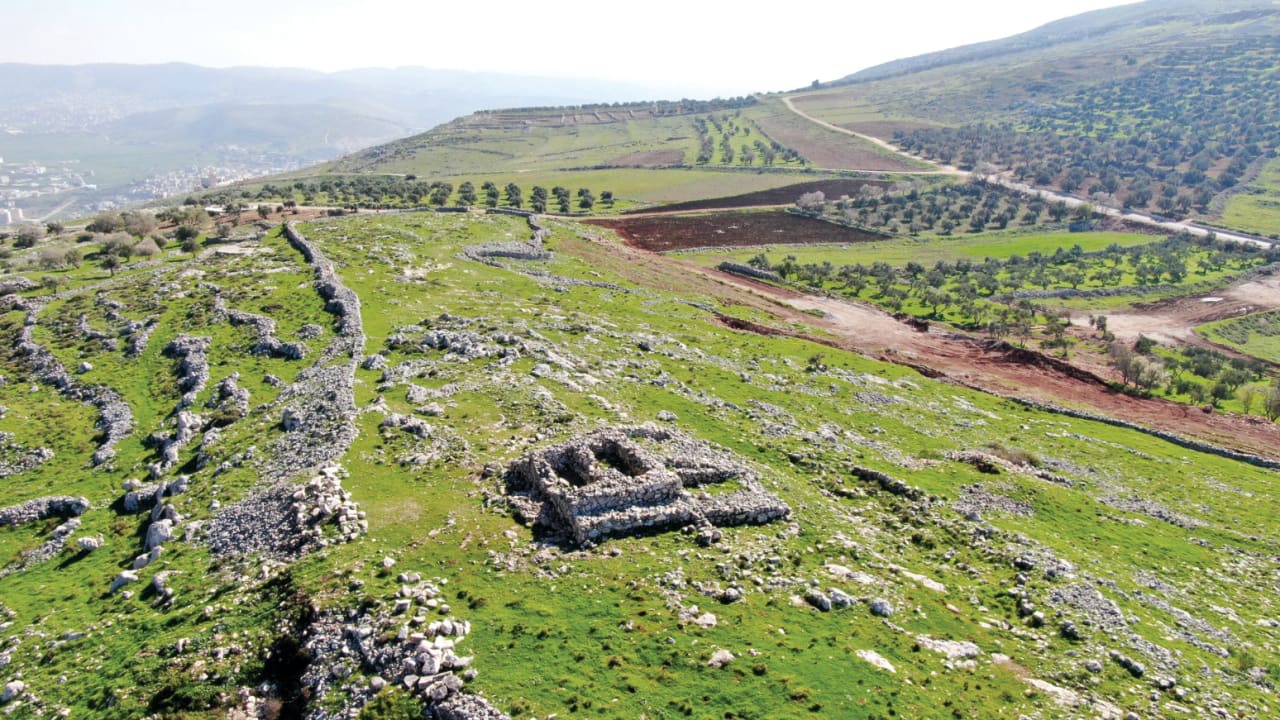
The most striking case is Mount Ebal, where a strip of Israeli territory descends from the IDF base toward Joshua’s Altar but misses it by approximately 200 meters. As a result, the altar was left outside the boundary and is now threatened by construction intended to erase a site sacred to hundreds of millions of Bible believers worldwide.
A national plan
These outcomes were not merely the result of negligence. They reflected a deliberate desire among decision-makers to shed the perceived burden of national heritage and the obligations it entails.
Classical and foreign sites were preferred over biblical and Jewish ones: Caesarea over Sebastia; Crusader fortresses over Hasmonean strongholds; early Zionist pioneer sites over ancient biblical settlements.
When the Oslo process offered an opportunity, these assets were relinquished with ease, all in the name of peace. It was precisely this mindset that prompted politician Yigal Allon’s warning: “A people that does not know its past – its present is poor and its future is shrouded in fog.”
Ironically, the Hashemite Kingdom of Jordan and the British Mandate, during their relatively brief rule, did more to preserve tangible history than Israel did for its own national heritage from 1967 onward.

Yet there is reason for cautious optimism. In recent years, the course has begun to change.
With the establishment of the current government, the Heritage Ministry was created, and a National Emergency Plan to Save Heritage Sites in Judea and Samaria was launched, with a budget of approximately NIS 150 million.
While insufficient, given the scale of the challenge, this funding signals a shift in policy. Enforcement has increased, site development and public access have begun, and after decades of neglect and looting, long-buried historical treasures are finally being uncovered.
The discoveries are significant, with the potential to reshape global scholarship on entire historical periods of importance to world heritage. Adjacent to the Hasmonean palaces lies the Jericho necropolis – the burial ground of the Hasmonean elite.
Aviad Neiman, an IDF soldier who was killed in Lebanon in 2024, had volunteered with Preserving the Eternal, a nonprofit coalition focused on protecting archaeological and heritage sites in Judea and Samaria. In 2019, he had reported the destruction of a priestly burial cave, with human bones scattered at the site.
In a joint operation by the Civil Administration and the Religious Services Ministry, the remains were collected and re-buried in Kfar Adumim beneath a monument reconstructing the original cave, allowing a modern community to honor its ancient roots.
Archaeological excavations are now accelerating across the region. At Hyrcania, near the Jerusalem-Dead Sea road, a fortress marking the fall of the Hasmonean Kingdom is being revealed as a “mini-Masada,” complete with siege systems, underground chambers, inscriptions, and ritual baths.
At the Alexandrion fortress on Mount Sartaba, mentioned in the Mishna in connection with signal fires that inspired today’s torch-lighting ceremony, excavations are producing dramatic new findings.
Every archaeological excavation is a victory over destruction and erasure. However, the most important work still lies ahead, which includes excavations in ancient Samaria at Khirbet al-Yahud (Tel Betar), the city of Bar Kokhba, and the inspiration for Ze’ev Jabotinsky’s Betar movement.
Israel does not operate in a vacuum. The choice is clear: Either Israel asserts responsibility for its heritage, or looting and destruction will continue under the sponsorship and leadership of the Palestinian Authority.
A proper state response is required: formal recognition of Israel’s moral duty to safeguard the historical treasures of the Jewish people and the universal heritage entrusted to it; expansion of the national plan to match or exceed investment west of the Green Line; and decisive diplomatic and enforcement action. Only then will Israel be worthy of reversing Allon’s warning. A people who know their past will enjoy a rich present and a bright, promising future.■
Moshe Gutman is chairman of the Association for the Protection of Israeli Antiquities. He is a senior fellow at the Misgav Institute for National Security. He served in the artillery corps and as chief home front liaison officer in the IDF Central Command.