
It was Jerry Seinfeld who once said humor has sustained the Jewish people for 5,000 years. Now, Israeli comedian Yohay Sponder is taking that concept one step further – he’s using comedy to unite the Jewish people during a time of deep polarization and crisis.
Over the past three years, Sponder, who grew up on the Golan Heights on Israel’s northern border, has been taking his English-language, one-man comedy show on the road, from London to New York, Toronto, Sydney, and beyond, bringing Jews – and non-Jews – together through laughter with his humorous and often sardonic observations of life.
“In every generation, the Jews go through one, or sometimes more, atrocities, and I feel like that story is coming back now,” said Sponder, 43, a veteran comedian of 20 years, in a recent interview with The Jerusalem Report.
“You know, we grew up on stories of antisemitism and the Holocaust and voices of what the Jews did back then to survive and how we had to come together in times like that,” he said, adding that redirecting his humor to address the dark events of the past few years of war was “instinctive.”
After Hamas’s October 7 terror attack on southern Israel, Sponder said, “the whole country was recruited to do something… We didn’t have shows for the first three months after the war started and so we went to volunteer in [army] bases and for evacuated people from the North and South.”
Sponder said that in between bouts of reserve duty and volunteering in the community, “one thing led to another” and he decided to pivot from his usual comedy routine to focus more on “the country, and the conflict with the Palestinians, and other stuff like that.”
“It’s not the first time I have done that, but it had been a while, and it got the attention of Jews [worldwide] because it was the subject that was most interesting at the time,” he said.
Pushing boundaries
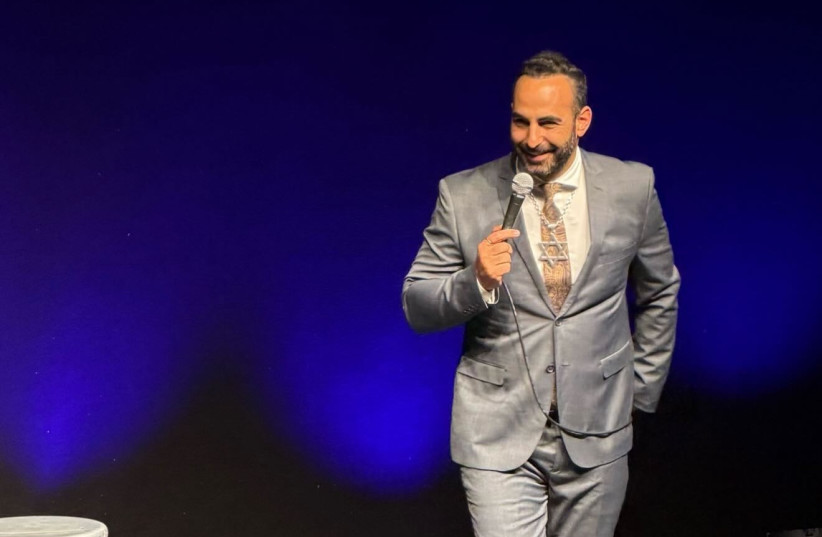
Since then, Sponder, with his comical Hebrew-accented English and fashionable suits, complete with a tie and an oversized Star of David necklace, has charmed audiences worldwide while drawing a massive online following through his social media channels.
Sauntering onto a dimly lit stage, Sponder offers the crowd a humorous but also critical look at the world around us as it relates to Israel and the Jewish people.
Describing his routine as a “live organism,” he also relishes interacting with audience members, sometimes pushing boundaries by poking fun at other people’s accents or their ethnic identities.
In one viral sketch, he calls out a Muslim man for coming to see an Israeli-Jewish comedian; in another, he pokes fun at a British woman for her very British pronunciation of certain words, declaring he doesn’t understand a thing she says and asking whether it is time for Brits, who invented the English language, to stop swallowing their “t’s.”

“It’s like being a toddler,” he told the Report with a mischievous glint in his eyes. “You look for your boundaries, you find them, and sometimes you cross them.”
Sponder admits that “it’s not good… I don’t think you should offend people, because my baseline is that I’m here to make you feel better and I want to entertain you, but I also have my opinions that are sometimes hard to swallow.”
“It’s not an easy path to navigate, but that is the craft, and I want to touch the complexities and add more layers to what we’re dealing with,” he said.
Sponder believes navigating that difficult line in front of a live audience is ultimately a “bonding” experience, especially at a time when there are so many divisions, and, he said, he is not afraid to tackle some of the more explosive topics of the day.
“I make jokes about everything absurd,” he said, describing how “it’s more about the hypocrisy of the world toward what we’re going through.”
“A really, really small amount of people actually know how to gaslight the Jews and what we have been going through since the war started… They didn’t even give us one day to mourn or rest, and just started saying ‘the genocide’ and blaming everything on us without fact-checking, without coming here… just because they watched a TikTok video, and now know better what’s going on,” Sponder said.
His tackling of tough topics, as well as a refusal to hide his Jewish and Israeli identity, has made him a target of anti-Israel campaigners, drawing vocal protests against his shows and venue cancellations worldwide.
“I get a lot of pushback,” Sponder said, describing how many times after inquiring about performing at certain clubs he would be told there were no available dates, even though a few minutes earlier there had been space.
In some places, he said, “we would get availability for dates, and then they saw what the show is about from a picture... sometimes with an [Israeli] flag in it... and suddenly there was no longer any availability.”
“Every time it is a different story,” said the comedian, noting that sometimes discrimination is obvious and other times it is far more subtle.
But, said Sponder, “you know antisemites when you see them.... It’s very frustrating, but Jews never lose.”
He said that after every cancellation, “we came back stronger, and we won.” He gives the example a club in Amsterdam that canceled one of his show and says that after moving it elsewhere, tickets immediately sold out.
“It’s very Jewish, it’s part of our DNA,” Sponder said about the hate he receives, including online.
Yet even that is something he is ready to poke fun at because, in many ways, it has only boosted his profile.
“I’m hiring them now… to send emails because it [the hate] boosts my popularity,” he quipped.
Jerusalem for an hour
We are sitting in The Jerusalem Post’s podcast studio overlooking the Holy City, and while the interview is meant to be serious, Sponder, who started his comedy career in Hebrew before transitioning to English, can’t help but crack jokes.
“I love Jerusalem,” he states stoically, looking out the studio window. “I always feel like it’s a place… a city that everyone should live in… at least for an hour.”
Sponder says his comic brain works similarly to an artist’s brain, but rather than seeing the vivid colors or shapes around him, he sees the humor in almost everything. It’s not too complicated, he explained: “Whatever makes me laugh” becomes good fodder for his show.
On the decision to do stand-up in English, Sponder responded with the straight-face of a seasoned comic: “I smelled the money… I’m Jewish.” But then he added more seriously: “I wanted to perform to my people, worldwide, and, after October 7, it was even clearer that we need humor of our own to talk about what’s going on.”
“I saw a lot of vanilla comedy from our people, but I wanted to talk about the gaslighting we’re getting, and I felt that this voice wasn’t being heard,” he said.
Being reborn
In his new, recently debuted stand-up show, Genesis, Sponder said he has drawn on the new reality created after October 7. Many people, particularly Jews, he explained, went through a sort of metamorphosis sparked by that deeply traumatic event.
Some people pulled closer to Israel, others pulled away, he said, describing some of the more personal challenges that shaped how he now views the world, including losing his father a few months after the attack, as well as a good friend, and also becoming a father.
“A few months after the war began, I started to travel with my show, and a lot of conclusions came up… and I felt that I was reborn personally,” he said, describing how he incorporated those experiences into the new routine and how that process is still evolving all the time.
But if there is one message Sponder said he wants to convey to audiences – Jewish and non-Jewish – around the world, it is this: “We should stop apologizing for who we are and be proud of being Jews.”■