
For every harried person who is overwhelmed at the prospect of turning his or her cluttered kitchen over for Passover – especially this year, when missile alerts threaten our sleep, curtail our shopping expeditions, and challenge our efforts to clean and cook – look at the bright side: You could be making Passover for the IDF!
E, a singer/entertainer by trade and tank loader in the IDF reserves, was enjoying life with his newborn daughter on February 28 when he got the active-duty call to go north. The singer/soldier, who got married just months after Oct. 7 and was deployed to serve 220 days, left his Purim shows, all canceled, drove north, and climbed into his tank.
He did so without a second thought. “We need to do our mission and protect the people of Israel,” he says.
With two weeks left until Passover, he says he is facing the possibility of spending Seder night squashed in his tank with three other soldiers.
“If we need to do Seder in the tank, we will be happy to do so,” E asserts. “We will drink grape juice and sing all the songs together – “Mah Nishtana?” and “V’hee She’amda.”
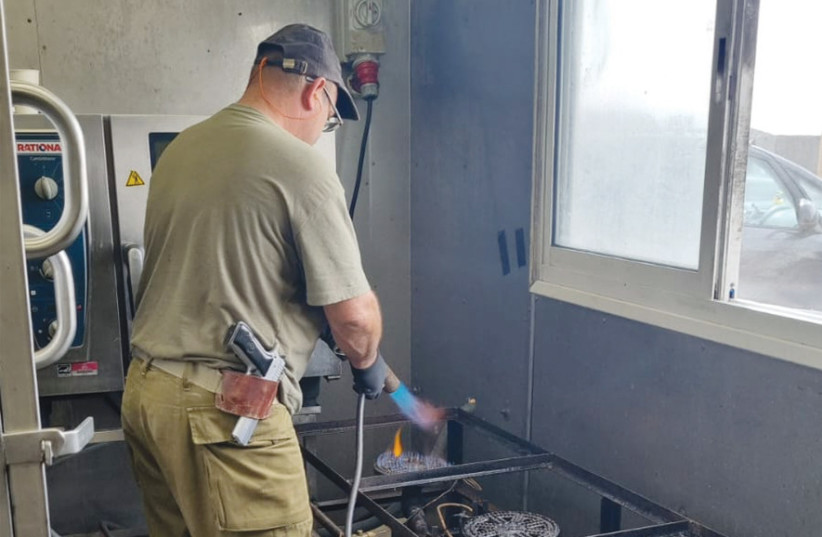
A few days before the holiday, E plans to clean out his space for Passover.
“Every year, Passover in the army is an operation,” explains Maj. Yehoshua Gerstein, the army rabbi of the 210th Division in the Golan. Where in past years, he says, “it was more driving around and handing out matzot, this year it is more of a military operation. I have been working hand in hand with commanders and will be koshering kitchens, inspecting, and delivering supplies within the command structure.”
“Passover in the army is standard,” Gerstein explains. “Even if soldiers aren’t Jewish, most officers in the army are instructed in Passover observances.”
Lt. Col./Rabbi Avihud “Udi” Schwartz is a senior Israeli military rabbi in the IDF Military Rabbinate, and head of the Halachic Branch. He coordinates and oversees the determination and implementation of Jewish law within the military.
In practice, this means he formulates halachic policy in accordance with the evolving operational reality. In addition, he is responsible for ensuring its implementation, which includes military and halachic quality control, and maintaining proper halachic standards.
“We explain everything from start to finish,” Schwartz says. “How to sell the hametz – the chief rabbi of the IDF sells all the hametz to a non-Jew. Soldiers can sign up for the sale with their smartphones. Even in the middle of the war, we are doing all we can to ensure Passover is within halachic guidelines.”
He says that with many soldiers sharing rooms, closets, tables, and vehicles, if the army wants to create unity it is important to support those who are Torah observant. The rules drawn up for Passover require everyone’s compliance.
“It’s an honor system, and we expect cooperation,” he said. “Lots of Jewish laws specifically pertain to the military.”
He says the laws are modifiable, depending on the soldier’s role and constraints. For instance, soldiers in Lebanon may have only five to 15 minutes to spare to conduct a Seder.
“Every person must perform mitzvot by the strictures of their military role. We even wrote a condensed Haggadah that encapsulates the entire night of information. It is reduced to one page for the on-duty soldier to put in his pocket.”
According to Rabbi Shaul Avdiel, of the Netzah Yehuda Association – Nahal Haredi in the Netzah Yehuda Battalion – and military rabbi with the rank of reserve captain, the IDF begins preparations for Passover as early as Hanukkah time.
They hold discussions on koshering equipment, required gear, and utensils to purchase, and check the manpower needs for Passover koshering, matzah, wine, Haggadot, and more.
Already at this stage, the IDF is preparing for a possible war during Passover.
For those of us non-military people tearing our hair out about making our homes Passover-compliant, “turning over” the IDF for Passover involves the entire army base, not just the kitchen.
“The base itself must be made kosher for Passover,” says Rabbi Gerstein. “We go through large storage facilities with commanders, looking for supplies that may be hametz. On every level of command structure, the pre-meetings begin two days after Purim, and introduce new soldiers and logistics personnel from platoon to division on what needs to be done for Passover and precisely how to do it.”
THIS IS a formidable task.
According to Rabbi Avdiel, since the IDF is a huge organization with hundreds of thousands of soldiers deployed across the entire country, from north to south, the cleaning and koshering days are carried out several days before Passover.
Several days before the holiday, the army stops cooking hametz and performs a “shutdown” from cooking. After a full day, they begin koshering all the utensils in the base: ovens, tables, cutlery, dishes, pots and pans, warming cabinets, and so on. Everything goes into a pot of boiling hot water or is torched with a blowtorch.
There are utensils that halachically cannot be koshered or are difficult to kosher, so they are replaced with new ones purchased specifically for that purpose.
He adds that in the haredi Netzah Yehuda Battalion, they are strict about koshering the kitchen, and the rest of the utensils – dishes, cups, cutlery, trays, pans, etc. – are brought specially for Passover and stored in the warehouse from year to year.
Gerstein will begin to kosher the kitchens two days before the holiday starts. “No one wants to be koshering the day before Passover.”
Rabbi Avdiel says, “Because of the severity of the hametz prohibition and the various customs, the IDF is very strict in Passover koshering and in the raw ingredients brought in. The Military Rabbinate conducts close supervision over the factories producing food for the IDF, and in maintaining kashrut procedures and Passover koshering.”
According to Avdiel, the search for hametz is carried out by the Military Rabbinate in the base’s public areas, with each soldier checking his own bag. Three days before the holiday, no hametz is allowed to enter IDF bases – not in the kitchen and not in the private rooms. Commanders conduct checks to ensure soldiers haven’t left any hametz in cabinets or corners.
Rabbi Yitzchak Deutsch is head of all the haredi units and part of Netzah Yehuda. He has fielded questions from one soldier about selling hametz online. On the form, the soldier was asked to put in his address. He explains that he didn’t have to give away his location.
Furthermore, the base, barracks, and vehicles are not his own; there is no ownership. The soldier can and should check his kit bag – that is considered his home.
According to Rabbi Avdiel, the search is done by flashlight due to the risk of fire that could break out if done by candlelight, and performed without a blessing for various halachic reasons.
The Military Rabbinate organizes siyums (completions of tractates) in central locations, and in certain situations even via Zoom, for firstborn soldiers who would be otherwise required to fast the day before Seder. Rabbi Avdiel explains that because it’s not possible to arrange a siyum for every soldier at every remote outpost, they instruct the soldier to redeem the fast, especially if fasting would impair their functioning in military missions. Since it’s a light fast, the soldiers themselves also find solutions, such as effecting siyumim on easier tractates.
MB, a combat soldier in Netzah Yehuda, has monthly siyums and has invited firstborn men to attend Passover siyums on the day of the Seder. He volunteers in other areas to perform Passover preperations – overseeing and supervising koshering kitchens, and other tasks.
Hummus-free zone
Each base has a rabbi who checks the entire base and army vehicles. Soldiers check their packs. The base rabbi koshers the kitchen, inspects, sells the base hametz to a non-Jew, says the blessings, and burns the residual hametz before Passover.
The IDF Rabbinate maintains careful standards throughout every army base, which is challenging, considering that standards and customs vary throughout various levels of observance. The army takes a somewhat stringent approach, disallowing kitniyot – foods Ashkenazi Jews traditionally avoid eating during Passover, including rice, beans, corn, and legumes.
Although the prohibition on kitniyot is a custom, not halacha, according to Rabbi Gerstein, regular army kitchens maintain an approach to allow everyone to eat. Rabbi Deutsch explains: “In order to have one kitchen that produces food for everyone at the same time, we go with the more stringent no-kitniyot approach.”
Rabbi Gerstein says that unlike hametz, which is prohibited from army bases and personal vehicles, if a soldier chooses to have “personal kitniyot,” it is allowed, so long as it doesn’t enter the kitchen.
Haredi units, which are separated from other units, maintain an even higher stringency of Passover standards than the rest of the army, not allowing gebrokts, also called sheruya – matzah that was soaked in liquid – cakes baked with matzah meal flour, and matzah balls, a Passover staple for some, which others avoid.
Even more stringencies exist in the Chabad world, which – in addition to not allowing gebrokts – peel all fruits and vegetables, and eschews many processed and packaged foods on Passover.
Rabbi Avdiel says the Netzah Yehuda Battalion works to accommodate Chabad members. “We provide them with handmade shmura matzah under Chabad supervision. We provide bottled water for those who are strict about not drinking tap water, bring them disposable utensils for eating, and even specially packaged meals with unique kashrut if they request them.
“Every year, I speak with the rabbis of those excellent Chabad soldiers and explain to them the accommodations we provide them, as well as the real need for the soldiers’ mission in defending the people of Israel.”

What makes this night different?
Rabbi Avdiel says the Seder night is a very significant event in the IDF. The army invests a lot of thought and resources into it. Even before Passover, the army holds events for lone soldiers and meets their holiday needs.
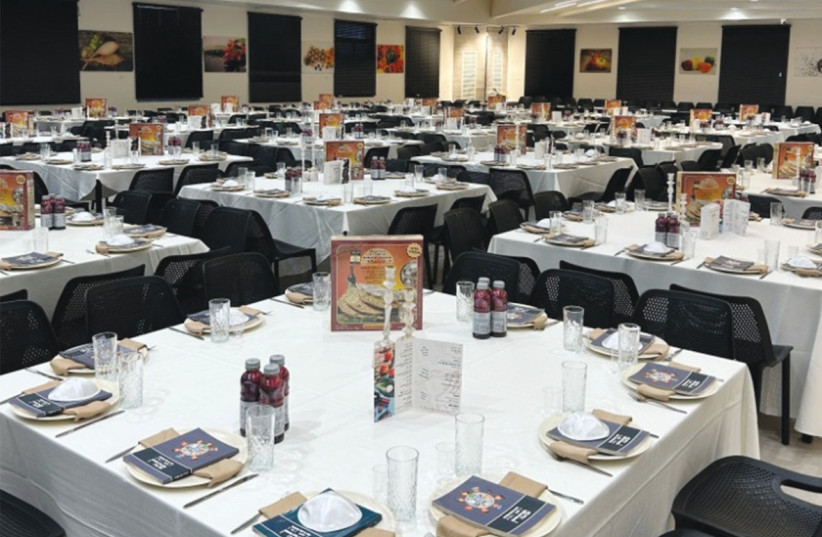
“At Netzah Yehuda, we give the soldiers a special gift that will serve them throughout the holiday and the year,” he notes. “On the Seder night, the army takes care of all the holiday needs: matzah, wine, maror, charoset, meats, gourmet food, and more. They set a beautifully arranged and elegant table. Military rabbis arrive. For example, at Netzah Yehuda the rabbis come with their families to bases and conduct Seders wherever possible.
“I come with my family, with God’s help, to hold a Seder with the soldiers of the Netzah Yehuda Battalion stationed on the Gaza border at a forward outpost, where Netzah Yehuda fighters are located in the war against Hamas terrorists.
“The soldiers always tell me that one of the hardest things for them on Seder night is the holiday atmosphere, which is hard to feel amid military activity, and when everyone is in uniform rather than the festive clothes they’re used to at home.
“That’s why my arrival with children dressed in holiday clothes reminds them of their families and the home atmosphere with lots of kids. My children sing “Ma Nishtana?” and participate in conducting the Seder. I assign the soldiers sections of the Haggadah to read, hand out prizes for participation, ask riddles and parables. And, of course, I don’t forget to do the afikoman game, at the end of which a soldier wins a prize.”
This year, according to Rabbi Deutsch, the Army Rabbinate gave all the base rabbis decks of playing cards, each with a different piece of the Haggadah, as well as prizes and gifts for the soldiers. He plans to give out the cards before the Seder so soldiers can take turns reading. The singing they will all do together.
“Over the years that I’ve been conducting Seders in the Netzah Yehuda Battalion, I’ve sometimes found myself conducting two Seders: one at the start of the holiday for half the soldiers, and a second Seder before midnight for the other half who were on operational activity during the first one,” adds Rabbi Avdiel. “We finished the second Seder at 3 a.m., with me having way too much sugar in my blood from the four cups...
“Sometimes the security situation forces the soldiers to be on guard over settlements in the sector during Seder nighttime, so we started the Seder for the entire base only close to midnight. My family joins me in these adventures... We’ve learned to be a ‘fighting’ family with self-sacrifice...”
For soldiers operating in the field on Seder night, the army devised a Seder Night Kit, complete with everything needed for four people to celebrate the Seder, including all the components of a Seder plate and the condensed Haggadah. In each location, according to Deutsch, someone will be assigned to run the field Seder.
Questions from the army rabbis
According to Rabbi Gerstein, some of the more common problems that come up include the following:
Last-minute pizza. All “last-minute pizza” (and other hametz) must be eaten off the army base, beginning three days prior to Passover.
Personal vehicle. Too often, an errant protein bar or bagel remains sitting in the glove box “just in case of emergency.” While there is a difference in status if it is in a soldier’s personal vehicle or in his army vehicle, it is wise to check everywhere.
MB, the combat soldier in Netzah Yehuda, says, “When I was in Gaza last year, I personally checked wherever we were, including my armored personnel carrier.”
Outside food. Soldiers sometimes go home for a few days, and return with some home-baked goodies or food from the outside. Rabbi Schwartz reiterates that no hametz is allowed to enter IDF bases at all, even private hametz.
Rabbi Avdiel stresses, “There is tasty, varied, and plentiful food available on base that is kosher for Passover, so there is no need for a soldier to bring hametz. The non-Jewish soldiers in the IDF respect this very much, and there are no problems with it. They also participate in the Seder night around the table with everyone. A Bedouin tracker once told me he waits all year for Passover: ‘I love the taste of matzah,’ he told me.”
Time constraints for Haggadah. Soldiers ask Rabbi Schwartz, “Can we conduct the Seder very late at night?” He says this is especially pertinent for the pilots flying late-night sorties and other soldiers with night duty. Technically, the Seder is supposed to begin after dark and end before midnight; but if pilots are coming back at 4 a.m., can they still participate in the Seder?
Rabbi Schwartz says a soldier returning from a military task before early dawn is permitted to do the Seder, complete with blessings. For those who arrive afterward, one who is doing a mitzvah is exonerated from doing another mitzvah.
“Our soldiers are sacrificing for the freedom of the people of Israel,” he explains.
What makes our Passover different from all the others?
With war raging, missile alerts, and ever-changing political climates, we have no idea what Seder night might be like – not just for our troops but for us at home. Rabbi Gerstein offers suggestions.
He says that interrupting the Seder to take refuge in a safe room or shelter is a mitzvah. If the missile warning is an isolated incident, he suggests going back to the Seder table as soon as the all-clear sounds.
“If the alerts continue with higher frequency, move your Seder to the safe room,” he suggests. “Don’t be disheartened. Sitting in a safe room is reminiscent of the original Seder night. Educate your children, showing them the correlations that, this year, are so very clear to us.
“In every generation they tried to destroy us, but Hakadosh Baruch Hu [God] has other plans. One of the points of the Seder is educating the children. Keep them engaged and show them the correlations of ‘in every generation they tried to destroy us’ as we huddle in the shelter.
“In the IDF, we have rules for how many can stay in one room and one dining room,” he notes. “Where in the past we were able to host large Seders with as many as 400 soldiers, this year the number will be capped considerably. Even if soldiers have sirens in the middle of the Seder, we will go back and forth, or say things faster if we must.
“Likewise, people celebrating at home shouldn’t stop the Seder completely. It’s okay to go back and forth or do the Seder in a nearby shelter.”
Schwartz suggests that this year, even in the event of extreme scenarios, to comfortably continue and enjoy the Seder.
“People can and should grab their matzot, grape juice, and Haggadot and sit among their neighbors in the safety of a shelter. The experience will be that much more meaningful.”
Meanwhile, singer/soldier E says he doesn’t feel bad about celebrating Passover in the field. “After 2,000 years, we have the honor of being soldiers in Israel.”
He does, however, feel sorry for his wife, who is making Passover with their baby – without his help.
“It’s not easy,” he says. “My wife is a wonder woman – she’s brave and powerful. My mother and sister will help her if they can. She knows that we have a very big mission, and even with a new baby, it isn’t easy. But she knows that if she loans me to the army, it will ultimately be good for our child.”
When asked how long he expects to serve, he answers simply, “Until the army says they no longer need us.”