
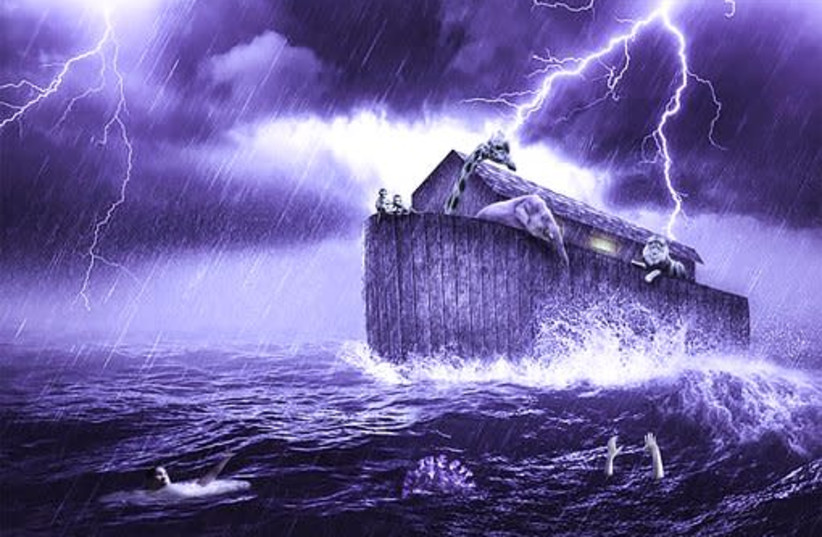
The world became engulfed by a torrential flood. Humanity vanished beneath the waters, and creation was reshaped. Never before had such an apocalyptic force swept the Earth.
The overwhelming presence of the divine surged through the chaos, leaving no refuge, no escape. Mankind could not withstand the celestial storm that reclaimed the world and began it anew.
Yet one family was miraculously sheltered from the devastation. God instructed Noah to build an ark to survive the cataclysm. For 120 years, he prepared, warning his generation and readying his vessel. Through divine instruction and tireless effort, Noah safeguarded his family from the waters that consumed the world.
Since Noah built the ark with his hands, it could have been torn apart by the rains and the Earth’s eruptive forces. God, however, sustained the ark and preserved the lives of Noah and his family, making them the first people in history to be surrounded by divine miracles that shielded them from certain death.
Silence after the flood
However, when Noah emerged from the ark, he was strikingly silent. He offered no words of thanks, no blessings for his miracles. Though he offered sacrifices upon an altar, they were unaccompanied by verbal expression of gratitude or recognition. His silence echoed louder than his offerings.
Rather than channeling his thankfulness into renewal, he turned to wine and drunkenness, wasting the precious opportunity before him.
Noah had the chance to restore the creation to the state of the Garden of Eden and to guide humanity toward perfection – but he faltered.
His silence and indulgence marked the beginning of decline. As a result of his ingratitude, the first cracks appeared in the new world, and hope for moral ascent began to slip away.
Gratitude for God’s care forms the pulse of identity, but in Noah it is absent. Emerging from the ark into a renewed world, he offered a sacrifice, a gesture, a hollow ritual observance rather than heartfelt devotion.
When death released its grip
Our people have been granted a divine miracle.
Most of us could not have imagined that all the living hostages would return alive without our army retreating from critical positions that safeguard our defense.
Twenty souls, once buried in a dark dungeon and subjected to hellish torment, have been restored to life and reunited with their families. It feels like the resurrection of the dead; a resurrection from the depths of despair; a moment when death released its grip.
Over these past two years, we have been privileged to witness divine care and affection. None of us can fully grasp the darkness of Oct. 7, nor can we explain why God allowed such barbarity to unfold. We have no answers for the tragedy and pain that have shadowed our people since that day.
Even amid the anguish, however, we cannot ignore the miracles. We cannot overlook 27,000 missiles launched at our nation and the remarkable way in which the majority of our lives were spared. We cannot disregard the collapse of armies that once threatened the existence of the Jewish state.
How do we express our gratitude to God? We all feel grateful, but how should that gratitude shape and transform our lives?
Gratitude to those who serve
Before discussing our gratitude to God, the gratitude we feel to His messengers is self-evident but worth emphasizing. Scores of soldiers and their families have sacrificed so much for these miracles, particularly for the release of the hostages. The release of the hostages remained the central mission for these soldiers, guiding every decision and risk they took.
Had we not focused on the hostages [and on minimizing civilian casualties in Gaza], the war could have been prosecuted with less danger to our troops. This focus reflects everything pure and noble about Israeli society – our reverence for human life, loyalty to one another, and our shared historical bond in the joint project of nation-building.
So many families paid a heavy price in this war. As the conflict shifts, possibly into a more moderate phase, their sacrifice will not be forgotten amid the euphoria of the miracles.
The voice of gratitude
What responsibilities behoove those for whom God has performed a miracle?
Foremost, we must express our gratitude.
Internal acknowledgment, while important, is far less powerful than articulating or vocalizing our thanks. Speaking our gratitude makes it vivid, compelling, and real.
Hundreds of years after the flood, Leah vocalized her gratitude to God by naming her fourth son Yehuda (“thanksgiving”), conveying her praise even though her life was far from perfect, and his birth did not change the fact that she would always take a backseat to Rachel in Jacob’s affections. Nevertheless, Leah recognized the miracle and thanked God.
Miracles need not be perfect for us to express our gratitude.
Some miracles are decisive: We cross from one side of the ocean to the other while witnessing the vanquishing of our enemies.
More often, though, miracles are not as clear-cut. We continue to face complex challenges, both in Gaza and the larger international arena. Voicing gratitude – through chapters of Psalms that celebrate God’s wonders, through invoking His name when recounting our victories – is the first and essential responsibility of anyone who has benefited from a miracle. To speak gratitude, both to God and to the many who sacrificed for this miracle, is to give it its living voice.
Duty and collective responsibility
The Hebrew word for “miracle” is ness, which literally means “a pole.” To receive a miracle is to be lifted upon a pole, to be elevated beyond danger and placed into a safer reality. Once we are lifted, we confront a new horizon of responsibility and a call to live in accordance with the gift we have been granted.
For an individual, translating a miracle into personal duty is straightforward. If God has spared me, what does that entail? What does He expect from me? God does not perform miracles without intention. While it may be difficult to determine specific expectations, future responsibilities can often be articulated in personal terms.
For a nation, understanding the duties that arise from a miracle is much more complex. Each individual is unique, and there are few duties that apply universally.
Perhaps these miracles create a collective responsibility for our nation to recognize this moment in history.
The drab routine of day-to-day life can obscure the larger historical narrative in which we live. A miracle breaks through this monotony, granting us the ability to see that we stand at the precipice of history. This perspective can galvanize us, raising us above our pettiness and internal divisions.
History elevates us, and the memory of this historic moment must expand our hearts and actions. We must be larger than our smallness.
Faith and miracles
Miracles should serve as wells of faith for the future. Before we begin our daily prayers, we recall past miracles and past redemptions. By retelling these wonders, we summon the confidence to believe in future miracles and trust that God will answer our prayers. Without this confidence, prayer risks becoming hollow.
History contains dark moments that severely test our faith. Oct. 7 was one such moment. We hope for a bright future, but there will inevitably be challenges that strain our trust. The miracles we have witnessed in recent years should fortify our faith, making it resilient even in dark times.
God’s intervention over the past two years – most notably in the release of our hostages – shows us that He acts in ways that exceed human understanding.
Miracles remind us that the divine is never distant. |■
The writer, a rabbi at the hesder Yeshivat Har Etzion/Gush, was ordained by Yeshiva University and has an MA in English literature. His books include To Be Holy but Human: Reflections Upon My Rebbe, HaRav Yehuda Amital.