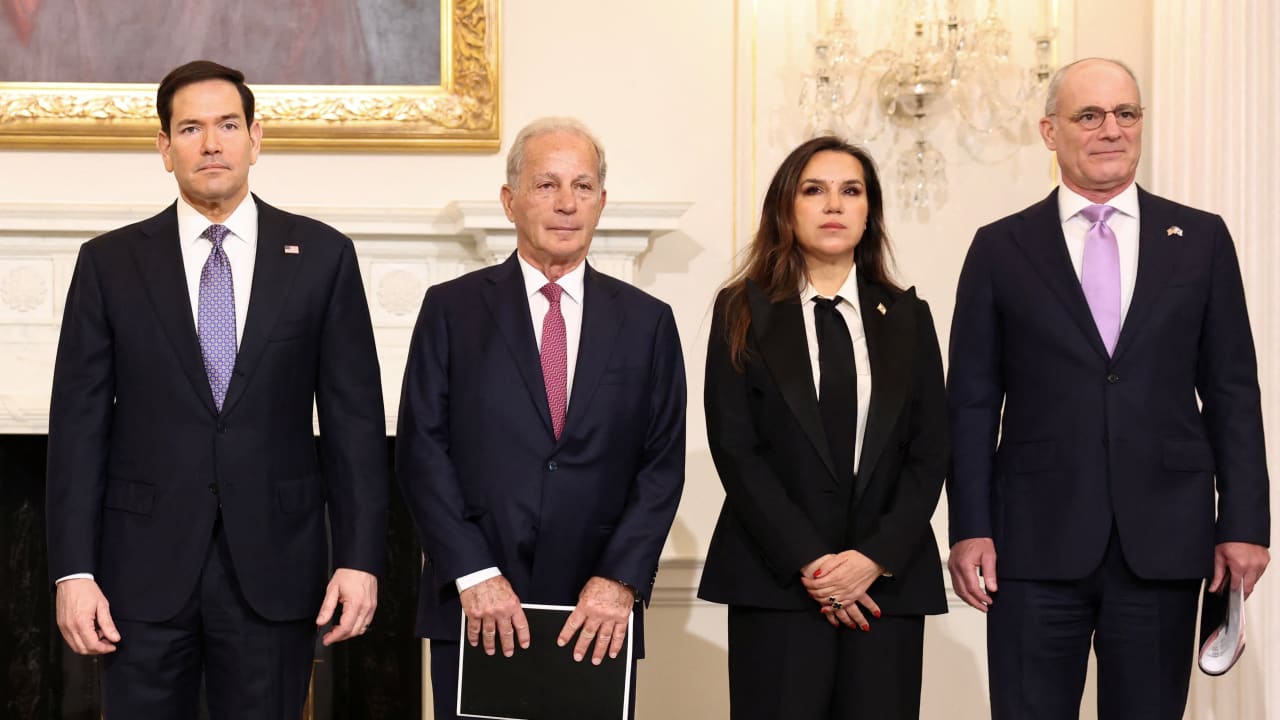
The third round of talks between Israel and Lebanon will open in Washington on Thursday, and for the first time, military representatives will also participate. The talks, which will take place at the State Department, come just before the expiration of the three-week ceasefire between Israel and Lebanon announced by US President Donald Trump.
The Lebanese delegation will be led by Lebanon’s former ambassador to the United States, Simon Karam; the current Lebanese ambassador to the US, Nada Hamadeh Mouawad; and Lebanon’s military attaché in Washington.
The Israeli delegation will be led by Israel’s Ambassador to the United States, Yechiel Leiter, and will also include a representative from the National Security Council, IDF Head of Strategy Brig.-Gen. Amichai Levin, and the acting Israeli military attaché in Washington.
An Israeli official told The Jerusalem Post that the talks aim “to discuss a framework for an agreement in greater depth.”
Representing the American side will be US Ambassador to Israel Mike Huckabee, Secretary of State Marco Rubio’s adviser Michael Needham, and US Ambassador to Lebanon, Michael Issa.

The Trump administration is pressuring Lebanon to take a significant step in order to advance the negotiations. One of Washington’s demands is that Beirut repeal the 1955 law prohibiting normalization with Israel. This demand was also raised with Lebanese officials by Leiter, and President Trump reportedly made the same request to senior Lebanese leaders.
“The Americans are telling the Lebanese: it is time for Beirut to offer something in return as well. So far, Israel has maintained the ceasefire and has taken significant measures to improve the atmosphere, and without action from the Lebanese side, it will be difficult to continue the ceasefire,” a source familiar with the details told the Post.
Third and fourth discussion dates decided
The talks are scheduled to begin on Thursday at 4:00 p.m. Israel time, and at the end of the day, both sides will consult with their leaders before returning for another round of discussions on Friday.
Before the meeting, Lebanon’s Foreign Ministry submitted an official complaint to the UN Security Council on Wednesday against Iran, accusing Tehran of interfering in Lebanon’s internal affairs and dragging the country into a devastating war it did not choose.
In the complaint, the Lebanese foreign ministry denied Iranian claims that the transfer of Iranian diplomats to the Ramada Hotel in Beirut, which was later targeted by Israel, had been coordinated with Lebanon. The ministry also revealed that some of the Iranian officials killed in the strike had never been formally registered in Lebanon as diplomats. The complaint further details additional violations allegedly committed by the Iranian embassy in Beirut.
Lebanon is demanding that the United Nations hold Iran to account for repeated violations of its international obligations.
Meanwhile, Hezbollah officials called on Lebanese President Joseph Aoun on Wednesday to hold a national referendum on direct negotiations with Israel and the possibility of signing a peace agreement. Hezbollah official Nawaf al-Moussawi, who oversees resources and border affairs for the group, told Qatar’s Al-Araby channel that “President Joseph Aoun has been cornered, and therefore a referendum must be held to determine what the majority of the Lebanese people support.”
Moussawi further claimed that President Trump is preparing an ambush for the Lebanese president during his upcoming visit to the United States.
He added: “It is shameful to shake hands with someone who is still killing your people [Netanyahu], whose hands are stained with blood – the man destroying homes in Lebanon – and to offer him peace while part of Lebanon’s land remains occupied. You would become a partner of the enemy in its aggression.”