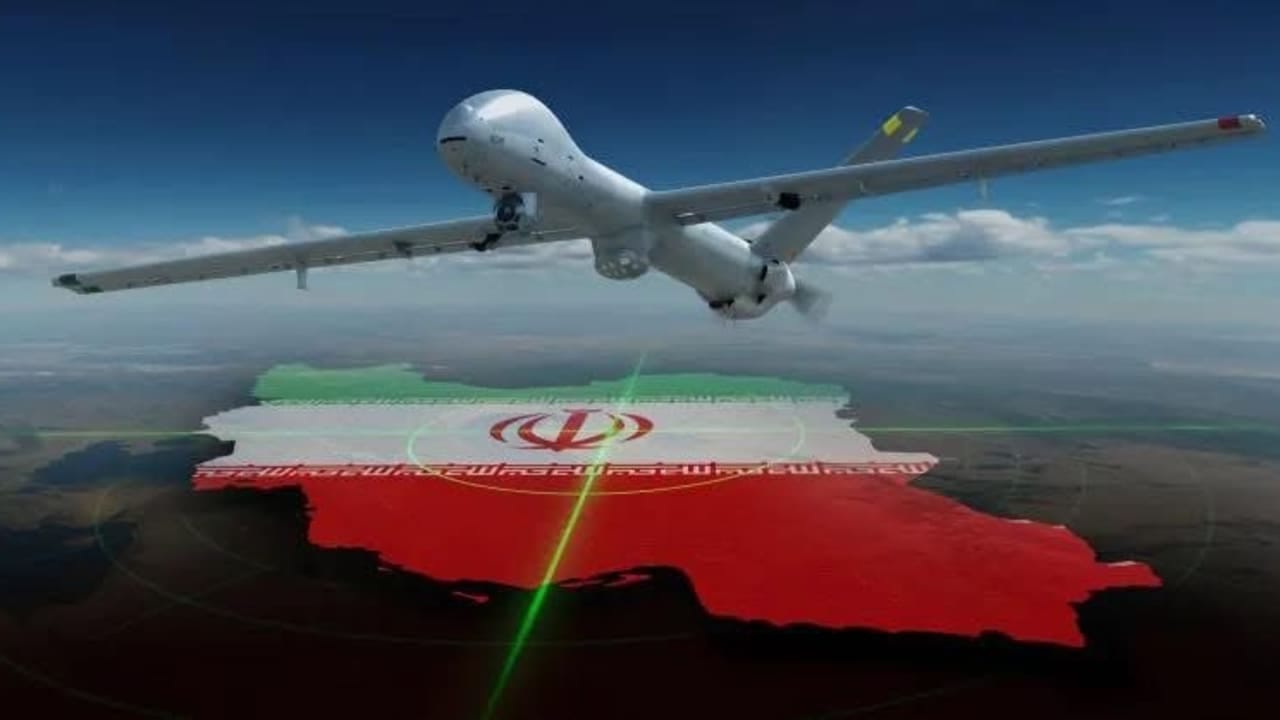
Elbit's Hermes 900 drones collectively helped locate dozens of Iran’s concealed ballistic missile launchers during the June war between Israel and the Islamic Republic, the vice president of Marketing and Business Development for Unmanned Aircraft Systems at Elbit Systems, Amir Bettesh, revealed on Wednesday.
Speaking at the UVID Drone Tech conference in Tel Aviv, Bettesh said that the success of the Hermes 900 during the war with Tehran showed that, despite trends in much of the West where mid-size drones are losing market share, they are still a critical aspect of Israeli national security.
Besides locating Iran's ballistic missile launchers, he said that the Hermes 900, also called the Kochav, helped strike Iran’s mobile air defense systems, radar installations, and ammunition facilities.
Previously, the IDF and Defense Ministry had revealed the significant role of drones in Israel’s air war against Tehran. Still, Bettesh’s statement marked the first time precise details were given, matching a particular line of drones to specific achievements.
Besides the Hermes 900, Elbit also sells the Hermes 450, one of its most commonly used drones, known in the IDF as the Zik. In 2024, it unveiled the Hermes 650, which sought to combine the 450’s affordability with some of the 900’s enhanced avionics, satellite, and other technological capabilities.

IDF air war: 70% drone flight hours, pilots retain F-35 role
According to Bettesh, 70% of Israel’s flight hours during the Iran war were drones, as opposed to piloted aircraft.
Also at the conference, Orbit Communications CEO Daniel Eshchar said that in the future, the percentage of flight hours for air forces like the IDF would jump to 90-95%.
He said that the world is getting closer and closer to a point where wars, certainly in the air, may be fought mostly by drones versus machines.
Despite that broader trend, Eshchar also said he was confident that human pilots would always be a part of the air force’s arsenal to handle highly complex missions.
For example, Israel destroyed Iran’s advanced Russian-made S-300 anti-aircraft missile systems, the crown jewel of its air defense, using its F-35 piloted aircraft.
Saudi Arabia and the US made mega headlines recently, talking about a multi-billion-dollar deal for purchasing new squadrons of F-35s. Israel is also purchasing new F-35 squadrons in the future – not something it would do if pilots were disappearing overnight.
Multiple speakers predicted that in the not-so-distant future, drones would go from being used to transport logistical items internally for the IDF only on special occasions to being one of the primary means of transporting military hardware between bases.
This will cut costs tremendously, increase speed, and have a wide range of ripple effects on the future shape of the IDF.
XTEND CXO and co-founder Matteo Shapira told the conference that his company has divided drones into five categories, ranging from total human control to mixed human-drone control to totally autonomous drones.
He said that total human control and assisted autonomous drones have been around for a long time. Still, that task-based autonomy is relatively new, and the most cutting-edge work is being done to develop mission-based autonomous drones.
For example, task-based autonomous drones will track and follow a target, making independent decisions on how best to maintain the target's position and avoid losing track of it.
Such drones may also work as part of a team, with one’s task to perform surveillance, another’s to force open a door or window, and another’s to eliminate resistance if encountered. A mission-based autonomous drone, such as the XOS model, could theoretically carry out multiple tasks as part of certain complex missions on its own.
Shapira said that in a potential future round of war with Iran, it was possible that swarms of such mission-based autonomous drones could be let loose against the Islamic Republic. However, this would still be short of full autonomy, as the missions would still have a limited number of well-defined and time-bound tasks.
In contrast, pilots (and a futuristic, fully autonomous drone) sometimes have missions with much more open mission goals, where they need to make decisions creatively and quickly and are given significant discretion about how much time to invest in a given mission.
A major message from the conference was that the drone market has expanded so dramatically that you can now purchase a drone of almost any size and weight with many different ways of being launched, landing, and being controlled in the field in order to carry out a vast number of tasks.
Following the wars against Hezbollah and Iran, Elbit Systems understood that it must also defend its platform from hostile threats, Bettesh told The Jerusalem Post’s Defense & Tech section. Bettesh explained this meant placing defensive systems on the platform itself.
Hezbollah downed several Elbit drones during the war.
Anna Ahronheim contributed to this report