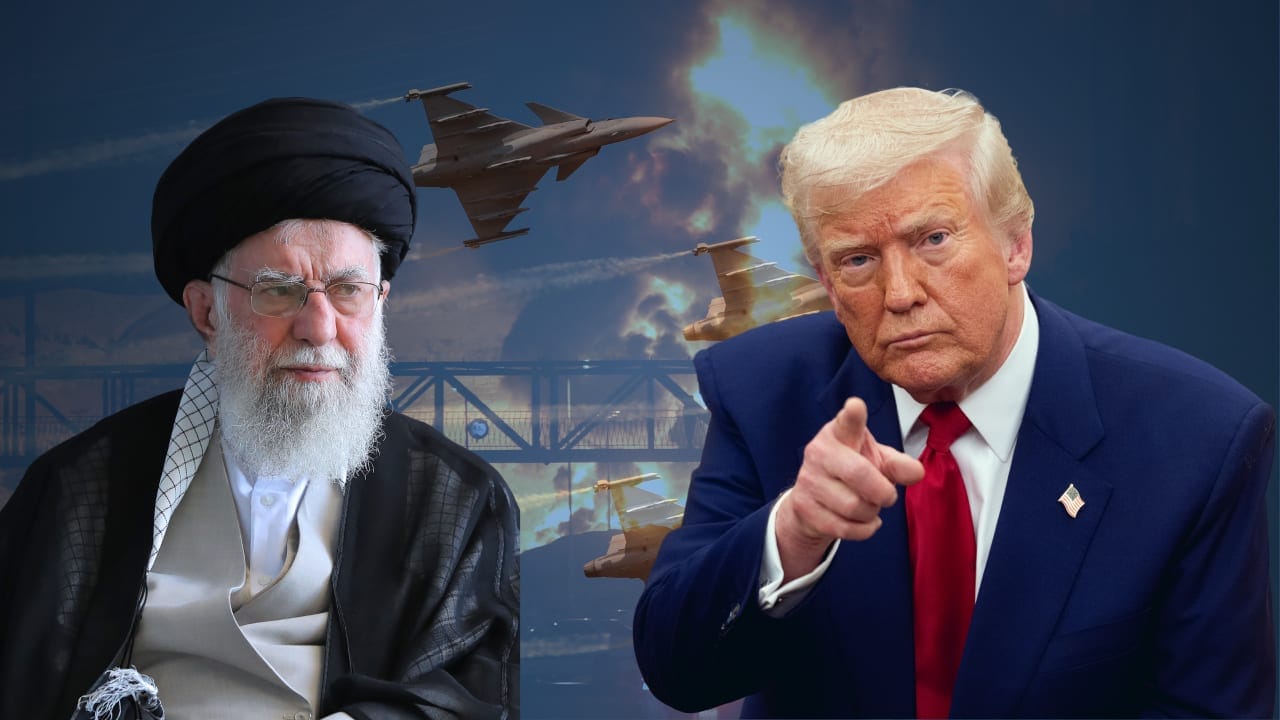
One question above all others must be dogging Iran’s leaders this week: Is US President Donald Trump serious?
For years, Iran's security establishment seemed to dismiss Trump’s tough rhetoric as TACO, Trump Always Chickens Out.
This term was coined early last year by a Financial Times columnist to describe the US president’s empty tariff threats. He threatened a 200% tariff on European alcohol, but it never materialized. Nor did his 100% levy on foreign films, 100% tariff on pharmaceuticals, or his $2,000-per-person tariff dividend. And that is all in the realm of economics.
As far as diplomacy, his frequent threats to Hamas to “open the gates of hell” never exactly transpired, and proved more rhetorical flourish than anything else.
His critics mocked and said he was all rhetoric, no follow-through; all hat, no cattle.

They are mocking no longer. Over the past seven months – and especially the past week – a counternarrative has emerged, one that may now be shaping how Iran’s leadership is calculating risks at this moment of renewed domestic unrest.
The question looming over the ayatollahs now is no longer whether Trump only talks tough but whether the long-standing belief that he ultimately pulls back still holds.
Trump’s credibility: How Maduro and June strikes shook Iran
The question looming over the ayatollahs now is no longer whether Trump talks tough, but whether the long-standing belief that he ultimately pulls back still holds.
The first mammoth crack in the TACO narrative came in June, when Trump joined Israel’s preemptive attack on Iran and authorized direct US strikes on heavily fortified Iranian nuclear facilities at Fordow, Natanz, and Isfahan.
This was neither symbolic nor indirect. It was a deliberate decision to use force on Iranian territory. A precedent was set, and it mattered: Trump crossed a line his predecessors had studiously avoided.
That precedent gained new weight this past weekend, though far from the Middle East. In a stunning and daring move, US forces captured Venezuelan strongman Nicolás Maduro and transferred him to New York to face charges. The operation was swift, precise, and entirely unexpected.
At a press conference Saturday alongside Trump, Secretary of State Marco Rubio made clear there was a broader message in this operation. When this president says he will act, he means it. Other countries, Rubio said, should take note.
It’s safe to assume that Iran most certainly did.
On Friday, a day before the operation in Caracas, Trump posted on Truth Social: “If Iran shots (sic) and violently kills peaceful protesters, which is their custom, the United States of America will come to their rescue. We are locked and loaded and ready to go.”
He repeated the threat on Sunday, telling reporters when asked: “We're watching it [Iran] very closely. If they start killing people as they have in the past, I think they're going to get hit very hard by the United States.”
These types of threats from Trump are not new. In fact, he has used the very term “locked and loaded” several times in the past, including during the North Korea crisis early in his first term and after the bombing of Saudi oil facilities in 2019. In both cases, his bark turned out much fiercer than his bite.
But what both the B-2 bomber attacks on Iran in June and Saturday’s arrest of Maduro have done is give these threats credibility. Iran’s leadership could, in the past, plausibly have discounted Trump’s threats as mere rhetoric designed to gain leverage. But today, that discount carries greater risks.
Early signs suggest that Tehran has taken notice.
Following Trump’s warning, Iranian security officials reportedly convened emergency discussions on how to manage the protests with less violence to avoid fanning the flames. These recommendations constitute a conspicuous departure from previous rounds of demonstrations, which were swiftly and brutally suppressed.
Some 20 people have reportedly been killed since the current round of protests began a week ago on Sunday, but compared with the crackdowns in 2019, when more than 200 people were killed, or during the Mahsa Amini protests of 2022–23, when more than 500 people were killed, these figures suggest the government is seeking to show restraint.
That caution reflects calculation rather than compassion. Iran’s leadership now faces a dilemma it has not previously had to confront: domestic unrest unfolding alongside a credible external military threat from both the US, which Trump issued, and Israel.
Prime Minister Benjamin Netanyahu repeated in a speech to the Knesset on Monday that if attacked by Iran, Israel’s response will be “very severe.”
Here is the ayatollah’s dilemma: Crack down hard, as it has done before, and risk triggering US intervention. Try to deflect the anger by attacking Israel, and risk an overwhelming Israeli show of force that will degrade the internal security apparatus. Hold back, and risk protests spreading, emboldened by the perception that the regime is constrained.
Compounding that pressure is the increasingly fragile posture of the regime’s top leadership. Supreme Leader Ayatollah Ali Khamenei has been notably absent from public view.
The Times of London reported Sunday on intelligence assessments suggesting he has authorized a “Plan B,” a contingency plan to flee Iran to Russia with family members and an inner circle, as Syria’s deposed dictator Bashar Assad did in November 2024. Whether such a plan will ever be activated is immaterial; its existence alone bespeaks tremendous anxiety at the top. Regimes confident in their grip on power do not prepare exit routes.
At the same time, the Israeli dimension has grown more prominent. According to reporting in Hezbollah-affiliated Al-Akhbar, Trump and Netanyahu reached an understanding during their recent meeting in Mar-a-Lago regarding joint action should Iran refuse to negotiate over its nuclear program on US terms.
Israel has made no secret of its readiness to act again if Iran rebuilds capabilities damaged last year. What is new is the perception, in Tehran and Beirut alike, that Washington may not restrain Israel and, in fact, may actively participate.
Some argue that there remains considerable logic in remaining skeptical of Trump’s threats, given that many past threats did not materialize. Yet focusing only on what Trump has not done misses the more relevant pattern of his second term: when he concludes that deterrence has failed, he has shown a willingness to act abruptly, decisively, and without drawn-out diplomatic maneuvering.
The strike on Iran’s nuclear facilities, the arrest of Maduro, and now the repeated, public warnings tied to specific behavior regarding the protests form a pattern Tehran cannot ignore.
Whether this will deter a brutal crackdown on the protesters remains unclear. But what is clear is that the old TACO assumption is no longer safe, and in Tehran, that uncertainty alone must be tremendously unsettling. When Trump says he is “locked and loaded,” Iran’s leadership, at least according to some initial signs, appears now to be taking him very seriously.