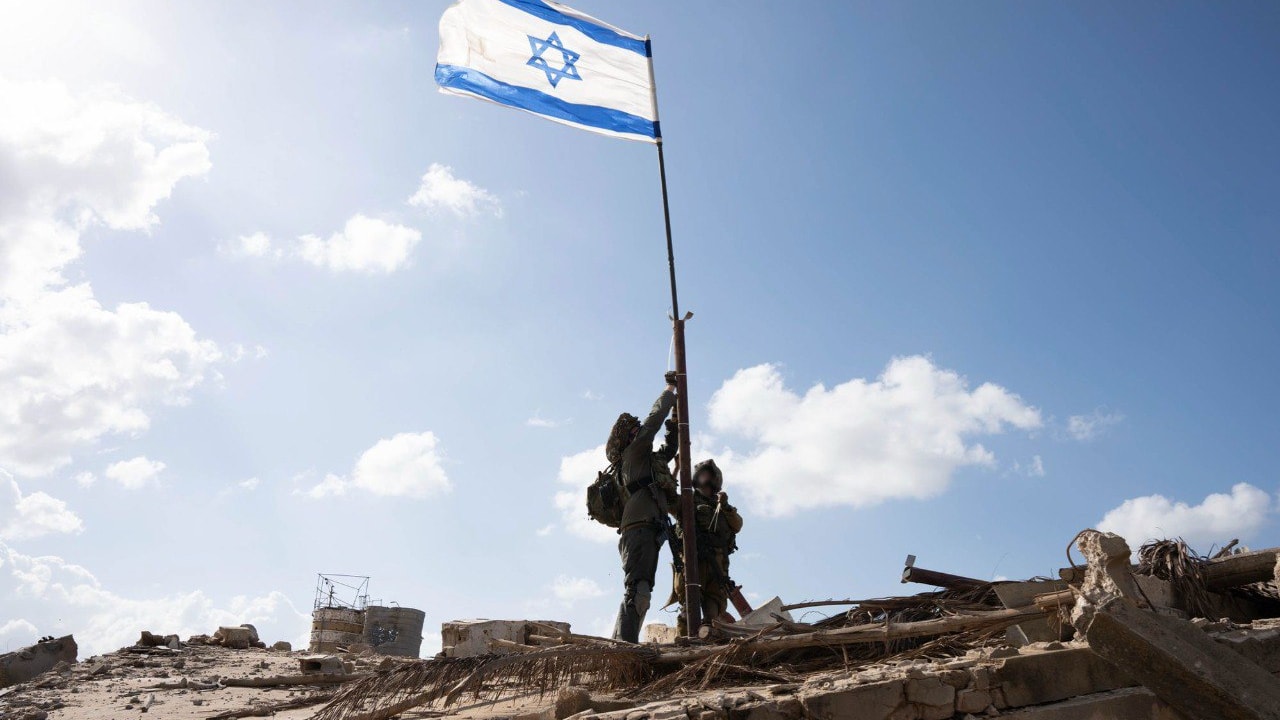
In the early hours of Saturday morning, Israeli and American aircraft struck deep inside Iran in a joint operation many had long deemed unthinkable. History rarely repeats itself neatly. It echoes. It returns in familiar shapes - but never in quite the same form.
Saturday’s strike on Iran inevitably calls to mind earlier chapters in Israel’s history. In 1956, Israel moved in concert with Britain and France against Egypt, launching the Sinai campaign alongside fading imperial powers. In 1967, after weeks of suffocating tension - tension that even exceeded the anxiety felt in recent weeks - Israel preempted, destroyed Egypt’s air force, and reshaped the region in six extraordinary days.
There are unmistakable parallels.
Then, as now, Israel acted amid a sense that time was not on its side. Then, as now, leaders faced the question of whether waiting would only strengthen the enemy. And then, as now, the decision to act carried the risk of regional escalation.
But the symmetry ends there.

The echoes of 1956 and 1967
In 1956, Washington opposed the move and forced a withdrawal. In 1967, Israel acted alone against neighboring armies massed on its borders. Today, by contrast, Israel is aligned with the United States - striking not a conventional army across a frontier, but the strategic infrastructure and the political and military leadership of a regime some 2,000 kilometers away - a regime that has built a ring of proxies precisely to deter such a moment.
This is not a war to break a blockade or preempt tanks poised to cross a border. It is a confrontation over capabilities - nuclear potential, missile arsenals, and the meaning of deterrence itself. The doctrine implicit in Saturday’s attack suggests that to deter an enemy - especially one fueled by ideological fervor - it is not enough to demonstrate matching strength. You aim to degrade the adversary’s capabilities decisively and to eliminate those who direct them.
The echoes of 1956 and 1967 are real, but only echoes. This confrontation is unfolding in a fundamentally different strategic universe.
In 1956, US President Dwight Eisenhower was infuriated by Israel’s action. In 1967, President Lyndon Johnson warned that if Israel acted alone, it would stand alone. On Saturday, President Donald Trump framed Iran not as Israel’s problem, but as a wider threat - to the United States and beyond. This time, Washington was not seeking to restrain Israel; it acted together with it, hand in glove.
The campaign was carried out in close coordination between the two militaries, with the United States deploying extensive air and naval forces alongside Israel’s own large‑scale aerial campaign.
October 7
Yet 1956 and 1967 are not the dates that most powerfully reverberate in this strike. The more consequential date is October 7.
When Hamas, under the leadership of Yahya Sinwar, launched its assault, it did more than ignite a war in Gaza. It shattered a strategic assumption that had quietly taken hold in Jerusalem over the past decade - that enemies could be managed, contained, deterred; that dangerous capabilities could be tolerated so long as intentions appeared constrained.
October 7 demolished that premise.
The lesson drawn across Israel’s political and security establishment was clear: you do not allow a sworn enemy to accumulate the capacity to destroy you and trust that deterrence will indefinitely hold - or that things will somehow work themselves out. You do not gamble national survival on assumptions about rational restraint, particularly when the adversary is driven by a radical ideology and religious zeal.
Hamas was a proxy. Hezbollah is a proxy. At the center of that network sits Iran - architect, financier, trainer, supplier. If the massacre exposed the cost of underestimating a proxy’s intent, it sharpened attention on the patron’s capabilities.
There is a deep irony here.
Sinwar sought to derail Israel’s normalization in the region and restore the “axis of resistance” to center stage. He wanted to light a fire. He did - but the flames did not consume Israel, as he had hoped. They consumed Gaza and then spread outward. What began as an assault meant to weaken Israel has instead accelerated a process drawing Israel and the United States into a direct confrontation with the regime that empowered him.
Iran armed Hamas, trained Hamas, and embodied the implacable and murderous hostility toward Israel that Hamas carried out. Yet the terrorist organization meant to bolster Tehran’s regional posture may ultimately be remembered as the trigger that brought about the Islamic Republic’s downfall.
The strike falls on Shabbat Zachor
The timing of Saturday’s strike adds another layer. The strike came on Shabbat Zachor, the Shabbat preceding Purim, when Jews read the biblical injunction to remember Amalek - the archetype, in Jewish memory, of an enemy that seeks destruction without compromise. In synagogues across Israel, that text was read as events unfolded in Iran.
Geopolitics is not a biblical metaphor. Yet Israelis are not only citizens of a state; as Jews, they carry an ancient memory. Even coincidental timing can shape how a moment is experienced.
Jews remember Purim. Israel will forever remember October 7.
Purim teaches that when an existential threat emerges, silence and passivity carry their own danger. October 7 teaches that threats allowed to mature do not remain theoretical. The lesson of both lies in agency. For people who desire life, waiting indefinitely is not a strategy.
On Saturday, Israel chose action - and it did not do so in isolation.