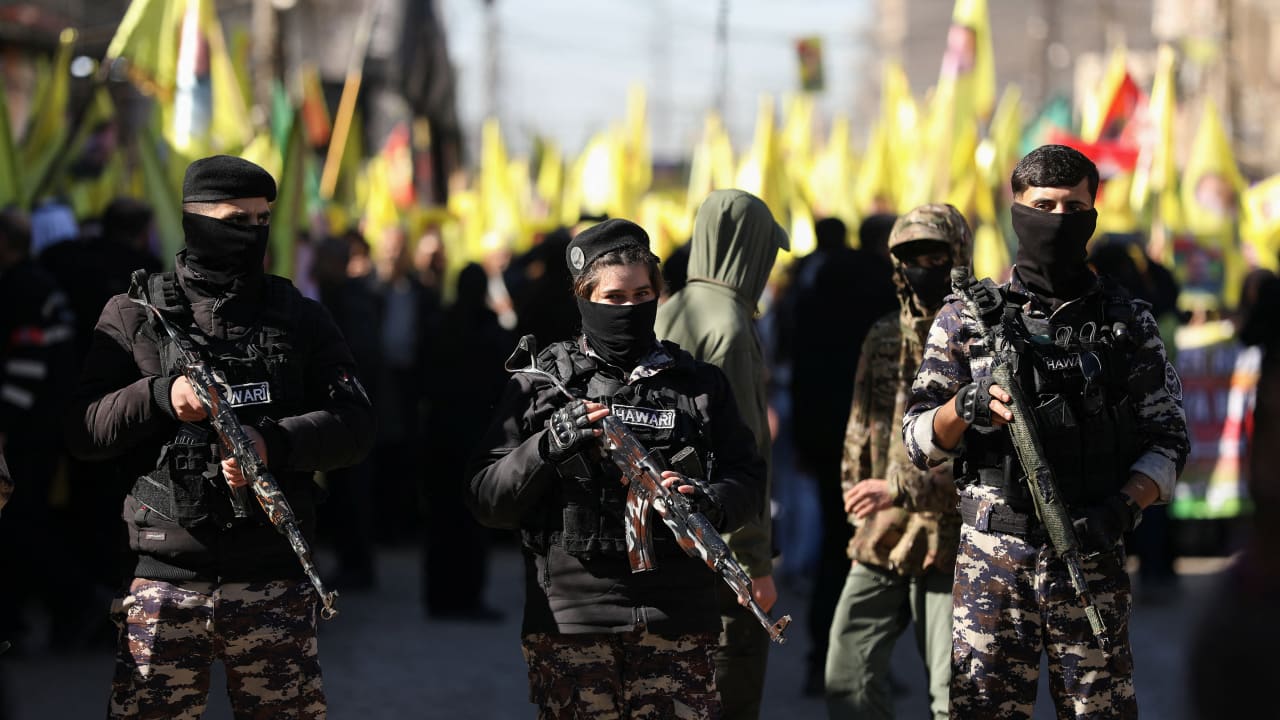
As the grip of the Iranian regime faces unprecedented challenges, the question is circulating through the Middle East, and the intelligence agencies is: Will the Kurds open a new front against the Ayatollahs?
There is a burning desire among the Kurdish people to unite with the West and Israel to topple the regime in Tehran, yet there is deep pragmatic hesitation among the leadership of the Kurds who fear being abandoned by Washington once again.
In recent days, hundreds of Iranian Kurds fighters returned to the country, suggesting that the Kurdish population in Iran are primed for an uprising. A senior Kurdish official told the Post that this uprising perhaps can come as soon as "next week," provided they receive the right support.
"Without America, without Israel, we cannot be successful," the official admitted. He stressed that the requirement is not just military hardware, but "political cover," specifically suggesting a "No-Fly Zone" over Iranian Kurdistan similar to the one established over northern Iraq in the 1990s. This, he argued, would allow the Kurdish opposition to take control of their territory from the regime.
"We need the Kurdish minorities to be united under one country which is called Kurdistan," the official dreamed, predicting such a state would be "the main ally with Israel and America."

"It will require more time"
Bashar Aziz, a Kurdish journalist and lawyer, offered a different view of the situation.
"The leadership of the Kurdistan Region goal is to maintain good relations with Iran," Aziz explained. "All efforts are focused on keeping the Kurdistan Region out of this struggle."
While Aziz acknowledged that the Kurds are currently suffering under direct missile and drone attacks from Tehran—launched under the "pretext" of targeting US and Israeli presence—he insisted that the Kurdistan Regional Government (KRG) priority is stability. The region is "boiling," Aziz noted, but the government is determined to protect its economic lifelines and trade relations.
Regarding the Iranian Kurdish opposition groups (forces from Eastern Kurdistan), Aziz confirmed they have formed an alliance and are preparing for the "next phase." However, unlike the senior official’s prediction of an imminent offensive, Aziz believes the question of an attack in Iran depends entirely on a mass popular uprising within the country.
"Given that the Iranian government is currently cracking down harshly on internal dissent the return of Iranian Kurdish forces remains difficult and will require more time," Aziz analyzed.
But the past serves as a lesson for the Kurds, when both of those we spoke with site the recent events in Syria as a cautionary tale.
The senior official expressed bitterness over the US handling of Rojava (Syrian Kurdistan), asking why Americans failed to protect allies who helped destroy ISIS, only to allow Islamist figures like Ahmed al-Sharaa, former Al Qaeda terrorist, and now the Syrian president, to encroach on their rights. "This makes the people of the Kurds a little bit aware: are the Americans supporting Islamic terrorists instead of their allies?"
Aziz echoed this sentiment, warning against the Kurds being used merely as a proxy force. "We saw in Syria how, after more than a decade of fighting against ISIS, the US turned its back on the Kurds," Aziz said. "Kurds must be given concrete promises and formal agreements, rather than merely being used as a fighting force by the international community."
The picture that emerges is one of a nation in waiting. There is profound sympathy for Israel and a willingness to fight for a different Middle East—one where a secular, pro-Western Kurdistan acts as a bulwark against radical Islamism.
"We have a Jewish community in Kurdistan," the senior official noted, highlighting the lack of distinction made between ethnic groups in Kurdish society. "We don't care about the political [correctness] - we look for our rights."
The official emphasized that unlike the hostility faced from neighbors in Iraq, Syria, and Turkey, the Kurds have never suffered at the hands of Israelis or Americans. "The Israelis didn't do anything bad to us," the official said, noting that historically, Israel provided advice and weaponry that helped the Peshmerga survive the onslaught of the Iraqi army in the 1960s and later.
"Kurds and Israel are hated by Muslim countries and Arab countries," the official stated, outlining a grim geopolitical reality. "It means we have shared enemies and shared principles. We like diversity, you like diversity. We like human rights, you like human rights."