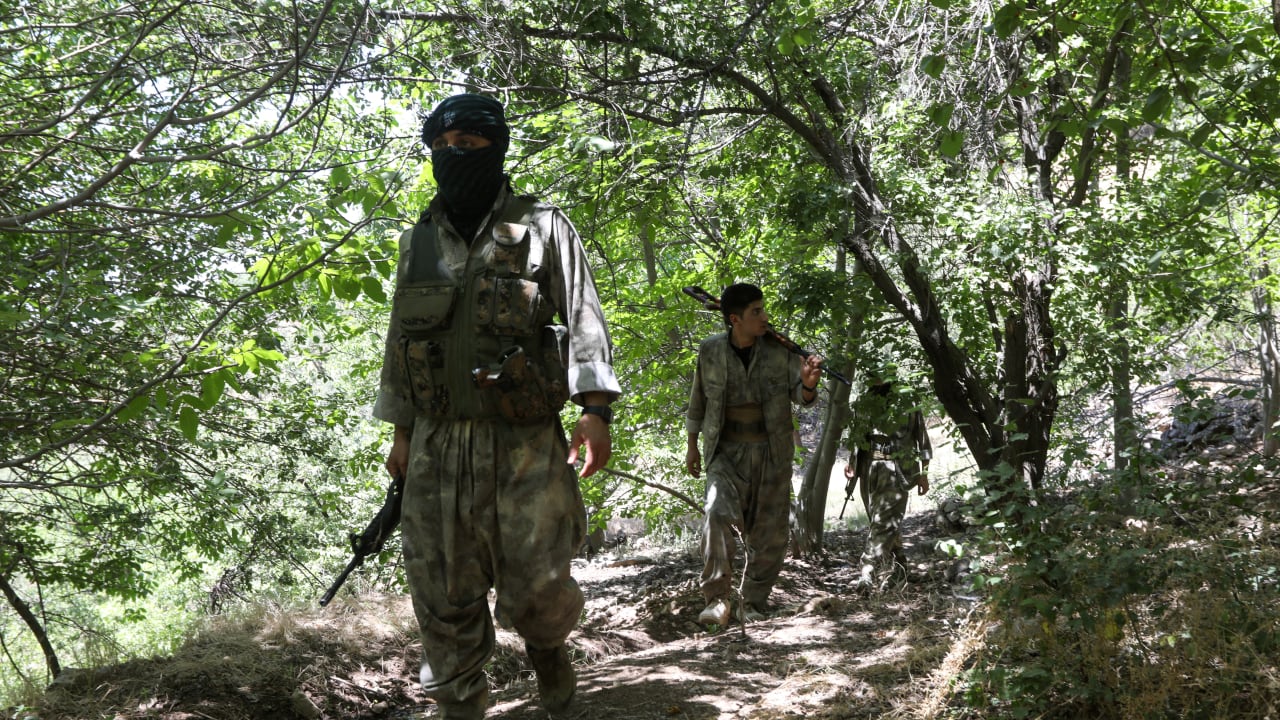
The Kurds would be taking a very significant gamble if Iranian Kurdish groups take up arms against the Islamic regime on behalf of the US, Washington-based Kurdish analyst and journalist Mutlu Civiroglu told The Jerusalem Post on Wednesday, adding that the risk carries a significant opportunity for the persecuted group to finally experience a level of rights and protection currently being denied by Tehran.
Civiroglu spoke with the Post after three informed sources told Reuters that Iranian Kurdish militias have consulted with the US in recent days about whether, and how, to attack Iran’s security forces in the western part of the country. While the sources said that a final decision has not been made about the potential agreement, the Kurdish groups have reportedly requested US military support, and there are reportedly ongoing talks that would see the CIA provide the militias with weapons.
Noting the US’s severing of ties with the Kurdish-led Syrian Democratic Forces in Rojava, Civiroglu admitted that Kurdish trust in the Trump administration has somewhat faltered, though he himself did not view the situation in Syria as a sign of abandonment.
“Many are saying that we shouldn’t trust the US; they can abandon us as they did in Rojava,” he explained. “I don’t believe the US abandoned Rojava. I don’t believe that, but that’s a different story… [But] many people think in this way… The question is valid, the question is relevant.”

Regime will likely worsen if US, Israel fail to secure regime change
Beyond what many see as a recent betrayal, the reality for Kurds in the Islamic regime will likely only worsen if the US and Israel fail to secure regime change, he explained. “It will be the Kurds who will pay the ultimate, deadliest price. It’s not hard to imagine their cities are going to be crushed. They’re going to be executed if it fails,” he said, but added he had every faith in the operations succeeding.
“Iran cannot go back to a monarchy like the Pahlavi monarchy. That is one of the major reasons the people of Iran are in this situation,” he said, noting that every fragment of society had suffered under the current regime.
“So that regime paved the way for the Islamic regime… After all this suffering, people cannot expect Iran to go back to the Islamic regime, or the monarchy. Iran has to have a democratic future. All of its ethnic and religious minorities should be able to freely express themselves. That’s why, for the new Iran, it has to be something that is pro-Western, something that treats diversity as a treasure, not as a threat, something that embraces all of its colors.”
THE CURRENT status of Kurds in Iran has likely made the gamble of involving themselves with the US an easier choice for the militias, he explained. Iranian prisons are filled with Kurdish prisoners, and members of the Kurdish leadership, particularly in the Kurdistan Democratic Party of Iran (KDPI), have regularly been assassinated by the regime.
Kurdish-language activists and teachers have also been frequently arrested and given long sentences for teaching their native tongue, as the regime has viewed it as a security threat, according to a 2024 Diakurd report presented to the Office of the United Nations High Commissioner for Human Rights.
“The Kurdish people in Iran are willing to get a decent life there; they want to live in peace and prosperity, but they have long been suppressed by the Islamic regime,” he shared.
“Kurds have been fighting against this regime for decades, so they fight for their dignity, for their identity, for their language, for their rights – it is nothing new. They have been doing this for a long time, and they have been paying the heaviest price. So when they think there is an opportunity that they could get their long-denied basic rights, they are going to fight, and they are going to speak up.”
He explained that there is a general willingness within the Kurdish community to take the risk of involving itself with the US in this new battle.
There is not only the risk of the operations failing, leaving the Kurds with the fallout, but the chance that the new government will be yet another oppressive regime. Under the Pahlavi dynasty, before the country’s monarchy fell to the Islamic regime in 1979, the Kurds were marginalized and oppressed. Under the reign of Reza Shah Pahlavi, the Kurdish language was banned and policies pushed for assimilation into the Persian identity.
Civiroglu also strongly rejected the image that Kurds are “tools being used by other forces,” pointing again to the community’s long struggle for independence and rights.
“They have formed an alliance with six parties. They have a joint alliance, and they are ready to defend Kurdish people in the case of an attack massacre; they are ready there, and the Kurdish people are looking forward to hearing the signal of these parties. So it is important that we understand the color picture of how Kurds view the events unfolding,” he continued.
Five Kurdish Iranian opposition groups formed a coalition against the regime last week, demonstrating increased coordination and willingness to take on Tehran, according to an analysis published by the Post’s Seth Frantzman.
Beyond having several allied political parties representing the interests of the people, “they have a strong popular basis among the people, they have the mountains, they have their fighters,” he continued, adding that while the regime has “oppressed” the ethnic group, it has been unable to “suppress” it.