Imagine you’re a professor beginning to lecture to a class composed of students who share the same primary language and are citizens of the same country. You would assume that your words are understood the same way by most students, even if they disagree with the opinions associated with those words.
Not so, says Dr. Celeste Kidd, a psychologist at the University of California, Berkeley, writing in the Wall Street Journal Review. Her research found that not only do our brains view polarized subjects such as politicians differently, but “people do not see eye to eye about even the basic characteristic of objects. We overestimate how many people see things as we do…words simply don’t mean the same thing to different people,” even those who are seemingly very similar.
Writers and speakers have experienced this phenomenon to one degree or another, as when a student or reader asks them a question about something presented as seemingly factual, without much room for much disagreement. Yet, the listener heard it entirely out of context, as if the words meant something completely different. If true, it is easy to imagine how more incendiary politicized words are understood differently by an audience with inherently biased viewpoints that they are unaware of or unwilling to confront.
So this begs the question, are we programmed so differently that we can never honestly communicate with one another without worrying about being understood correctly? Remember the book Men Are from Mars, Women Are from Venus, which pointed out how the sexes perceive things differently?
In our highly polarized world, where facts are often ignored if they challenge one’s political worldview, are we capable of being objective if we are hardwired to interpret even non-incendiary words differently?
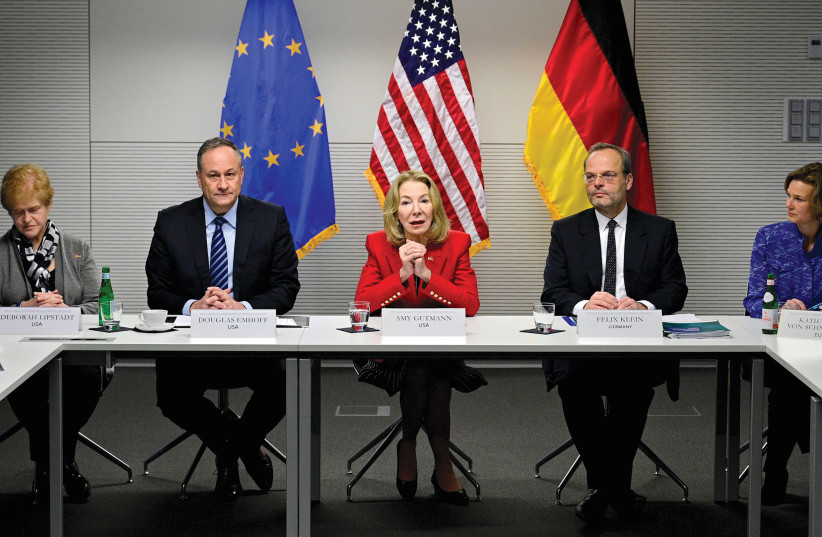
Is polarized US and Israel, is being objective possible?
This preamble is fascinating, but its implications for divided democratic societies, whether in America or Israel, may partly explain why we recede into our echo chambers and are unwilling to listen to other points of view that make us uncomfortable.
I tell audiences that one of the best ways to assess your bias is to ask yourself the following question. If a policy you agree with was advocated by the other side of the political debate, say a Republican instead of a Democrat, or a member of Yesh Atid instead of Likud, would you still be advocating as passionately for that position? Suppose a Republican president was as strong a supporter of arming Ukraine as President Joe Biden is. Would more Republicans favor aid to Ukraine instead of challenging the costs associated with our support?
If you believe The New York Times is “all the news that’s fit to print,” are you willing to challenge yourself by reading the editorials in The Wall Street Journal, which are often opposed to the NYT’s perspective but could add a deeper understanding of an issue, perhaps moderating your opinion? Or the other way, if that’s how it is for you?
Within the last year, whether speaking to Ivy League university audiences or to lay organizational groups, when I pointed out that most news reporting has a point of view and, as a responsible citizen you must read multiple sources of information, including those that challenge your viewpoint or inherent bias, how many took my “words” to heart? Maybe they heard them differently based on intrinsic preferences.
People are, to one degree or another, naturally discriminatory, but does that mean you cannot evolve, grow, and change your judgment if you consciously try to be open-minded and informed? In previous generations, uncomfortable views were tolerated in the name of free speech, whether on campus, in a newspaper, or in a political debate. Today, some family members won’t speak to one another based on political viewpoints. It is hard to challenge your inherent bias or perspective if your ideologically fellow travelers tell you it is OK to ignore or demonize those with different views as though they are evil and immoral. Their words are heard as incendiary, even if offered without animosity.
Words are weapons, and we hear them differently. Our political climate allows us to shut down speech and demonize opponents. This must stop, and the way to begin is like an alcoholic attending an Alcoholics Anonymous meeting; you must acknowledge your problem before treating it.
An article in the Conversation said, “Bias is natural: How you manage it defines your ability to be just.”
Today, unpopular ideas and misinterpreted words based on inherent bias invade your safe space, giving you a politically correct rationale to dismiss challenging concepts and disparage those who think differently. If students feel unsafe, they can justify screaming down a speaker or having a speaker disinvited, censoring debate like authoritarians. This happens all too frequently at American universities. Corporations, universities, and government demand pro forma statements of allegiance to correct political philosophy; loyalty tests are more akin to fascist regimes, not open-minded democracies. Using the wrong word can have you fired.
According to an article in the Times of Israel by Shakked Beery, who was studying what the field of “implicit bias” says about the leading form of religiously biased hatred in the US, antisemitism, she found no academic research in implicit bias against Jewish victims of hate. That is because Jewish Americans are considered part of systemic oppression in far too much of the progressive biosphere. So, are progressive academics looking inward and asking themselves if they are biased if nearly 60% of hate crimes in America are against Jews, who represent under 2% of the population, and they choose to ignore them?
Wouldn’t it be great if those with extreme bias against Israel, a form of antisemitism, could be self-reflective? How do you define anti-Israel bias? According to the ADL, it is “hyperbolic criticism of Israel… false and vilifying accusations directed against Israel, often with the aim of delegitimizing the State of Israel.” Is it possible for the “Squad” to own up to their inherent biases against Jews whose primary identification with being Jewish is Zionism? Intrinsic bias is not a one-way street, an affliction of only those who don’t share your politically correct viewpoint.
The American democracy, the Israeli democracy, and all democracies need to step back, look at our commonality, and see the humanity of the other. Words can heal or harm. It is up to us, as free peoples who are privileged to live in democracies, to revisit the importance of freedom of speech, the power of words, and the ability to rise above our inherent prejudices.
The rise of DEI (diversity, equity, and inclusion) on American college campuses, in government and corporate offices may be the greatest threat to the free flow of ideas and the future of US democracy, as their administrators and human resource personnel have become like the censors of authoritarian regimes. Alternative viewpoints are not only frowned upon; they can cause dismissal, chastisement, and intimidation, as often happens to pro-Israel students on college campuses. As Tunku Varadarajan writes in the WSJ, politically correct or woke views “have run amok in culture and economy-defining institutions ranging from news organizations and local government to professional societies and corporate boardrooms.”
According to two professors – one from Stanford and the other from U.C. Santa Clara – “the free-speech watchdog organization Speech First (reported) 56% of American universities have adopted schemes that encourage students to report on one another anonymously for bias… anyone who falls short of campus orthodoxy on proscribed language might soon be denounced … DEI offices…that polices language, forces ideological training down the throats of faculty and students, and mandates loyalty oaths from faculty candidates will be in charge of administering the system of informers.” Welcome to George Orwell’s 1984!
The American experience of stifling other opinions has always been present to one degree or another, but it didn’t become mainstream until the Obama and Trump presidencies. In Israel, the ongoing judicial debate has produced rants from both sides that are too often more ad hominem attacks than policy disputes, which are the essence of legitimate arguments. If we comprehend non-inflammatory words differently, how much more distorted is our interpretation when we hear from someone we passionately disagree with?
What we need but do not have are leaders, whether in politics, corporations, or academia, who have humility and ask their supporters, students, and employees who disagree with others to challenge themselves with uncomfortable ideas while remaining respectful of alternative viewpoints. The world is not black and white but gray. If you think you and your fellow travelers are overwhelmingly right, that is a hint that you may suffer from inherent bias.
It is time for everyone to look inward and acknowledge their prejudices and address them. This includes not just so-called privileged people but also those who claim they cannot be biased because they are members of an aggrieved intersectional group. The way forward is for responsible, sensible, humble leaders in academia, politics, and business to speak up to end viewpoint litmus tests and advocate for respect for diverse opinions.
According to Jonah Berger’s book Magic Words: What to Say to Get Your Way, “the power of words has less to do with picking a particular word than with paying attention to how words operate and affect people…. Understanding these patterns is crucial to using words more effectively to achieve our goals.”
Choosing your words carefully, listening more, and saying less is the first step in bridging the divides between people with different viewpoints, helping to overcome our inherent biases. ■
Dr. Mandel is the director of MEPIN (Middle East Political Information Network) and regularly briefs members of Congress and their foreign policy aides.