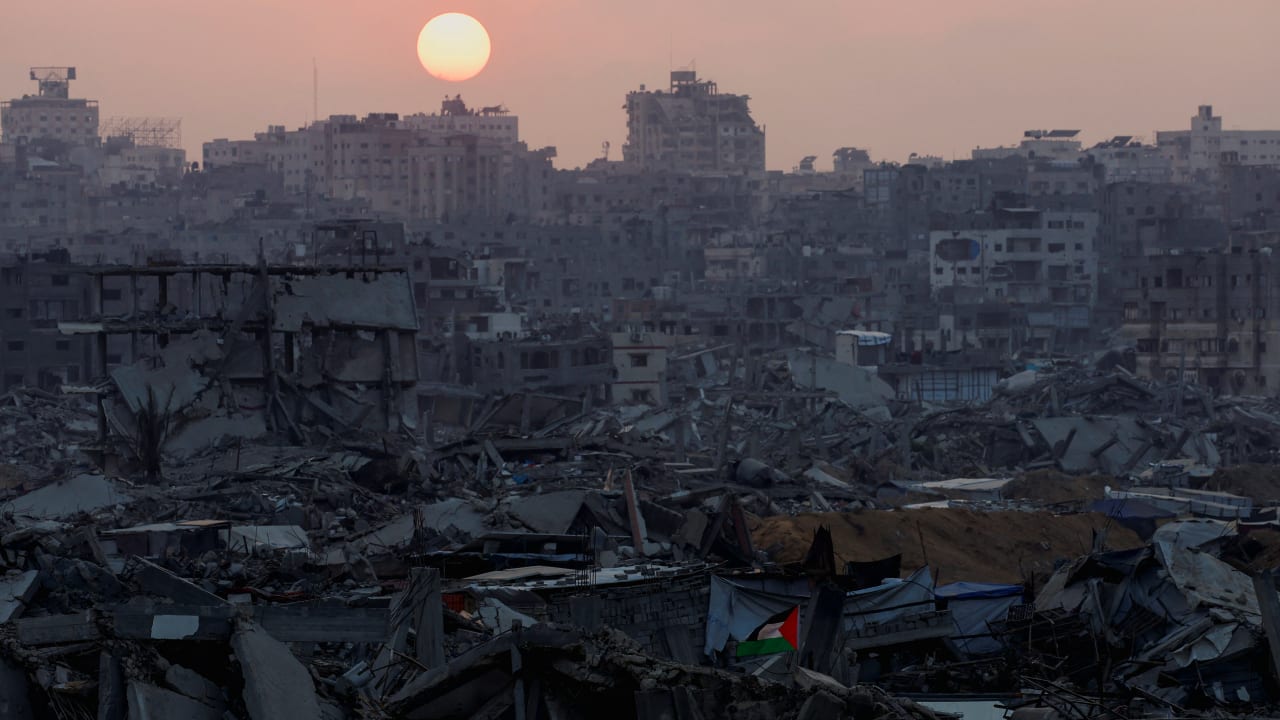
We’ve been hearing experts talk about Turkey, Qatar, Iran, the United Arab Emirates, the Palestinian Authority, and even an international force for rebuilding and ruling Gaza. There’s plenty of analysis about the benefits, but mostly the dangers, of any of those parties taking a leading role in postwar Gaza.
For more stories from The Media Line go to themedialine.org
Those experts are missing the obvious- Israel’s peace neighbors and partners, Egypt and Jordan. It makes me wonder if they have ever visited this corner of the Middle East.
In contrast, I’m writing as a journalist who has covered the region on the ground for five decades, and, notably, I’ve had extensive reporting experience in Egypt and Jordan. I even lived and worked in Egypt for two years during the Arab Spring.
So, where are Egypt and Jordan in all these Gaza scenarios? They are Israel’s natural allies in the struggle against Hamas in Gaza and the Muslim Brotherhood in the region. But analysts either ignore them, or worse, mislead with conclusions like these:
- Egypt must open its borders and let in hundreds of thousands of Palestinian refugees from Gaza.
- Jordan must … well, fill in the blank with any number of untenable demands, from absorbing Gazans to openly supporting Israel in all its actions.

Let’s take Jordan first, because it’s easier. Any formula that begins with “Jordan’s King Abdullah II must…” is misguided or misinformed. It’s a conceptual thing. Over here on the stronger side of the fence, we have this idea that King Abdullah can do whatever he wants. After all, he’s a KING. So there’s no reason why he shouldn’t be out front leading the Arab world in support for Israel. Why else should Israel have a peace treaty with Jordan?
In fact, Jordan is a small, poor country, mostly desert, ruled by a segment of its society, the Hashemites. King Abdullah faces economic and political challenges that are almost incomprehensible. It’s an accomplishment for him to stay afloat at all. For example, at the height of the recent civil war in neighboring Syria, Jordan was hosting about a million refugees with only limited support from the outside. Many have been repatriated in the meantime, but the economic burden remains.
More significant is the challenge of the Palestinians and their increasing radicalization. The majority of Jordan’s population is Palestinian. Exact numbers are impossible to get because, for obvious reasons, Jordan’s rulers don’t want to admit how dire their demographic situation is. Best estimates, probably on the low side, are 60%.
Jordan’s parliament is already heavily Islamist, with the influence of the Muslim Brotherhood. And there, by the way, is the answer to the “Jordan is Palestine” argument, the view that the king should be overthrown and the Palestinians should take over, making Jordan the “Palestinian state” and leaving the West Bank for Israel. That would mean a full-blown Muslim Brotherhood state, with sovereignty, common borders, and radical allies, right next to Israel. That’s what King Abdullah is holding the line against.
Abdullah has none of his father’s magnetic qualities. It is unrealistic to ask Abdullah to do more than he already is—maintaining quiet security coordination with Israel. The time may come when Jordan can take an active role in reviving Gaza, but it won’t be a leader. It can’t be a leader.
El-Sisi has imprisoned many thousands of Muslim Brotherhood activists, setting off the predictable wails from human rights groups in the West. Letting them out, however, would destabilize his regime.
Now add to that the effect of opening the border and letting in a few hundred thousand Gazans, who have been living under the influence of their branch of the Muslim Brotherhood, Hamas, for a generation. That would certainly endanger the secular regime of el-Sisi.

Acknowledging that Palestinians are not popular in the Arab world
This is the place to acknowledge that, despite decades of lip service to the “Palestinian cause,” Palestinians are not popular in the Arab world. That’s no surprise, considering that Palestinians have come down on the wrong side of history time and again- supporting Nazi Germany, Iraqi tyrant Saddam Hussein, al-Qaida, the Islamic State, and now Iran.
It gets personal. Working for a leading news agency in Cairo, I met all kinds of people. There were two Palestinian news photographers on the staff. I knew them from the Jerusalem bureau, basically nice fellows and good photographers. But I was the only one in the bureau who would talk to them. The Egyptians ignored them.
The net effect of the demands on Egypt and Jordan to help solve the Gaza problem by opening their borders could well be the establishment of two sovereign, Palestinian-dominated Muslim Brotherhood states right next to Israel. Such a development would make Israelis pine for the good old days when all they had to deal with was Gaza and Hamas.
What, then, can Jordan and Egypt do? Plenty.
They were the first two Arab nations to sign peace treaties with Israel decades ago. Both have extensive areas of cooperation with Israel that neither side feels it should publicize. Both are threatened by the Muslim Brotherhood on the one hand and Iranian extremism on the other. So is Israel. So a partnership is only natural.
Their involvement could take many different forms. For example, Egypt and Jordan have well-trained militaries with American weapons. Their roles could develop over time.
Meanwhile, Israel would be well advised to take the interests of Egypt and Jordan into account when dealing with Gaza, even if it means lip service to the two-state solution that the Palestinians themselves have rejected time and again, and that neither Jordan nor Egypt actually wants.
And we “experts” would all be well advised to tone down our demands, recommendations, and criticism of Israel’s closest peace partners.