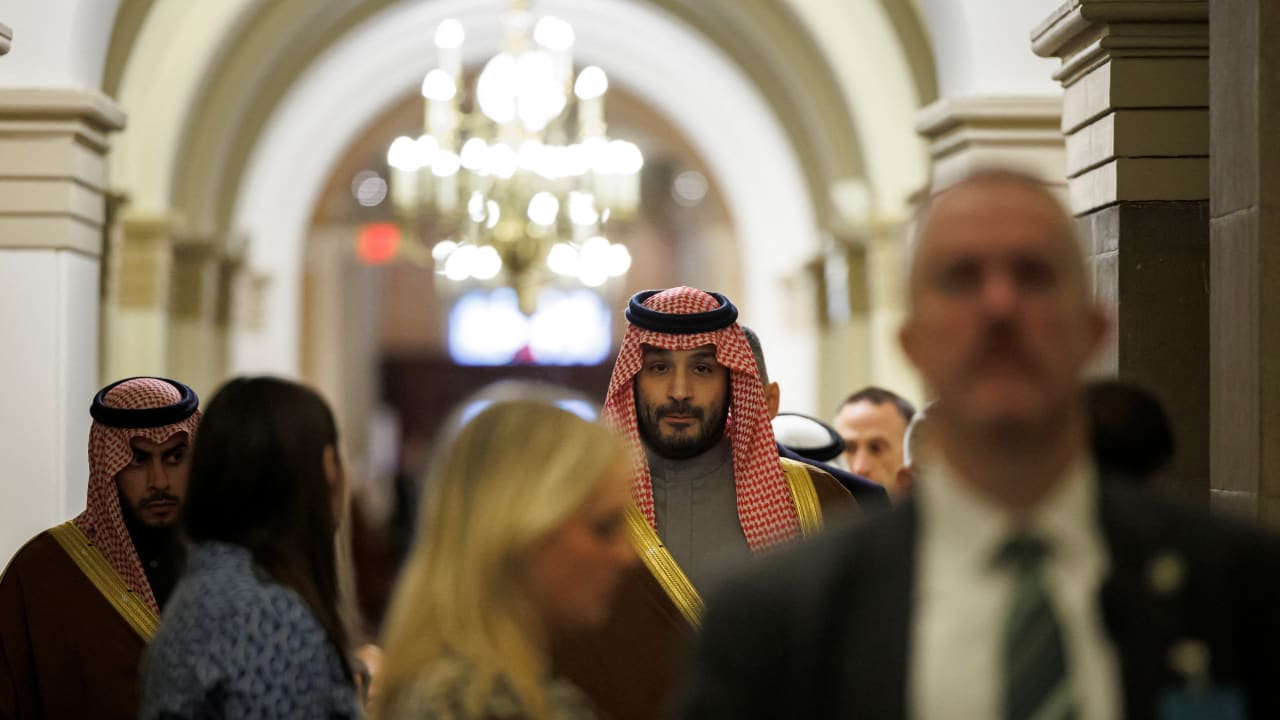
The White House meeting this week between US President Donald Trump and Saudi Crown Prince Mohammed bin Salman (MBS) may prove to be one of the most consequential diplomatic encounters of this era, especially for Israel. Jerusalem was not formally at the table, yet the conversation in Washington was, in many ways, about Israel’s future place in the region.
At the core of this moment lies a renewed US-Saudi alliance. According to reporting from The Jerusalem Post correspondent Amichai Stein, MBS’s visit is “the culmination of years of quiet negotiations between Washington and Riyadh.” The symbolism is unmistakable: Riyadh is signaling that it intends to be a rule-maker, not just a resource supplier.
It wants to sit at the head table on questions of diplomacy, defense, and trade, and it has chosen to do so in coordination with Washington.
MBS, often described as a “fundamentally pragmatic… nationalist,” is in the midst of redefining the Saudi social contract.
His Vision 2030 program is designed to move the kingdom away from exclusive dependence on oil toward a diversified, globally integrated economy. Normalization with Israel is not an isolated gesture in this context. It is one more pillar in a broader strategy to reposition Saudi Arabia as a central player in the emerging Middle Eastern order.

MBS stated at the White House, “We want to be part of the Abraham Accords.” For a Saudi crown prince to say that publicly in Washington is seismic. The Abraham Accords were initially seen as an ambitious but limited framework, a cluster of early adopters willing to break with decades of Arab consensus. Bringing in Saudi Arabia, the Gulf heavyweight and custodian of Islam’s holiest sites, would change their nature entirely.
Saudi-Israeli normalization closer than ever
Why does this moment feel credible, particularly under Trump?
First, Trump’s earlier record on the Abraham Accords shows that he can deliver bold diplomatic architecture when he prioritizes it. Whatever one thinks of his style, his administration demonstrated that entrenched assumptions about Arab-Israeli relations were not carved in stone.
Second, the meeting underscores Saudi Arabia’s willingness to accept a US strategic blueprint that includes Israel, not as a side actor to be managed, but as a partner to be integrated. MBS’s public endorsement of the Accords in Washington is not mere atmospherics.
Third, the defense and trade dimension highlighted in Seth J. Frantzman’s analysis of Saudi Arabia seeking “a strategic reset in a high-stakes US diplomatic mission” is crucial. Discussions about F-35 sales, trade corridors, advanced air defense, and emerging regional security architecture suggest that this is not symbolic diplomacy.
For Israel, Saudi Arabia’s entry into the Abraham Accords would be more than another flag on a joint communique. It would redraw the region’s diplomatic map. A Saudi-Israeli alignment, anchored by explicit US guarantees, could consolidate an informal Gulf-Israel security bloc focused on shared threats, first and foremost Iran’s regional influence and its proxies.
This is where Trump’s particular brand of deal-making becomes both an asset and a test. He has the instincts, relationships, and inclination to pursue a grand bargain. The White House could pair the Saudi-US summit with a concrete roadmap: phased normalization between Saudi Arabia and Israel, backed by US security guarantees, coupled with measurable Israeli engagement on the Palestinian track.
At the same time, Israel must do its own strategic homework. It should move quickly from asking whether Saudi Arabia will join the Abraham Accords to planning for the day after it does. That means designing a serious economic and diplomatic agenda with Riyadh, thinking through how a Saudi agreement can be leveraged to encourage other hesitant states, and preparing the Israeli public for the compromises that may be required.
For Israel, this is a once-in-a-generation opening to move from relative isolation to an embedded partnership with the Arab world’s most influential state.
Ultimately, this moment demands vision, not just tactical maneuvering. The Abraham Accords were never meant to be static; they were a prototype. Saudi Arabia’s entry would transform them from a bold experiment into a governing architecture for the Middle East.
Whether the region is ready to follow, and whether its leaders are prepared to think beyond old paradigms and slogans, will go a long way toward determining what the Middle East looks like in the next decade.