No one should fall off their chair at the fact that the person who asked about a pardon for Netanyahu, outside Trump’s Mar-a-Lago estate, was a man named Yaakov Bardugo.
In the situation Netanyahu has found himself in over recent years, Bardugo is his closest adviser, the fixer, the broker of political and other deals, the man for whom no task is too small.
He flew to Miami with a clear brief: not our national security. Not Iran. Not Gaza, Syria, or Hezbollah either. He is focused on one thing: the pardon. What about the pardon? Because I think even Bardugo knows, meaning it has been explained to him, that the cases against Netanyahu are not collapsing.
The cases are proceeding at an infuriatingly slow pace, but they are closing in on the defendant. Therefore, a pardon is required. Actually, not a pardon. For a pardon, you have to admit and step down. As far as Netanyahu is concerned, the trial must be canceled. At any cost.
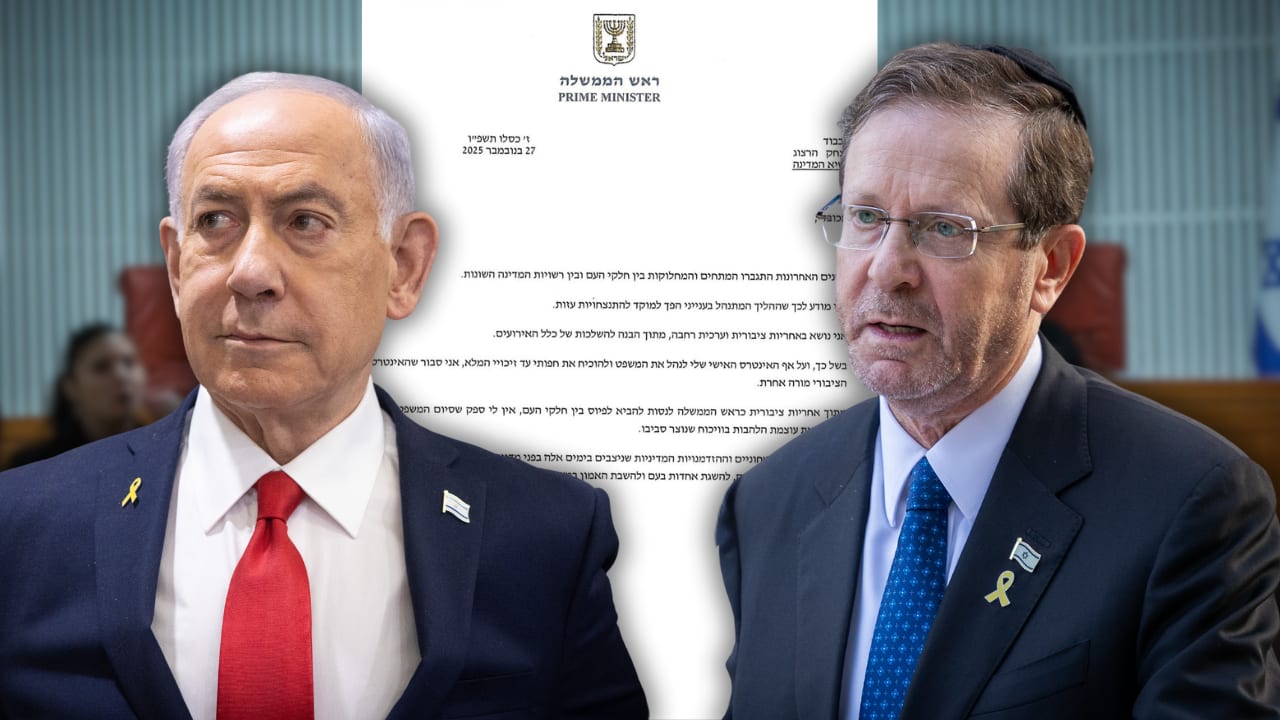
Trump, being Trump, gave a vague answer, seasoned with creative imagination. No, contrary to what he said, he did not speak with President Herzog. After the scene in the Knesset plenum, Trump sent Herzog a letter that was published in full. Since then, they have not spoken. The statement that “the pardon is on its way” is also quite creative, not to say inaccurate.

The request by Netanyahu’s attorneys for a pardon is stuck in the exhausting legal procedural pipeline. Herzog would donate a kidney for it to disappear there. This is not a hot potato; it is an exploding potato, a cluster bomb that robs Herzog of sleep, mainly because he knows he cannot grant it.
Netanyahu’s lawyers are not requesting a pardon; they are requesting the cancellation of the trial, a procedure that does not exist and is not within the president’s authority. Even in the precedent set by Herzog’s father, the Shin Bet chiefs who received a pardon before trial admitted their actions, and the Shin Bet director resigned his post. All the things Netanyahu is not prepared even to consider.
The one who spoke with President Herzog was Jared Kushner. The two held very intensive contacts on the issue of freeing the hostages before the big deal. In that context, on one occasion, Kushner asked Herzog where the pardon matter stands. Herzog gave him a detailed lecture on the procedure. A rather boring lecture.
Afterward, ahead of Netanyahu’s visit, another inquiry arrived from the American embassy, and it too was answered at length. What is the bottom line? There is no bottom line.
I still believe Herzog knows he cannot cancel Netanyahu’s trial. Israel is not a banana republic, not yet. So why did Trump say that “the pardon is on the way”? First, because Trump says whatever he wants, regardless of reality. He also said that all the hostages were released under him and that no hostages were released under President Biden. The trouble is, the first hostage deal was carried out during Biden’s term. Next.
I opened this column with the pardon because it is the most important issue for Benjamin Netanyahu, as his confidant Bardugo testified. But other things were said yesterday at that “press conference” of Trump and Netanyahu, which was in fact Donald Trump’s show, with a sidekick next to him who hardly said a word, apart from a forced smile here and a nod there.
Netanyahu's first win
On the Iranian issue, Trump’s comments are encouraging, and Netanyahu can check this issue off the list. He will give Israel a green light to strike again, and it may be that the Americans will also strike again, and even quickly, if it becomes clear that Iran is returning to the nuclear project.
What about the ballistic missiles? Not clear. But there is no doubt that, of all the issues on the table, on the Iranian file, Israel and the United States are more aligned than on the others. And that is good. Netanyahu received many compliments from Trump yesterday, with subtle jabs sprinkled within. He was called a “hero,” it was said that without him, Israel would have been destroyed, ignoring the fact that under him, Israel indeed almost was destroyed. Those who saved it in the first hours and days after that accursed Saturday were the fighters, the civilians, the standby squads, and also Biden.
President Biden, who hurried here a few days after the massacre with an armada of two aircraft carriers. I know, Biden is passé and it is fashionable to hate him, but in this regard he delivered the goods, and big time. Not when we were on the horse. When we were on the floor.
Alongside the praise, Trump also sent small jabs in Netanyahu’s direction, such as the statement that Bibi is a “tough guy,” and sometimes it is complicated, and “there is no one who knows disagreements better than him.” Trump is generous with compliments, not only to Netanyahu, mainly because there is no tax on them.
He handed Netanyahu quite a few candies yesterday, on the assumption that he will receive his return inside the room, on the issues that matter to him. What will come of all this we will only know later. One must hope that the barter between them will include only national interests, not personal ones. And I know I am naive.
What should Netanyahu be worried about?
On two issues Netanyahu, and we as well, can be worried: Trump’s fondness, not to say love, for Turkey, as emphasized in that bizarre conversation with reporters, and also his positive approach toward Syria and its president, Assad, who is “not a choirboy,” in Trump’s words, but is trying to bring order to his country.
The big unknown remained the Gaza issue. Trump repeated his commitment to disarming Hamas, but that is a declarative, principled commitment. What will be said inside the room, whether the Americans will agree to suspend reconstruction of the Strip until the last Hamasnik turns in his Kalashnikov, is impossible to know. We have to wait and see.
It was depressing to look yesterday at the line of figures sitting on Netanyahu’s side facing the American counterparts. The Israeli delegation numbered nine members. Netanyahu plus eight. Along the entire row there was not a single person of stature relevant to such dramatic contacts with the American administration. Let us review them, from far to near:
Cabinet Secretary Yossi Fuchs. He did not even arrive on the prime minister’s plane, but landed on a commercial flight yesterday. Lightweight. Next to him, the diplomatic adviser Ophir Falk. Nice, but not a significant player. After him, “chief of staff” Tzachi Braverman, about whom enough has been written lately. At least he will not try to “extinguish” this meeting. After him, the ambassador in Washington, Yechiel Leiter. A good man, a bereaved father, a rookie in the field, far from the abilities of a professional ambassador who lives and breathes Washington. After him, Netanyahu.
After him, Gil Reich, acting national security adviser, because there is no national security adviser. Next to him, the next Mossad director, the military secretary Roman Gofman. He does not know a word of English. After him, the businessman Michael Eisenberg, who was added to the delegation at the last minute, his role unclear. Next to him, someone unidentified from the embassy. That is it.
Think of the people who once surrounded Netanyahu, before he went into exile in the realms of messianic madness. Think of the heads of the National Security Council. When he established the NSC in 1999, Netanyahu appointed Maj.-Gen. David Ivry to head it. Head and shoulders above. Prof. Uzi Arad, a former division head in the Mossad, was there once. Giora Eiland. Yaakov Amidror. Yossi Cohen. Meir Ben-Shabbat. Dr. Eyal Hulata. People of stature.
The same goes for chiefs of staff and advisers. The hive that is supposed to surround a prime minister on such a dramatic mission is supposed to contain the foremost forces and minds that the people of Israel have to offer. Well, we are as far from that as we have ever been.
This is not written here as an attempt at political point-scoring. We have enough political point-scoring. The issues on the agenda are so important, so fateful, the boat we are all in together is navigating such stormy waters, that the concern in the face of this event should be shared by all of us, and the prayer that the meeting will nonetheless yield positive results.