On 28 January, US Senator Marco Rubio testified before the Senate: “I don’t think anyone can give you a simple answer as to what happens next in Iran if the supreme leader and the regime were to fall – other than the hope that there would be some ability to have somebody in their systems that you could work toward a similar transition.”
The problem is precisely that hope.
Any transition brokered with figures from inside the Iranian regime would not be a solution; it would be another disaster for Iranians and for Israel. Now that negotiations are ongoing, any agreement would lead to so-called reformers getting a second wind.
The Islamic Republic has killed tens of thousands of its own citizens. During the current uprising alone, more than 36,500 people have been killed, making it the deadliest mass repression of the 21st century.
Internet access has been systematically restricted, leaving only a fraction of Iranians able to circumvent censorship.
From London, I open Instagram each day to messages from followers inside Iran sending me the names of friends, relatives, and neighbours who have been arrested or killed, asking me to pass them on to opposition channels. This has become my daily routine: opening messages and crying.

Reformists have never been the solution
It worsened when I learned that my friend Masoud Hasirchin, the Persian translator of The Case Against Socialism, had been imprisoned.
There is a crucial fact that Western observers consistently forget: The worst violence against Iranian protesters has always occurred under so-called “reformist” governments.
When Hassan Rouhani was president, Western media declared a breakthrough: A Gorbachev had emerged, they said. There was the Joint Comprehensive Plan of Action (JCPOA), renewed diplomatic optimism, and talk of moderation.
Then came Bloody Aban in November 2019. Over the course of just three days, security forces killed around 1,500 protesters, shut down the Internet nationwide, and plunged the country into silence. I was in Iran at the time. Only weeks later did we learn the scale of the massacre.
Soon after came Flight PS752. The Islamic Revolutionary Guard Corps (IRGC) shot down a civilian airliner shortly after take-off, killing all 176 passengers and crew.
And who defended the regime internationally? It was the reformists who defended that terrorist act in Western capitals: Javad Zarif, Hassan Rouhani, and today’s foreign minister, Abbas Araghchi.
Fast forward to today.
Once again, reformists return to office, and once again, Western media indulges the illusion that reform is possible. It is not that reformists lack power. It is that they lack will.
Reformers are not an alternative to the regime; they are its continuation, albeit a fragile one, because they have no legitimacy among the Iranian people.
Unlike European diplomats and Western journalists, Iranians have long since abandoned any faith in internal reform.
During the 2019 protests, people chanted: “Reformists, hardliners – this is the end of the story.” From Mohammad Khatami, who dismissed protests as a Western conspiracy, to Masoud Pezeshkian, who recently declared on X/Twitter that “an insult to the Leader is tantamount to an all-out war.”
On all fundamental issues, reformers share the same values as hardliners; their difference lies in strategy rather than substance, a temporary accommodation in service of a longer-term confrontation.
The political father of the reformists, Hashemi Rafsanjani, was the very figure who translated Akram Zuaytir’s The Story of Palestine and helped make the struggle for Palestine an integral part of the Islamic Revolution’s identity. The architect of the doctrine of perpetual conflict with Israel was also the progenitor of the so-called reform.
The reformists’ biggest achievement has not been for the Iranian people, but the mullahs; they have bought time and resources for a regime whose ambitions remain unchanged.
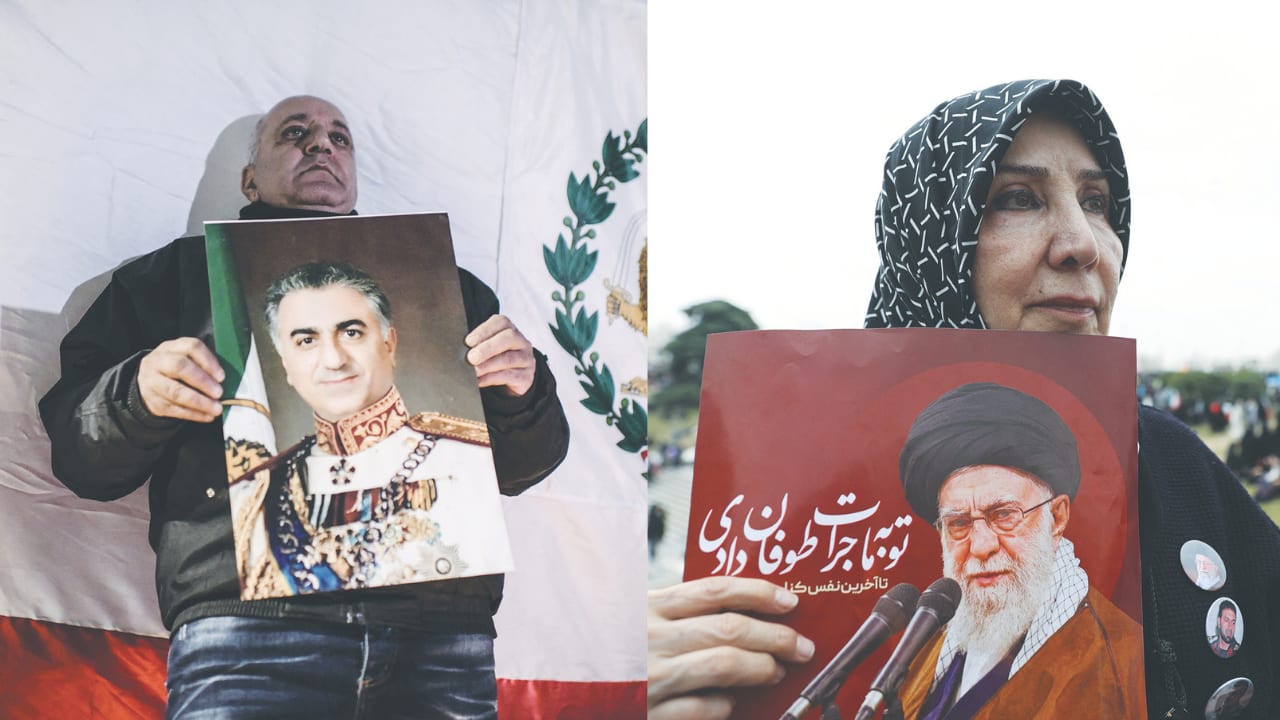
In the current uprising, reformists were not even mentioned. No one believes in them anymore. The political divide is between Khamenei and Pahlavi – not between clerics in robes and clerics in suits laundering blood for the mullahs.
With reformists in power, the regime’s reliance on the IRGC remains intact. Their political survival depends on it. That ensures the continuation of a terrorist organization, which the European Union, finally, has designated as such. Any transition engineered from within the regime would fail because those figures lack legitimacy. What Iran needs is not another illusion of reform but decisive Western support for genuine regime change.
Yet the ghost of Syria still haunts us.
Syria was arguably the West’s greatest strategic faux pas in the last 25 years. When Bashar Al-Assad assumed power in 2000, many hailed him as a reformer. As an ophthalmologist who had studied in London and married a British Syrian lady, many thought his Western education would bring economic and political liberalization to the country.
To some extent, he initially did. Syria opened to new markets which, however, centralized socio-economic power with his loyalists in Damascus. Tony Blair invited Assad and his wife back to London in 2002 for a state visit, the first by a Syrian leader. Assad even met Queen Elizabeth II.
However, all was in vain and when Blair needed support for military intervention in Iraq, and Assad – unlike his father – did not support these measures.
None of what had been discussed for the future of Syria was implemented (similar to the situation with today’s interim ruler). By 2011, a mix of political, economic, sectarian, and social factors fueled a bloody civil war that resulted in the loss of 600,000 lives (10 times more than in Gaza and yet public outcry was minimal).
In 2012, then-US president Barack Obama made his famous red-line comment on Syria, saying that if the regime used chemical weapons, it would trigger a significant US response.
In 2013, chemical weapons were used, and Obama was nowhere to be seen. Instead, he allowed the Russians, with Assad’s backing, to enter Syria and dismantle the weapons. In this process, he showed the world that Syria can do what it wants and gets away with it.
Then, he invited Russia to set up naval bases in Lattakia, a strategic global position. If Trump claims to be everything that Obama was not, he should not repeat the mistake of making empty threats that serve no purpose other than to empower the incumbent and weaken the resolve of many within Iran who are risking their lives for regime change.
Mani Basharzad is an Iranian economic journalist whose work has been published in The New York Post, The Spectator, and National Review. He is an Asia Freedom Fellow at the London School of Economics.
Mike Salem was born in Syria and is now based in the United Kingdom, he works in political advocacy, serves on a council for Christian-Muslim relations, and sits on the board of political educational charities.