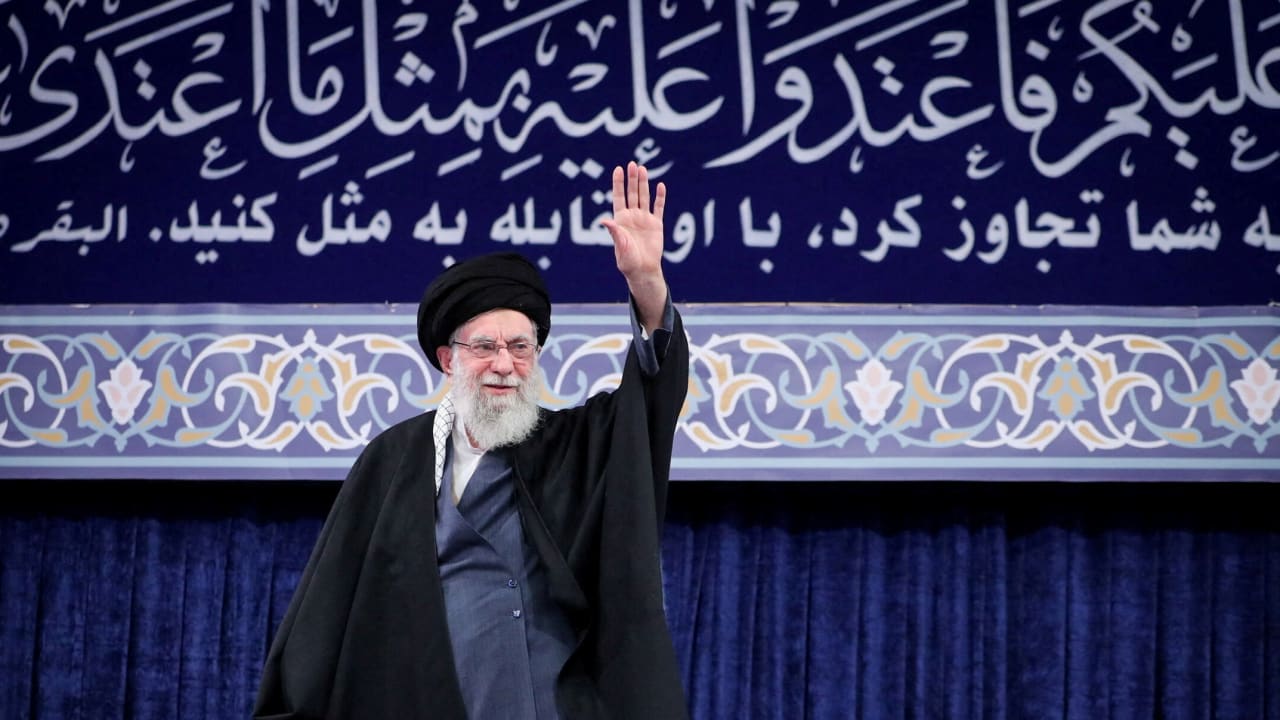
Iran’s Supreme Leader once again threatened the United States, dismissed its military presence in the region, mocked US President Donald Trump personally, and reaffirmed Iran’s refusal to limit either its missile program or its nuclear ambitions, when he spoke to Iranians on Tuesday with an air of confidence unbecoming a leader who knows he is in the final days of his regime – or perhaps because he knows deep down the game is up.
Responding to the deployment of US aircraft carriers to the Middle East and the American military buildup in the region, Khamenei acknowledged their power before issuing a blunt warning. “Of course, a warship is a dangerous piece of military hardware.”
“However,” he stated, “more dangerous than that warship is the weapon that can send that warship to the bottom of the sea.”
This was a direct threat against American forces, issued by the man who ultimately controls Iran’s missile arsenal and regional proxy network.
Khamenei followed this with a personal taunt aimed squarely at Trump. Referring to the former and current presidents’ remarks that the US had not succeeded in “eliminating the Islamic Republic,” Khamenei called it “a good confession,” adding confidently that Trump “will not be able to do this.”

Tehran has watched men move in and out of the Oval Office for nearly five decades and believes it can outlast the current US president, but it should learn that it is dealing with a president like no other, and that the game has changed since his first term.
Khamenei claims 'America is in decline,' while Iran falls into chaos
The supreme leader attempted to showcase Washington’s position as a symptom of decay, stating, “A sign of the decline of the corrupt, oppressive US empire is its irrationality,” citing what he described as American interference in Iran’s internal affairs. Yet this claim sits uneasily alongside Iran’s own behavior, with the massacre of protesters demanding an end to the Islamic Republic, as well as the funding of armed terror groups across the region, the targeting of shipping lanes, the export of drones and missiles, and the orchestration of violence through Hezbollah, Hamas, and other proxies.
On missiles, Khamenei was unapologetic. “They say, ‘Limit your missiles to this range.’ What’s that to do with you?” he asked. “Without deterrent weaponry, a country will be crushed by the enemy.” Iran’s missile program is explicitly offensive, designed to threaten Israel, intimidate Gulf states, and hold US bases at risk. Its range, precision, and deployment are central to Tehran’s regional strategy, and non-negotiable, by its own admission, as talks continue in Geneva.
On the nuclear question, “the fact that nuclear energy is our undeniable right has also been included in the guidelines of the International Atomic Energy Agency,” Khamenei claimed, insisting that “all countries have the right to own nuclear and enrichment installations.” What he did not address – again – is Iran’s record of concealment, obstruction, and deception, nor why a supposedly peaceful program requires enrichment levels, missile delivery systems, and hardened facilities inconsistent with civilian use.
For Israel, none of this is theoretical. Iran’s missiles are aimed at us. Its proxies are armed against us. Its leaders speak openly of our destruction while insisting the world take their assurances on trust. The same regime now threatening US warships is the one that for years has orchestrated attacks from Lebanon, Gaza, Syria, Iraq, and Yemen.
What makes this moment different is the international context. After 47 years, a Republican president in the White House has publicly stated that “regime change in Iran would be the best thing that could happen.” We in Israel need that “best thing” to happen sooner rather than later.
The Islamic Republic is a revolutionary regime whose survival depends on confrontation, whose legitimacy is built on exporting violence, and whose leadership now feels secure enough to threaten the United States directly.
Khamenei has made clear that Iran will not limit its missiles, will not abandon enrichment, and will not retreat from its regional campaign. He has also made clear that he believes Washington lacks the will to act.
For the good of Israel, for the security of American forces, and for a Middle East held hostage by Tehran’s ambitions, the question is: When will the world finally do something about this tyrant by providing a clear response?