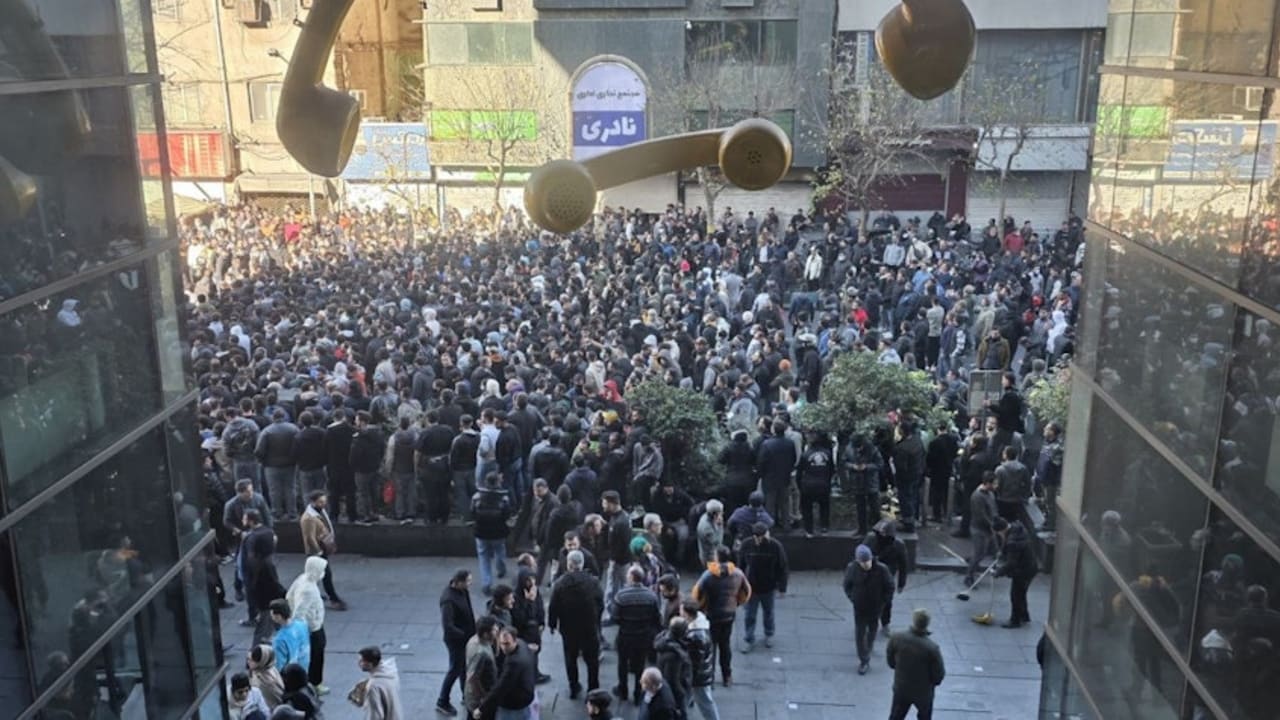
There are degrees of pain. At some point, pain becomes so overwhelming that the mind can only process it as a blinding flash, the moment when atrocity stops being abstract and becomes undeniable.
Images of broken bodies, infants hit with bullets, faces demolished with shotgun pellets, corpses strewn on the floor like wheat after mowing, black and white, flesh and blood flash before your eyes. This is what systematic atrocity looks like when it ceases to be statistics and becomes the lived reality of a nation. It is light versus darkness.
You see mothers dancing over the graves of their children. You see children singing anthems about home, about Iran, over the fresh graves of slain parents, brothers, sisters. You see a child saying, “My life is over. My mom has been killed. I no longer have any life left to live.” You see a flash of light, and the pain turns into flames, leaping to the sky, all-consuming, but calm.
In the bright light coming from the furnace of the pain, you see Iran’s past, present, and future, melted, molded, reshaped. You recognize the mistakes of the past but are no longer bound by them. You see the adversaries of today, but also the ocean of friends embracing you. And you see the narrow path to dawn, a path as narrow as the eye of a needle.
You step into the sea, before it parts. You take a leap of faith. You act beyond certainty about the outcome. Victory and survival have become one. That’s where Iranians are.

Nation being born in Iran
When personal becomes collective and collective becomes personal, the answer is no longer a “trauma response.” In the furnace of industrialized repression and mass killing, a nation has been born in Iran.
Now, to build a state worthy of this young-old nation, many Iranians are looking to the lessons of the Zionist movement and the founding of Israel as one example of how a nation scarred by unimaginable atrocities can build a resilient state.
The first lesson is recognizing the transcendence of Iranian identity beyond all affiliations and labels. I can despise your politics. We can come from backgrounds lightyears apart. But if you are Iranian, whatever your politics, ethnicity, or beliefs, you are my people, and if someone brings harm upon you or yours, they will pay for it. Nationhood does not erase disagreement and differences: It simply reminds us that some bonds must be stronger than all of them.
In June 2024, IDF soldiers rescued four hostages from Nuseirat Camp in Gaza. Videos released by the military show soldiers raiding a grove used by Hamas as a base. The soldiers rush through the trees and reach a building, where the hostages are cowering in a corner.
The traumatized captives are uncertain of the identity of the soldiers. Words and glances are exchanged; words and glances that silently proclaim: “Am Yisrael Chai.” Fear dissipates like fog in the morning sun. One of the hostages bumps fists with the soldiers.
The same degree of peoplehood has been born on the streets of Iran. A protester tells me, “Facing a barrage of bullets, no one gives a damn about your politics, affiliations, or myriad of identities. When you drag an injured protester to safety, when you use your own body to shield them, you don’t ask questions. You have no time for rhetoric or political alignment.
“When you look death in the eye, the noise subsides. You are Iranian, and that’s reason enough for me to fight for you, to die for you. On the battlefield, you only care about finishing the job.”
The second lesson is a burden for the diaspora, especially at the leadership level. It starts with recognizing that conflict is not abuse, that unity is not the absence of discord. Mature nations argue fiercely, but they do not allow those arguments to destroy the possibility of a shared future.
In the diaspora, the threat is not physically present, and the collective pain is not as immediate. Here, the stakes are high, maybe even higher, since we are struggling to convince the world that the opposition represents a viable solution to the world’s decades-old Iran problem. However, unlike our compatriots in Iran, our lives are not on the line. This dual reality requires us to slow down and speed up at the same time.
We need to rush toward building bridges and seeking points of agreement, while slowing down our campaigns to secure votes in referendums and elections yet to come. But at the same time, both we and our allies need to accept the universal reality of politicking. It is messy until it is not – and even then, it is a mess.
The titans who laid the foundations of Israeli democracy were not above engaging in petty fights, holding grudges for decades, and smearing rivals. An example in point is the Altalena Affair. This violent confrontation unfolded in June 1948, a month after the establishment of the Jewish state and during the murky process of absorbing all Jewish military organizations into the newly founded IDF.
While the State of Israel was still fighting hostile Arab armies, a ship was bringing in much-needed weapons to a coastal village north of Tel Aviv. The boat was the Altalena, manned by the Irgun, a Jewish paramilitary force led by future prime minister Menachem Begin.
Israel's first prime minister, David Ben-Gurion, saw Begin’s militia as a threat to the new Israeli government – a threat that, if armed further, could trigger civil war. Ben-Gurion ordered the ship to be torched. A gunfight ensued. Nineteen Jews were killed, 16 from Irgun and three from the IDF.
The lesson was brutal but necessary: a state cannot survive if rival factions place their own power above the survival of the nation itself.
The tragedy did not lead to an extended armed conflict since the Zionist leaders at least tried to bury the hatchet.
Their bitterness and rivalry cast a shadow over the early decades of Israel’s history. However, their commitment to preserving the Jewish state at any cost overrode their bitterness. Begin later said, “My greatest accomplishment was not retaliating and causing civil war.”
Iran is perched on the precipice of seismic changes. Our actions cannot be driven by bitterness about the past or delusions about the future. The regime has killed tens of thousands of innocent Iranians since the beginning of what many Iranians now call the Lion and Sun Revolution in late December. The accumulated number of lives crushed by the Islamic Republic over the past two decades is at least ten times higher. But the United States and Israel have finally provided us with a chance in many generations to liberate Iran, to reclaim our motherland.
History rarely offers nations a second chance to reclaim themselves. Iran has been pushed into the furnace of atrocity, but from that furnace something unmistakable has emerged: a people who once more recognize one another. If we fail to build a future worthy of that recognition, the loss will not belong to one faction or one generation. It will belong to our Iran – the Iran we failed to build.
The writer is director of research at the National Union for Democracy in Iran (NUFDI) a nonprofit, non-partisan organization representing the Iranian-American community.