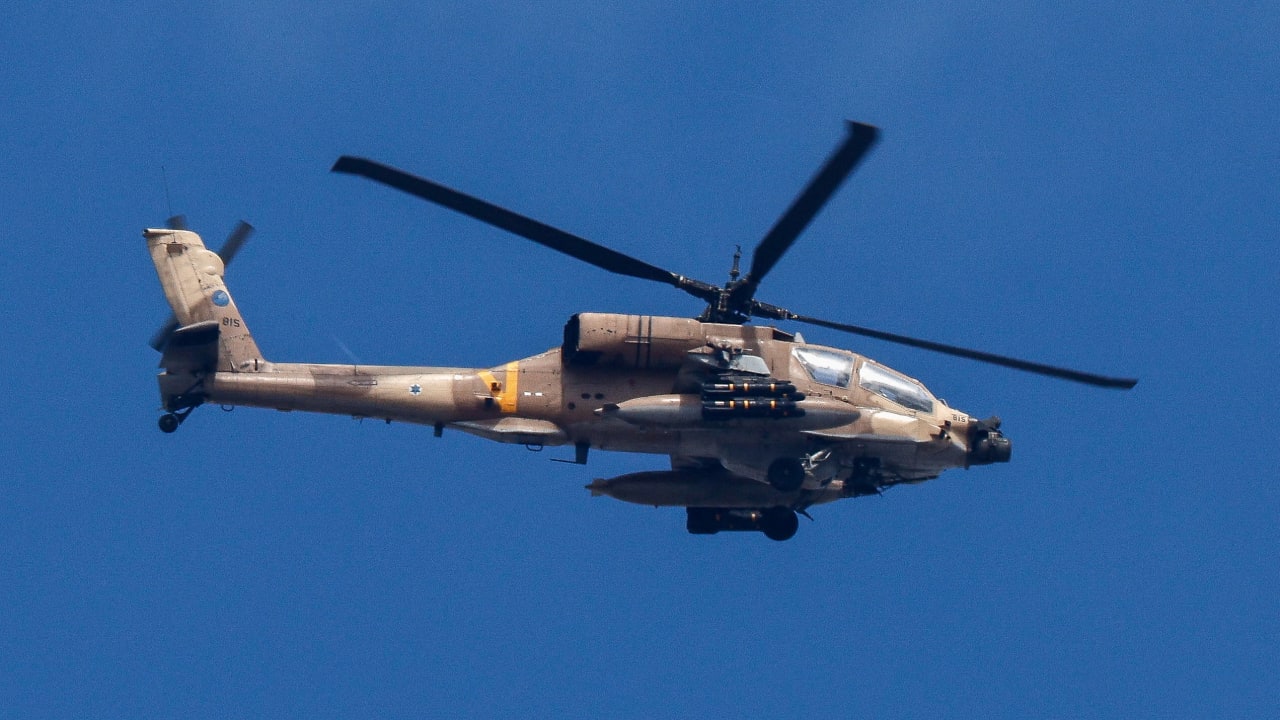
Eyeing developments in the bilateral relationship with the United States, Israel may want to fly solo. But its purchase of American attack helicopters demonstrates that it is not ready to fly alone.
Israel’s Defense Ministry announced an agreement with Washington on October 14 to procure 12 AH-64E Apache attack helicopters. The agreement is an important step toward modernizing Israel’s military after the deal stalled over funding issues within the Israeli government.
For the sake of shared US-Israeli interests, Congress must act to ensure a delay in funds does not prevent Israel from being as militarily capable as possible.
While the signing should secure a place in the delivery queue, Israeli and American leaders must acknowledge the funding challenge, which reflects Israel’s need for high defense spending amid continued threats and competing budget priorities.
These issues could intensify once US military aid declines, or potentially ends after 2026, as US President Donald Trump indicated on November 3. A militarily capable Israel remains important to Washington’s security objectives in the Middle East.

Under the 2016 US-Israel memorandum of understanding (MOU), America pledged to provide Israel $3.3 billion per year in Foreign Military Financing (FMF), with almost all being spent in America through FY 2028, as well as $500 million annually for cooperative missile defense.
The two governments began discussions in June on a new agreement that would phase out US military assistance.
Although Trump declared on November 3 an end to the military aid after this year, he added, “We’ll help Israel if they need it,” and said Israel could continue buying American weapons. The two governments should prioritize maintaining Jerusalem’s ability to purchase critical defense equipment.
American systems, such as the F-35, F-15, and KC-46, have helped Israel fight Iran and its proxies. The latest Apache model, compared to the A and D models, provides better aircraft performance and interoperability and improved capabilities against drones. The longer-range radar and enhanced sensors will similarly strengthen Israel’s capacity to address regional threats.
The US Department of State approved the sale of up to 30 Apache AH-64E attack helicopters to Israel in January, along with related equipment, logistics support, and munition launchers. The deal was estimated at $3.8 billion, with the Federal Register listing FMF as the source of funding.
The AH-64E can conduct armed reconnaissance, strike, and close air support missions.
The helicopters are expected to be delivered in the 2030s, and once deployed, can replace and augment the Israeli Air Force’s AH-64A Peten and AH-64D Saraf, which have operated since 1990 and 2005, respectively. The acquisition is a “critical step” in force buildup, according to Defense Minister Israel Katz.
Beginning in 2005, the IAF reduced its attack-helicopter fleet, disbanding one AH-1 Cobra squadron that year and retiring its remaining 33 Cobras in 2013. The latter decision reflected budget constraints, maintenance costs, and the growing use of less-expensive drones.
With its remaining Apache fleet aging, Israel now faces the challenge of maintaining and modernizing its attack-helicopter capabilities.
Israel has over 40 older Apaches and has upgraded some of the AH-64As. The IAF’s AH-64Ds are built with Longbow radars that can function under poor visibility with less ground interference. Jerusalem also outfitted its AH-64Ds with Israeli technology, including satellite communication systems, missile warning receivers and countermeasures, and radar-jamming equipment.
Despite these upgrades, the latest AH-64E still offers improved capabilities.
Plans for the future
The US Army has employed AH-64Es extensively, including in combat operations in Afghanistan, Iraq, and during the Iran conflict, with some AH-64s patrolling the Strait of Hormuz. Compared to older models, the AH-64E has improved radar, increased speed, and greater payload capacity.
The latest variant can also maintain higher altitudes with a full payload and remain on station longer than earlier models. The Version 6 upgrade has additional improvements in countering small and large unmanned aerial systems (UAS).
Israel has used its Apaches against Hamas in Gaza and Hezbollah in Lebanon, to support operations against Palestinian militants in the West Bank, and to intercept Iranian drone attacks. Israeli Apaches responded to Hamas's terror attack on October 7, 2023.
During the fighting, they supported UH-60 Black Hawks carrying Israeli special forces and engaged Hamas forces, according to pilot interviews. Footage that emerged after the attack appears to show Israel’s AH-64s using 30 mm chain guns and air-to-ground missiles against Hamas.
Following October 7, the IAF has sought to improve how it employs its attack helicopters, with particular emphasis on rapid response. An immediate change was to keep more units on standby, as Israel was operating at reduced numbers on October 7 due to a holiday, and the primary focus was on the northern border.
Israel reportedly sought the AH-64E after abandoning a plan to fully replace the AH-64As with UAS. While Israeli unmanned aircraft performed well in the 2025 and 2026 conflicts with Iran, the AH-64s have downed enemy drones that bypassed other defenses.
Despite initially purchasing only 12 of the 30 AH-64Es the US approved for sale, Israel struggled to finalize the deal. After requesting multiple extensions, Jerusalem ultimately cut funds from elsewhere in the national budget to finance the purchase, possibly replacing or augmenting the intended FMF with Israeli national funds.
If the US follows through on ending FMF at the end of the year, Israel may struggle to finance future arms purchases. Jerusalem’s defense budget has already planned for approximately $25 billion in FMF funding for the 10-year period starting in FY 2029.
Israel is America’s most capable partner in the Middle East, and FMF has helped make that true. The Pentagon’s 2026 National Defense Strategy labeled Israel a “model ally” for its ability to confront Iran and its proxies.
With Jerusalem already diverting funds from other budget priorities to finance defense acquisitions, an abrupt end to US aid could force Israel to delay or scale back future purchases, potentially weakening its military capabilities.
Accordingly, Congress should appropriate the annual funds next fiscal year consistent with the MOU. It should also enact legislation requiring the administration to certify that any proposed termination or reduction of FMF would serve US national security interests and not undermine Israel’s ability to advance those interests.
Israel’s purchase of 12 AH-64Es represents an important step toward modernizing its attack-helicopter fleet, but the funding difficulties surrounding the agreement highlight the broader challenge for US-Israeli defense cooperation.
The two countries should work to address these obstacles as Israel considers acquiring the remaining 18 helicopters approved for sale and plans for future defense procurement.
The writer is a senior research analyst at the Center on Military and Political Power (CMPP) at the Foundation for Defense of Democracies (FDD).