NASA
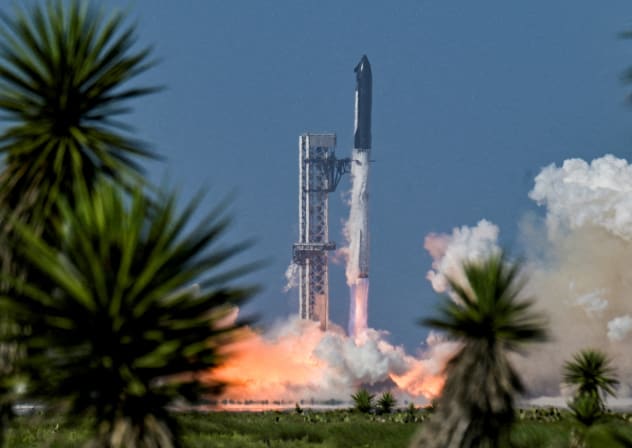
SpaceX's Starship engine failure could cause problem for NASA's 2028 moon mission objectives
A longer delay would pose not only a greater setback to SpaceX's commercial ambitions to rapidly expand its Starlink broadband satellite network, but its pivotal role in NASA's Artemis moon program.

US, China arm for space warfare, raising stakes in race for military control of orbit

NASA launches powerful Roman Space Telescope, a spy satellite turned to the stars

NASA finds some microbes could survive on moon, raising concerns over unintended life transfer
Israeli hospital to join NASA, SpaceX mission to study microgravity’s effects on diseases
For this experiment, Sheba will partner with the US firm SpaceTango to grow several bacterial species aboard the ISS using a specially designed Earth-controlled system.

NASA repairs Juno space probe camera from 600 million kilometers away
Jupiter and Earth were near their closest all year, but it still took over half an hour for a signal to go from Earth to the probe or vice-versa.

Asteroid the size of 145 Elmos to fly past Earth on Tuesday, July 15 - NASA
Asteroid 2025 MA90 is set to fly past the Earth on Tuesday, July 15. With an estimated diameter of 88.8 meters, that comes out to around 145 Elmos, thanks to measurements taken by Drew Brees.

Two asteroids the size of 32 George Washingtons to pass Earth on Fourth of July - NASA
Americans will use anything but the metric system. So let's put that to its most logical conclusion and measure asteroids with the first US president: George Washington.

Netflix to stream live NASA launches and missions
NASA hopes the partnership will help bring excitement to space exploration through live streams of launches and astronaut activities.

Asteroid 2024 YR4 could hit the Moon in 2032 with a 4.3% chance
NASA says even if it hits, the Moon's orbit will remain unchanged.

Jewish entrepreneur Jared Isaacman won’t helm NASA after Trump yanks nomination
Donald Trump has withdrawn his nomination of Jared Isaacman, a Jewish entrepreneur who has traveled privately to space himself, to helm NASA.

Asteroid the size of 12.5 gorillas to pass Earth Wednesday in close flyby - NASA
Asteroid 2025 KF is set fly very close to the Earth this Wednesday, according to NASA. Its size is comparable to 12 and a half fully grown gorillas.
NASA's advanced telescope embarks on a two-year mission to map the universe
During the mission, the scientific team is expected to investigate the early stages of the universe’s expansion and search for frozen molecules that may indicate life in other planetary systems.

Aging with dignity: The telescope that changed space exploration celebrates 35 years
The Hubble Telescope, 35 years of groundbreaking discoveries, continues to surprise despite glitches, retirement risk, and replacements, remaining at the forefront of space research.
