
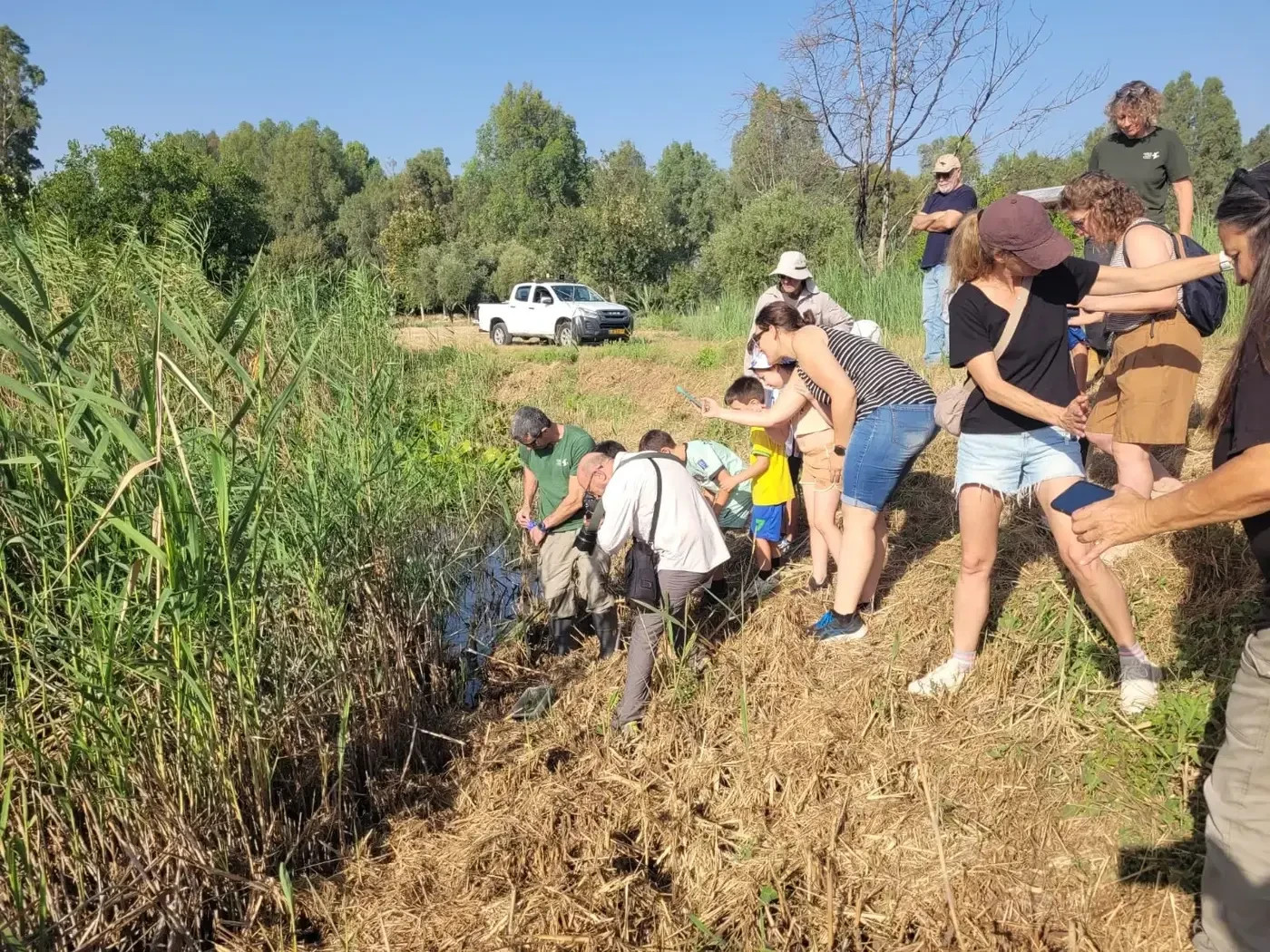
Returning to the North: Early on Tuesday morning, more than 250 Hula painted frogs, an endangered species, were released into the Hula Nature Reserve from a breeding nucleus at the Biblical Zoo. Approximately 250 tadpoles, 18 one-year-old frogs, and 12 individuals that have not yet completed their metamorphosis process were released into the reserve. The frogs and tadpoles will join hundreds of individuals already living in the reserve, and the Nature and Parks Authority hopes to return additional individuals to the wild in the future and establish further populations inside and outside the reserve.
In 2011, Yoram Malka, a veteran ranger at the Hula Nature Reserve, found an individual Hula painted frog, a species that until that day had been considered extinct for decades and was even declared extinct worldwide in 1996 by the International Union for Conservation of Nature (IUCN). The Hula painted frog had almost vanished from the landscape, with its main causes of extinction being the draining of the Hula Lake and the destruction of its habitats. The discovery at the time was joyful and generated great excitement.
The species, whose name in Hebrew derives from the structure of its short, round tongue that does not extend from its mouth and its black belly, was transferred to a breeding nucleus. Over time, two breeding nuclei were established: One at the Hula Nature Reserve and the second at the Biblical Zoo in Jerusalem. For research purposes, the Nature and Parks Authority built dedicated habitats for the species in an enclosed compound, and an additional site was allocated where the frogs could grow without human interference. "At the site adjacent to the reserve, about 250 to 300 individuals live in the wild," Malka explained. "We hope that the frogs released today will add to the population, and in the coming years we will see more and more individuals."
Incredible breeding success
At the Biblical Zoo in Jerusalem, staff members said that over the past three years since the frogs arrived, the zoo team created a sort of laboratory for raising them to determine their preferred living conditions, ranging from temperature levels and vegetation to the size of grasshoppers they like to eat. When they first arrived, much was unknown. Teams did not know what size their eggs were, whether they had eggs at all, or even how to tell males and females apart. Gradually, through daily work and facing quite a few challenges along the way, fascinating details about the species were revealed, and the successful results led to incredible breeding.
Following the discoveries and hard work, the zoo managed to raise more than 500 individuals, all born at the Jerusalem zoo. On Tuesday, as noted, the Jerusalemites made their journey back home to the North. Ariel Kedem, nature conservation coordinator at the zoo who was responsible for caring for the frogs, said: "It was a great challenge and a pure pleasure to see how we uncovered layer after layer of the frogs' behavior, leading to the long-awaited and successful result of establishing a functioning breeding nucleus. This year, for the first time, we are not taking frogs from nature but returning them to nature and to a new location, hoping to establish a new local group."
The Nature and Parks Authority invites the public to visit the Hula Nature Reserve and enjoy the sights of flora and fauna, but notes that the chance of spotting one of the unique Hula painted frogs is very low. "The Hula painted frogs are active mainly at night and like to hide, so it is very difficult to find them, especially during the daytime when the reserve is open to the public," noted Ido Shaked, manager of the Hula Nature Reserve. "Nevertheless, once every few years, visitors report to us that they managed to spot an individual. Perhaps you will be the next lucky ones to see the elusive frog."