Jacob’s Well in Haran is not only a place of deep Torah meaning; it is also an important tourist destination for Jewish travelers
This week’s Torah portion tells the story of Jacob and Rachel’s meeting. It is written: “Then Jacob went on his journey and came into the land of the people of the east. And he looked and behold a well in the field” (Genesis 29:1).
This biblical story may seem imaginary to us, but it can become very real and tangible, because we too can visit this very well today. At least I did. It lies in Haran, in southeastern Turkey, and the locals call it “Yakup Kuyusu” (Jacob’s Well).
I have traveled a good deal in my life, and I find that Haran is different. You arrive expecting dust and find, instead, a silence that seems to have been waiting for you for 3,000 years.
Besides this well, love flared at first sight between our patriarch Jacob and Rachel. “And when Jacob saw Rachel, the daughter of Laban his mother’s brother, Jacob kissed Rachel, and lifted up his voice and wept” (29:11).
Consider that. A man who had traveled alone across the desert, carrying nothing but his fear and his father’s blessing, sees a young woman with her sheep and weeps openly. There is no irony in the verse, no hesitation, only a heart that has been opened all at once.
Jewish traditions related to Jacob's Well
Over the past few centuries, on Tu B’Av, the holiday of love, Jews from nearby Urfa and Izmir, from Constantinople (today Istanbul), and even from northern Iraq, used to gather at Jacob’s Well for large family picnics.
These outings also provided an opportunity for young men and women to meet, while their mothers discreetly explored potential marriage matches.
The custom faded as the Jewish communities of Haran dwindled after most of their families made aliyah to the Land of Israel. In recent years, Rabbi Mendy Chitrik, the Chabad emissary in Istanbul, has tried to revive this beautiful tradition.
The well is also mentioned in a volume of responsa (Shu”t) written by Rabbi Chaim Palaggi, chief rabbi of Izmir, more than two centuries ago. A father asks for a segula, a spiritual remedy, to help his daughters find husbands.
In his letter, the father mentions that he had taken his daughters to drink from the waters of “Jacob’s Well” in Haran. From this we understand that the place was a center of prayer for those whose matches were delayed, much as people today pray at the Tomb of Yonatan ben Uziel in Amuka (near Safed).
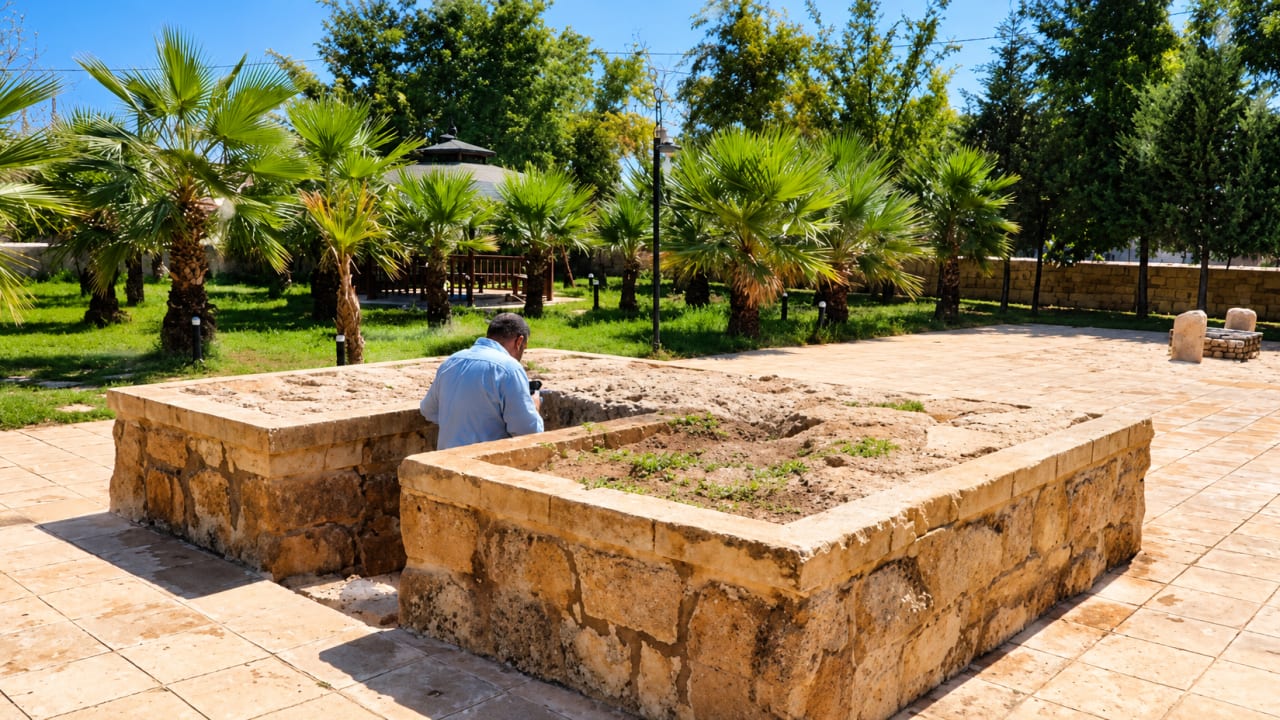
The well has survived through the centuries partly because Muslims also hold it sacred. Since the ground has been covered by centuries of soil, a structure stands above it.
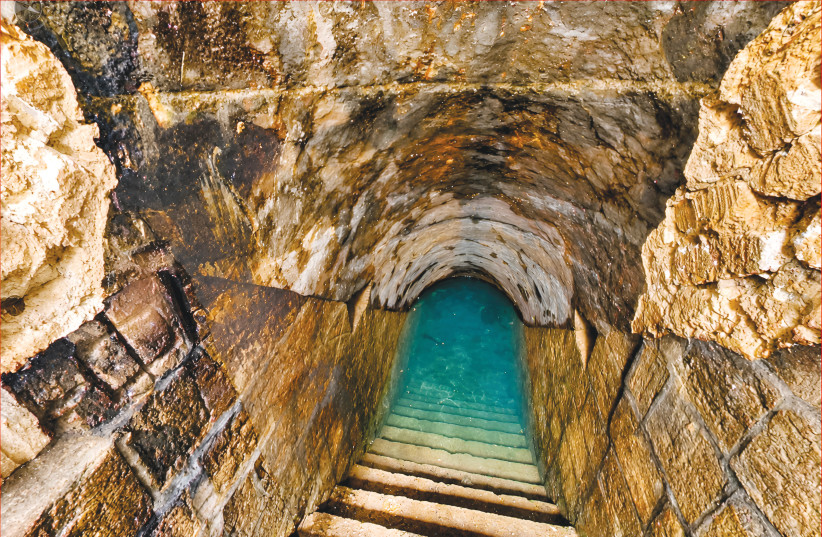
The builders constructed a stone structure over and around the well to preserve the original. Most of it lies beneath the surface. Only about half a meter of the upper walls and roof rises above the ground.
The roof has an opening covered with iron bars, directly above the well, and a flight of stone steps descends from the roof to the water below.
How time has changed Jacob's Well
IN THE past, a large stone covered the well’s mouth, and several strong men were needed to roll it aside. The Torah tells us: “A great stone was upon the well’s mouth. And thither were all the flocks gathered: and they rolled the stone from the well’s mouth, and watered the sheep” (29:3).
Then Rachel arrives, with her father’s flock. “And when Jacob saw Rachel the daughter of Laban his mother’s brother, Jacob went near, and rolled the stone from the well’s mouth, and watered the flock of Laban” (29:10).
Think about the timing. Jacob has come a long way, and he finds the one person who matters at the very moment she arrives. Had Rachel come an hour late or an hour early, she would have missed him, and perhaps the whole course of human history would have been different.
I sat by this well and tried to imagine it: the dust in the light, the bleating of the sheep, the young shepherdess lifting her head at the sound of a stranger’s footsteps.
The meeting seems almost arranged by the hand of God, and I found myself wondering whether we ever truly choose the moment that changes our lives, or whether it chooses us.
Around the old well there are other wells at ground level, their “mouths” closed by round stones that look like great stone balls, plugging the openings like corks.
Till today, shepherds still come to water their flocks, exactly as the Torah describes. At the Abraham Monastery in Haran, we can see a similar stone considered by many to be the original stone that once covered Jacob’s well.
Turkey invited travel writers to grand reopening
The Turkish Tourism Ministry and the Haran municipality recognized this biblical attraction’s potential and recently renovated the site. Today the well and its structure sit inside a beautiful, well-kept public garden.
For the reopening, the authorities invited travel writers from around the world, and I was among them.
The local people have kept this place alive because they believe in the special powers of its water. They call it “Hastalıklara şifa olan kuyunun” (The well that heals illnesses).
The mayor of Haran, Mahmut Özyavuz, hosted our delegation and told us: “About two months ago, a woman came with a sick child. I went down into the well with the little boy and poured its water over him, from the soles of his feet to the top of his head.
“They left, and a week later they came back to thank me, because their son was completely healed.” The mayor himself went down, filled a cup with the water, and offered it to me to drink.
There are two ways to look at this place. With physical eyes, you see only a small, plain place, nothing more. It cannot be compared to the Colosseum in Rome or the Eiffel Tower in Paris.
But when you look with spiritual eyes, the place grows enormous. You feel that you’re standing on the very ground where our patriarch Jacob and our matriarch Rachel once walked.
I imagine Rachel arriving here with her father’s sheep. And then, the small structure takes on dimensions and value no less than the pyramids of Egypt.
The cool water I drank a moment earlier seemed to carry a spiritual force louder than Niagara Falls. Measured by its spiritual meaning, this site holds an experiential power equal to the Western Wall and the Cave of the Patriarchs combined.
Jacob’s Well can certainly strengthen our bond with the Torah. It touches the soul.
Souvenirs that tell Torah stories
OUTSIDE THE compound gate, across the road, there are cafés and souvenir shops. At one of the stalls, I bought a few small clay jugs and a camel carved from olive wood.
Since then, they have stood with dignity on the sideboard in my living room. With them, I tell my children and grandchildren the biblical stories about the water jars from which Rachel and Rebecca gave drink to Jacob and to Eliezer’s camels.
The children are thrilled to hear that these toys came from the very place mentioned in the Torah.
If relations between Israel and Turkey warm again, Israelis may once more come to relax in Antalya. If you are among them, set aside a day for Jacob’s Well. It suits lovers of the Torah.
I recommend bringing a Bible or Chumash, and reading the relevant verses aloud beside the well. This could be one of the most memorable experiences of your children’s lives.
I left Haran as the light was going gold over the wall, and I carried the little clay jugs back to the car as carefully as if they were full of water.
Somewhere between the well and the road, I understood that I had not come here only to see a stone and a hole in the ground.
I had come to stand where a young woman lifted her eyes from the well and found the man who would change her life, and where, 3,000 years later, a stranger from the other side of the world could still feel his heart rise to his throat.
Love does not keep records of its beginnings. It simply begins quietly, at a well in the field, and waits for us to notice.
Perhaps that is the real pilgrimage: not to the stone, but to the moment when we finally look up and see who has come to the water.
The author is the creator of the JewishTraveler blog.