The mood is dark in the IDF's General Staff ahead of next week's "peace" conference in Annapolis. As one senior officer directly involved in the negotiations with the Palestinians and the Americans said, "As bad as it might look from the outside, the truth is 10 times worse. This is a nightmare. The Americans have never been so hostile."
On Thursday a draft of the joint statement that Israeli and Palestinian negotiators are discussing ahead of the conference was leaked to the media. A reading of the document bears out the IDF's concerns.
The draft document shows that the Palestinians and the Israelis differ not only on every issue, but differ on the purpose of the document. It also shows that the US firmly backs the Palestinians against Israel.
As the draft document makes clear, Israel is trying to avoid committing itself to anything at Annapolis. For their part, the Palestinians are trying to force Israel's hand by tying it to diplomatic formulas that presuppose an Israeli withdrawal to the 1949 armistice lines and an Israeli acceptance of the so-called "right of return" or free immigration of foreign Arabs to Israel.
The Palestinians are also trying to take away Israel's right to determine for itself whether to trust the Palestinians and continue making diplomatic and security concessions or not by making it the responsibility of outside parties to decide the pace of the concessions and whether or not the Palestinians should be trusted.
As the leaked draft document shows, the Americans have sided with the Palestinians against Israel. Specifically, the Americans have taken for themselves the sole right to judge whether or not the Palestinians and the Israelis are abiding by their commitments and whether and at what pace the negotiations will proceed.
But the Americans have shown themselves to be unworthy of Israel's trust. By refusing to acknowledge Palestinian Authority President Mahmoud Abbas's Fatah party's direct involvement in terrorism and indeed the direct involvement of his official Fatah "security forces" in terrorism, the Americans have shown that their benchmarks for Palestinian compliance with their commitments to Israel are not necessarily based on the reality on the ground. Then too, the US demands for wide-ranging Israeli security concessions to the Palestinians even before the "peace" conference at Annapolis have shown that Israel's security is of little concern to the State Department.
IDF sources blame the shooting murder of Ido Zoldan on Monday night by Fatah terrorists on Israel's decision to bow to Secretary of State Condoleezza Rice's demand to take down 24 security roadblocks in Judea and Samaria. If it hadn't been for US pressure, they say, it is quite possible that the 29-year-old father of two small children would be alive today.

But this is of no concern for Washington. As Rice has made clear repeatedly, the US wants to see "signs of progress." Since the Palestinians are taking no action against terror and doing nothing to lessen their society's jihadist fervor, the only way to achieve "signs of progress" is by forcing Israel to make concessions to the Palestinians. And so that is exactly what Rice and her associates are doing.
Rice is able to force Israel to accept her demands because she faces the weakest Israeli leaders the country has ever produced. Prime Minister Ehud Olmert, Foreign Minister Tzipi Livni and Defense Minister Ehud Barak are all incapable of standing up to the Americans or even arguing with them. Olmert's and Livni's weakness has been apparent since their mishandling of the war with Hizbullah last summer and their negotiations over the cease-ire agreement with Rice. For his part, throughout his brief and disastrous tenure as prime minister, Barak behaved as though he were then president Bill Clinton's employee.

BUT IF Olmert's, Livni's and Barak's willingness to compromise their nation's security is a function of their weakness, what explains Rice's and Bush's behavior? Why are they weakening Israel and pushing for the establishment of yet another Middle Eastern terror state? What US interest do they think they are advancing by acting as they are? Over the past several weeks, a number of theories have been raised to explain their behavior. The most frequent explanation is that Rice and Bush are championing Palestinian statehood at Israel's expense in a bid to mobilize a coalition of Sunni Arab states to cooperate with the US against Iran.
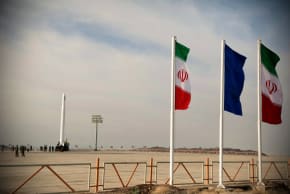
According to this theory, if Annapolis is seen as a success, then the Arab states will be convinced that the US is worth supporting on Iran. This theory has several flaws. First, as the US's treatment of Israel makes clear, success in Annapolis involves weakening Israel whose destruction Iran seeks and empowering the Palestinians whom Iran supports. This means that far from weakening Iran, success at Annapolis advances Iran's interests.
But beyond that, whether wittingly or unwittingly, by convening the conference next week, the Bush administration has directly empowered Iran. Today the determination of whether the administration emerges unscathed or humiliated from Annapolis is entirely in Iran's hands. Iran will decide whether the conference opens and closes peacefully or whether it is convened as Lebanon is submerged in civil war by Iran's proxies Syria and Hizbullah.
According to the Lebanese constitution, Saturday is the last day on which a new Lebanese president can be elected. Lebanon's president must be elected by two-thirds of the members of Lebanon's parliament. Through their campaign of assassination, Syria and Hizbullah have taken away the two-thirds majority that anti-Syrian forces won in the 2005 elections. As a result, Hizbullah has veto power over the election. And so far, Iran and Syria have refused to allow Hizbullah to back any candidate. This is the case despite the anti-Syrian majority's willingness to support a pro-Syrian presidential candidate.
Due to the Iranian-Syrian induced impasse, today there are two possible scenarios for what may happen in the next few days in Lebanon. Either Iran and Syria will allow elections to take place and an agent of their regimes and Hizbullah will take over the presidency, or elections will not take place and two governments - one anti-Syrian under Prime Minister Fuad Siniora and one pro-Syrian - will be formed. The pro-Syrian government will be supported by Hizbullah and the Lebanese army. The anti-Syrian government will be supported by Christian, Sunni and Druse militias. A civil war will ensue. Syria, Hizbullah and Iran will win.