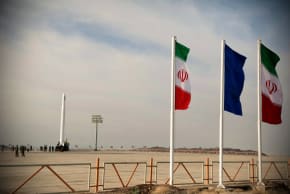
Iran is just a heartbeat away from the A-bomb.Last Friday the Daily Telegraph reported Teheran has surreptitiously removed a sufficient amount of uranium from its nuclear production facility in Isfahan to produce six nuclear bombs. Given Iran's already acknowledged uranium enrichment capabilities, the Telegraph's report indicates that the Islamic Republic is now in the late stages of assembling nuclear bombs.
It would be a simple matter for Iran to assemble those bombs without anyone noticing. US spy satellites recently discovered what the US believes are covert nuclear facilities in Iran. The mullocracy has not disclosed these sites to the UN's International Atomic Energy Agency, which is charged with inspecting Iran's nuclear sites.
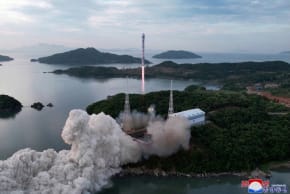
As to the IAEA, this week it presented its latest report on Teheran's nuclear program to its board members in Vienna. The IAEA's report claimed that Iran has taken steps to enable its Shihab-3 ballistic missiles to carry nuclear warheads. With their range of 1,300 kilometers, Shihab-3 missiles are capable of reaching Israel and other countries throughout the region.
In support of its swiftly progressing nuclear program, Iran has escalated both its conventional military and terroristic adventurism. It has also ratcheted up its diplomatic assault on the US. This week, Teheran conducted a countrywide air defense exercise. Gen. Khatim al-Anbiaa, the commander of Iran's Air Defense Corps, explained that the exercise was aimed at defending against both electronic jamming systems and actual bombing strikes.

Also this week, Yahya Rahim Safavi, the former commander of the Revolutionary Guards Corps and current senior adviser to Supreme Leader Ayatollah Ali Khamenei for security affairs, announced that Iran has shifted responsibility for naval warfare on the Persian Gulf from its regular naval forces to its more fanatical Revolutionary Guards. The Iranian navy will now be deployed only in the Gulf of Oman and along the Caspian Sea.

The deployment of the Guards along the Persian Gulf means that the force will be responsible for naval operations in the narrow Strait of Hormuz, through which 40 percent of global oil shipments travel. Issuing Iran's most explicit threat to US naval forces in the area and global oil shipments to date, Safavi declared, "The entire Strait of Hormuz is under the tight control of the Iranian security forces, which are ready to defend Iran against any threat."
As for terror, al-Qaida boss Ayman Zawahiri's recent tirade against the Islamic Republic notwithstanding, Iran has apparently intensified its cooperation with al-Qaida. Over the past two weeks, Israeli counterterror officials have issued explicit warnings to Israeli vacationers to immediately depart from Sinai. They have stated that terror cells from al-Qaida and Hamas are working with Iran's Hizbullah to abduct groups of Israeli vacationers to Gaza. Moreover, as Hamas and Teheran have openly acknowledged their "brotherly" ties, more and more reports have been published about al-Qaida's escalating presence in Gaza.
Beyond all this, both regionally and globally Iran is escalating its diplomatic and strategic offensive against the US. It has widened its diplomatic operations in the Western hemisphere from Venezuela, Cuba, Ecuador and Nicaragua to the Caribbean by opening diplomatic relations with Grenada and St. Vincent, and it is pursuing diplomatic ties with Jamaica.
Teheran has initiated its own pro-Russian diplomatic initiative to "stabilize" the Caucasus. This week Iran's Foreign Minister Manoucher Mottaki caught the US State Department by surprise when he arrived in Tblisi to meet with Georgian President Mikheil Saakashvili. That meeting was part of a regional tour that took Mouttaki to Russia, Azerbaijan and Armenia, as well as Germany.
Finally, of course, there is Iranian President Mahmoud Ahmadinejad's annual trip to New York for the UN's General Assembly opening session next week. Aside from being honored by leaders of the supposedly pacifist and clearly anti-Semitic Quaker and Mennonite churches, Ahmadinejad will be feted by newly elected General Assembly President Miguel d'Escoto Brockmann from Nicaragua.
COUNTERING TEHERAN'S sprint to the nuclear finish line and its intensifying threats against Israel and the West are three Western initiatives to prevent Iran from acquiring nuclear weapons.
First, the US, France and Britain have stepped up their rhetoric calling for additional economic sanctions against Iran. During the General Assembly meeting in New York, US Secretary of State Condoleezza Rice is scheduled to meet her counterparts from the other permanent members of the Security Council and Germany to try to agree on such sanctions. But this will be an exercise in futility.
Russia has made clear that it will reject any further sanctions. Indeed it is intensifying its military and financial ties to Teheran. Moscow has pledged to have the Bushehr nuclear plant up and running by the end of the year. And Iran is already suspected of diverting plutonium from the plant to develop still more nuclear weapons.
Germany, too, has evinced no interest in curtailing its financial ties to Teheran. To the contrary, German trade with Iran expanded 12% in the last year, from $2.7 billion to $3b.
So the US will fail to pass additional sanctions against Iran in the UN Security Council. And this is a shame. But even if a miracle occurred and Russia, China and Germany agreed to adopt and enforce stiff sanctions against Iran, those sanctions would come too late to prevent Iran from acquiring nuclear weapons.
The uranium that the Iranians took from their Isfahan plant will be weapons grade and attached to Shihab-3 missiles or transferred to Hizbullah, al-Qaida or Hamas terrorists for use long before such hypothetical sanctions would even be noticed.
The second way that the West - and particularly the US and Israel - have sought to stymie Iran's nuclear ambitions is through sabotage. As Yediot Aharonot reporter Ronen Bergman documented in his book, The Secret War with Iran, over the past few years the Mossad and US intelligence agencies have had some success killing personnel involved in Iran's nuclear weapons program. They have also managed to sell faulty nuclear components to Teheran that have slowed down and sabotaged its operations. As the assassination of Iran's terror master Imad Mughniyah in Damascus in February demonstrated, Israel has the capacity to carry out sensitive covert operations deep inside enemy territory. And more successful covert operations could no doubt cause still more damage to Iran's nuclear program.