During and after the 2023-2025 Middle East, the IDF Medical Corps has been engaged in a full-fledged revolution, using artificial intelligence, whole blood, and, soon, drone delivery of whole blood, which could potentially save thousands of lives.
Maj. “S,” IDF Medical Corps’ head of research and development, spoke about the latest cutting-edge developments in these fields in a recent interview with The Jerusalem Post.
S has spent 15 years working in different arms of the Medical Corps, including on the front lines with the lead Gaza invasion division, Division 162; in headquarters capacity with medical brigades; and stationed at Southern Command headquarters in Beersheba.
Since the war started, he has managed the IDF Medical Corps’ Innovation Center, especially regarding technology and research and development.
He manages three R&D sections: the operational medical section to help soldiers who are wounded in real time; general health issues that go beyond routine health checkups; and routine health checkups, which make the army’s medical provider the fifth largest medical insurance company in the country.

In combat, surviving is time-based
A number of factors can impact whether a soldier wounded in Gaza or Lebanon survives long enough to receive life-saving medical care at a hospital inside Israel.
The first factor is simply time.
S said operations research led to tactics that helped bring the time for Gaza evacuations from the field until a hospital down to a stunning average of 60 minutes. This is definitely within “the golden window within which to save many wounded soldiers,” he said.
Lebanon, at an average of 107 minutes from the field to an Israeli hospital, was longer due to the farther distance, but the speed of the evacuations still saved lives, he said.
Paramedics were placed near the front lines with combat fighters, so they could reach wounded fighters within two to three minutes to provide initial medical care, start the evacuation process, and often provide the soldier with whole blood.
From 2013-2023, the IDF has invested vast resources to save lives, including determining through research that excessive bleeding was the most common cause of death, S said.
After this finding, the Medical Corps invested in ways to stop bleeding and how to bring whole blood to the field, S said.
“Many countries have observed Israel’s use of whole blood in the field, since it is the first to make such use in such high quantities,” he added.
In 2014, the division S now manages helped work with the Defense Ministry’s Directorate of Defense, Research & Development (DDR&D, or MAFAT) and the private sector to develop and distribute a Combat Application Tourniquet (CAT), which can be quickly self-applied to stem one’s own bleeding or the bleeding of a wounded comrade.
Unlike older tourniquet versions, which required multiple elements and careful application, this one-piece CAT is essentially like a belt that has a clear and easy, almost automatic, way to wrap it around the wound without any significant training.
S’s unit helped develop this CAT, which internally has a small mechanized engine. They had realized that most officers at most bases were not sufficiently trained to utilize certain medical devices and techniques on their own until trained medical professionals arrived. To address this, the IDF decided to lower the bar and make equipment that was far more user-friendly.
Another major achievement was the wide distribution of whole blood in the field to wounded soldiers before they could be taken to hospitals.
At first, only the special rescue crews of Unit 669 had deployed in the field with whole blood, S said, but eventually, it was also supplied to regular field teams.
This created new logistical challenges about how to have sufficient supplies of whole blood close enough to the front lines that rescue units could easily access when they made their sudden and emergency deployments, S said.
The IDF had to contend with new medical challenges when the invasion of Gaza started in December 2023-January 2024 after the October 7 massacre.
Delivering whole blood to the field via drones
A major new focus for S has been the use of drones to bring whole blood and other medical supplies to the field.
There were a huge number of drones, and there were many strategic ideas for how to use them, for medical purposes in coordination with IDF Logistics Corps and MAFAT.
One idea was that drones could fly off to provide medical supplies on the front line, land, and then fly back to the base. Initially, there were concerns that the multiple dangers were too high.
“It took time until the technological developments were ready and also many attempts and drills until the spectrum of IDF units involved in operations could handle them,” S said.
“There was a danger that our soldiers might shoot them down accidentally, thinking they could be enemy drones” if they were not drones they personally recognized from their unit, he said.
“We decided that the drones must perform most of their travel at an altitude of at least 200 meters, so they would not be accidentally shot down,” he added.
They then developed technology to keep the whole blood intact and usable.
For example, S’s department developed sensors, which could be incorporated within a drone, to ensure that the blood remains at a temperature between two to four degrees Celsius, despite the drone flying at higher altitudes, which can create problems in that regard.
Another challenge has been managing the landing slowly and softly enough to not harm the whole blood.
“MAFAT is developing smart sensors that perform critical functions a few meters before a drone lands to protect and stabilize the landing area,” S said.
Finally, in December 2024, “we learned a lot from a specific experimental drill, but it was still not yet enough to implement usage of the drones,” he said.
“We worked more with Magen David Adom and the Health Ministry to create the oversight and mechanisms for correction that were needed,” he added.
Furthermore, the IAF was involved with some of the exercises, with engineers from the Logistics Corps continuing to address safety concerns and following potential problematic issues on an ongoing basis, S said.
“In October 2025, a full-fledged drill worked,” he added. “We expect to receive a final engineering approval to move toward operational use soon.”
AI and PTSD
A separate major advance has been in using artificial intelligence to improve mental-health operations at medical centers, which handle soldiers with post-traumatic stress disorder (PTSD).
While there is a full spectrum of treatments to handle symptoms – including group-based, individual, and occupational therapies – one focus is simply sometimes helping individuals calm down in the event of a negative episode.
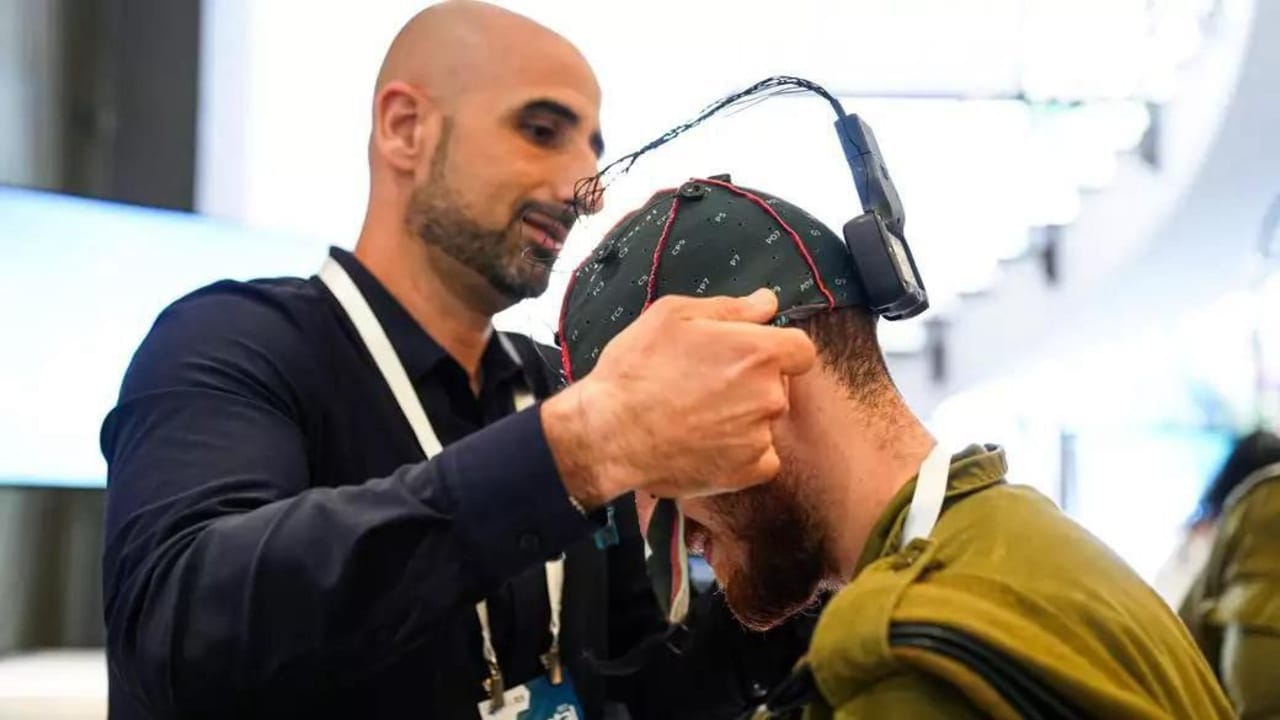
S’s unit has developed procedures for medical professionals to use EEG machines working with AI to provide feedback on individualized “calming cues.”
A soldier can now meet with a mental-health evaluator, including using an EEG and AI, and then have a discussion.
There is research about whether exposure to a girlfriend or a beloved song during a rough episode has a better impact and improves stability and calmness, S said.
AI can help figure out triggers for problems or for progress, he said.
Yet another area where AI is assisting in mental health for soldiers is helping reduce professionals’ record-keeping time, so they can invest more time in meeting with patients sooner and more often.
For example, without AI, mental-health professionals could spend a full hour analyzing a given set of records, during which they are not actually meeting with soldiers.
The AI systems can assist the mental-health professionals to take less time in dealing with record-keeping or with record-analysis issues, S said.
They can also use AI to more quickly draft their own summary of meetings with their soldier patients, he added.
The hope was to lower the time for accomplishing certain bureaucratic tasks from an hour to 15 minutes, S said.
These new changes are not perfect and create other problems, such as privacy risks, he said.
“The privacy risks from AI are a big deal... We define when it can be used,” he added.
S acknowledged that AI, left to itself, can make wildly wrong decisions.
“So, there are always humans in the loop to figure out when the AI systems are making mistakes,” he said.
“The idea is for the AI systems to assist professionals with making decisions, but not to replace the human mental-health professionals,” he added.
Finally, new AI tools are being used to more quickly identify skin problems, including regarding fingernails, S said.