
“There is persuasive evidence of a connection between extremism in the Muslim world and antisemitism,” found a Monday report by the UK-based Counter Extremism Group.
The central argument of the nearly 100-page report is that it is futile to rationalize (or attempt to rationalize) Islamist antisemitism as a response to the Israeli-Palestinian conflict.
The precedent for the CEG’s report was William Shawcross’s Independent Reviewer of Prevent, which said, “Prevent should… better address the anti-Jewish component of both Islamist and extreme right-wing ideology.”
The CEG began writing the report in 2023, but it “was inevitably shaped by the massacres which Hamas perpetrated in Israel the following month.” The events since October 7 served to “demonstrate the threat which Islamist antisemitism presents to the UK’s national security but also provided insights that are reflected in this report’s findings.”
Radicalization and the Israeli-Palestinian conflict
Six key individuals were interviewed as part of the report: two former members of Islamist organizations who now work as counter-extremism practitioners (one male and one female), two researchers employed by think tanks or government agencies (one male and one female), and two representatives of Jewish communal organizations (both male).

The report states that while the interviewees expressed varying views, one thing emphasized by all was the importance of grievance narratives in radicalization.
Interviewees emphasized that a range of grievances are exploited by Islamists and other Muslim extremists in their radicalization efforts. The Israeli-Palestinian conflict is one source among many that can be used to generate feelings of grievance that can, in turn, be employed in radicalization, the report adds.
According to one interviewee: “One of the greatest motivating factors for Islamist radicalization is the depiction of Muslim suffering elsewhere… [and] the narrative that… ‘Your co-religionist is suffering, is being oppressed, and… we have to go out and defend them because the nation-states aren’t going to, the Arab states… [are] shills of the West.’”
This individual posited such victim narrativization of Muslim suffering as a key initiator of radicalization.
The report goes on to suggest that there is a correlation between the two: When there is armed conflict between Israel and Hamas, Islamist antisemitism “suddenly shoots up and then… after [that]… expressions of the ideology come back down again… but never to the previous level, so you end up with this sort of ratcheting up where each [armed] conflict sees a surge and then a new normal which is worse than before.”
NEVERTHELESS, the interviewees all concurred that the importance placed on the grievances of the Israeli-Palestinian conflict is paradoxical, as it is “one of the more minor of the many conflicts around the world in which Muslims are being hurt.”
So, what is the explanation for this? “It’s a story that’s easily simplified from what is a very complex conflict: good guys and bad guys,” said one interviewee. “Poor oppressed Muslims getting killed by evil Jews.”The report also notes that such instrumentalization of the conflict by Islamists results, at least in part, from Western antisemitic ideas about Jewish power and supremacy.
The idea of Jewish power produced a sort of dissonance with the idea in the Muslim world of Jewish inferiority.
This dissonance became particularly heightened with the creation and subsequent existence of the State of Israel.
“Some interviewees argued that it was not only for the sake of convenience that Islamists had – in the words of one interviewee – made ‘defeating Zionism their cause célèbre.”
“Three interviewees noted a particular sense of discomfort aroused in many Muslims by Israel’s location within the Muslim world, where Jews were historically permitted to reside as subjects but not to enjoy political sovereignty.”
This is somewhat resolved by focusing on “defensive jihad” against the Jewish state, as it becomes of utmost importance to reclaim “Islamic land… from the Jews.”
Jews, and especially Jews in the State of Israel, become synonymous with colonialism, and this enables Islamists to engage in what one interviewee described as “instrumentalization [of] the language of… decoloniality,” thereby facilitating the building of coalitions with the Western political Left.”
Islamist antisemitism in the UK
In terms of the UK, the report states that Islamist narratives about the Israeli-Palestinian conflict combine theological discourse on jihad with a “superficially secular political framing which draws on the language of human rights and anti-colonialism.” This, it states, enables Islamists to build rapport with far-left Western entities.
One interviewee spoke about the sermons that have been delivered at a number of mosques, both in English and in Arabic, since October 7, 2023, noting that they have “all been quite similar.”
The interviewee suggested that the imams responsible were “working from the same sources” or adapting “model sermons” from the Internet. An example was the Palestinian Scholars Organisation, which the same interviewee described as being “closely tied to Hamas,” which disseminated a model sermon via its website.
The report referenced a recent survey that found that only one in four British Muslims, as opposed to more than six out of ten members of the general population, believe that members of Hamas committed murder and rape in Israel on October 7.
All interviewees in the report stressed that Islamists or other Muslim extremists viewed attacks on Israeli civilians as a form of legitimate self-defense.
ONE OF the prominent issues expressed by those interviewed was that many official institutions “did not recognize or understand antisemitism as manifest in the context of Islamism and other forms of Islamic extremism.”
“If someone was expressing admiration for Adolf Hitler, there’s no kind of second guess as to whether that person was antisemitic,” said one interviewee. The same is not typically the case for Islamist antisemitism.
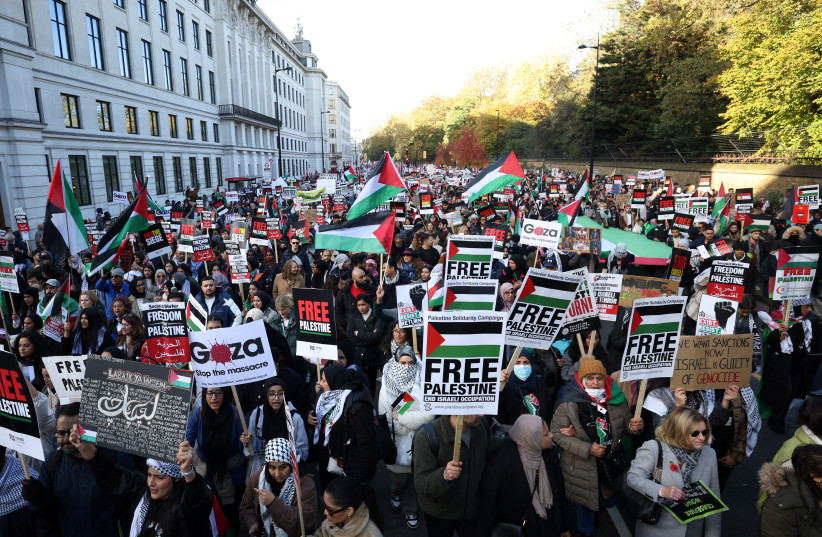
This particularly manifests in what has been seen with the policing of anti-Israel demonstrations in the UK.
One interviewee said the police allow many rallies about the Israel-Palestine conflict to go ahead and only make arrests afterward because officers assigned to maintain order at the demonstrations often “simply do not understand what they are seeing” and “have no idea what they are looking for.”
Another aspect that has created a sort of permissibility around Islamist antisemitism is the increase in the usage and application of EDI (equity, diversity, and inclusion) initiatives in the UK. According to one interviewee, “EDI initiatives sometimes acted to lend plausibility to antisemitic stereotypes and conspiracy theories.”
“EDI ends up creating more problems when it comes to antisemitism… especially [with] the more kind of radical approaches of ‘all racism is about structures of power and white supremacy, and the world is divided into the oppressors and the oppressed and every conflict is a function of this systematizing of the world.’
“It encourages people to see it as ‘Israel is the white, powerful, Western oppressor; therefore, Israel’s networks of support in the West are white and powerful and oppressors and racists (as are all Jews in this view)’ and that then opens up spaces for antisemitic conspirac[y theories] or stereotypes about Jews being powerful.”
In some cases, Islamists have been given a platform because of EDI in organizations.
The report highlighted the importance of recognizing the threat posed by Islamist antisemitism because, on a wider societal level, “too often, antisemitism is identified exclusively as a characteristic of right-wing extremism in the white British population, which may create a false impression of the threat landscape faced by the Jewish community in the UK.”
“Earlier research has consistently found that the latter perceives Islamist antisemitism to be a greater threat than the antisemitism of the extreme Right; the research presented here indicates that there may be very good reasons for that perception.”
Additionally, “polling of British Muslims appears to indicate substantially higher levels of anti-Jewish and anti-Israeli attitudes than are to be observed in the general British population,” and “antisemitic views are a much better predictor of support for extremism among British Muslims than any standard demographic variable.”
Read the full report here: https://counterextremism.org.uk/wp-content/uploads/2025/06/CEG_Daniel_Allington_-_Islamist_Antisemitism.pdf