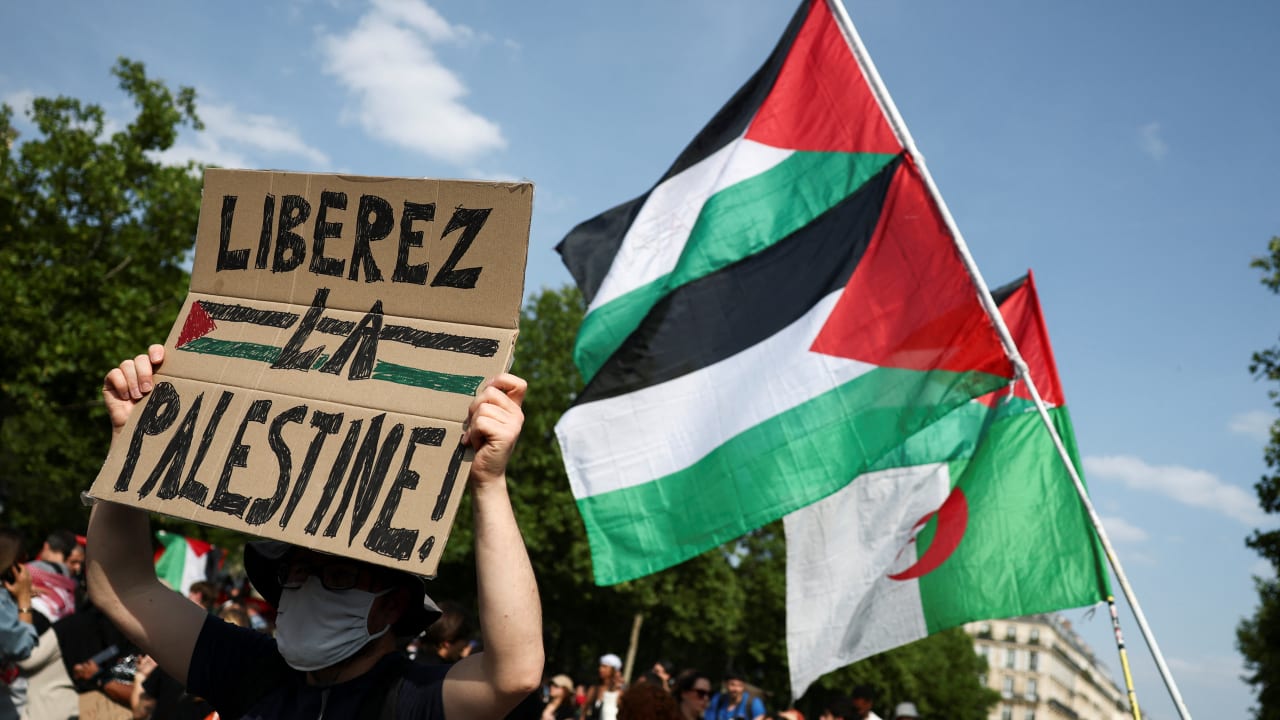
UK Prime Minister Keir Starmer, Canadian Prime Minister Mark Carney, and Australian Prime Minister Anthony Albanese recognized a Palestinian state on Sunday, ignoring multiple warnings and appeals from Jewish Diaspora groups that the move would embolden extremists and fail to advance peace.
Carney said in a statement that the move would counter Israeli measures to prevent a Palestinian state from being established through settlement expansion and the current Israel-Hamas War. The Canadian leader assured that his decision would not legitimise or reward terrorism, and would instead empower the Palestinian Authority, which had committed to reforming, demilitarizing, and holding elections in 2026 without Hamas.
The Centre for Israel and Jewish Affairs decried Canada's recognition of Palestinian statehood as a reward for the October 7 Massacre.
"This move emboldens Hamas, undermines peace efforts, prolongs the suffering of Palestinians under Hamas rule, and fuels global incitement against the Jewish people," CIJA CEO Noah Shack said on X. "The government’s policy should be clear-eyed and focussed on releasing the Israeli hostages, securing a ceasefire, and the removal of Hamas from power."
Shack noted that since Carney had announced his intention in July, antisemitic crimes had only surged in Canada.

Bnai Brith Canada said that Carney's move relied on the "empty promises" of the PA, which showed repeatedly that it has been unwilling to meet the promised commitments.
"Hamas continues to arm itself, hold hostages, and carry out terror attacks. Recognition at this time does not bring us any closer to lasting peace, it only further compromises the prospect of a two-state solution," said B'nai Brith Canada.
The Globe and Mail reported that Canadian Foreign Affairs Minister Affairs Minister Anita Anand said Friday that while the country was preparing to recognize a Palestinian state it would hold off on normalizing diplomatic relations until such commitments were met. Shack said Wednesday that recognition without normalization acknowledged that conditions had not yet been reached.
Starmer said that in his speech recognizing a Palestinian state that their framework for peace was a practical plan that would bring about reform of the PA and a ceasefire in Gaza. He also assured that his plan, which would ostensibly save the two-state solution, would not reward Hamas because it meant that Hamas would have no future in the Palestinian government. Starmer added that the UK would work to sanction other Hamas figures in coming weeks.
The Board of Deputies of British Jews expressed deep dismay in Starmer's decision in a statement, which it described as doing the exact opposite of advancing long-term peace by reducing pressure on Hamas and allowing it to claim that its October 7 Massacre had led to the milestone.
The Jewish Leadership Council said that the UK's recognition of a Palestinian state on the eve of the Jewish high holidays came almost two years after the massacres during the Simchat Torah festival, and was "nothing short of a betrayal of the hostages and a reward for terrorism. It will make peace even more elusive."
"Lasting peace will only come when Hamas disarms and relinquishes power in Gaza, and when the Palestinians establish truly democratic institutions," said the JLC.
The Board of Deputies and Jewish Leadership Council met with UK Middle East Minister Hamish Falconer on Thursday to further convey recognition of a Palestinian state at this time. The British Jewish groups told Falconer that they offered the wrong incentives, noting that Prime Minister Keir Starmer's July 29 speech threatened Israel with recognition of a Palestinian state if it did not accept a ceasefire, commit to a two-state solution, freeze annexation, and expand humanitarian aid access, but did not set any conditions on Hamas. Starmer's intention to recognize a Palestinian state without conditions disappointed the families of hostages, and "may have created incentives on the group [Hamas] to avoid a ceasefire."
The Board and JLC said that they "received insufficient clarity" from Falconer on the practical implications of the move.
Falconer was also reminded, the groups said in a joint statement, that the conflict had emboldened antisemitism in the UK.
Albanese and Foreign Minister Penny Wong announced their own recognition of a Palestinian state, as a coordinated effort with Canada and the UK. The Australian leaders said the joint effort would build new momentum for a two-state solution, and that work was already underway to develop a credible peace plan that would enable the reconstruction of Gaza and build the capacity of a state that would guarantee the security of Israel.
The Zionist Federation of Australia said that Albanese deviated from the long-standing policy of a negotiated two-state solution by taking a unilateral step.
“Unilateral recognition removes any incentive for the Palestinians to reform or return to negotiations," said ZFA CEO Alon Cassuto. "If Australia wants to help, it should support Palestinians to reform and build their institutions, the foundations of any viable Palestinian state. That is how we should contribute to real peace, not by emboldening terrorists through empty symbolism.”
The joint proposal only served to stall ceasefire negotiations and prolong the suffering on all sides, and offered nothing but symbolism that did not change the suffering in Gaza or remove threats to Israelis.
The Board of Deputies of British Jews, the Centre for Israel and Jewish Affairs, and Executive Council of Australian Jews issued a joint statement on Thursday, arguing that Hamas would see the diplomatic move as a reward for its violence, noting that Hamas official Ghazi Hamad had described state recognition as one of the “fruits of October 7.”
While the UK, Australian, and Canadian governments had called for Hamas to release hostages seized during the October 7 Massacre, surrender, and disarm, they had not made fulfillment of these demands a precondition for recognition of a Palestinian. To the contrary, the Board, CIJA, and ECAJ said that the announcements by their states had lessened rather than increased pressure for disarmament and the release of hostages.
"Our governments are in effect saying that the fulfilment of these requirements post-recognition will be taken on trust and left for some unspecified time in the future. This is a posture that lacks credibility, borders on recklessness, and sets up Palestinian statehood for failure from the outset," said the Jewish groups. "It will therefore set back rather than advance prospects for a genuine peace based on the internationally-endorsed principle of two states for two peoples."
The stance of the government ignored not only that it was Hamas and its sponsors in Iran that initiated the war, but that the Islamic regime and its proxies remained committed to the destruction of Israel and visiting violence upon the Jewish communities in the UK, Canada, and Australia.
The Jewish groups also noted that the recognition of a Palestinian state with territory under Hamas control betrayed Palestinians living under their regime.
<br><strong>French recognition of a Palestinian state</strong><br>
France is also set to recognize a Palestinian state at the UNGA on Monday, after French President Emmanuel Macron announced his intention on July 24. Macron told CBS on Friday that recognition would isolate Hamas, because Hamas did not want a Palestinian state, and instead wanted to convince Palestinians that there was no chance of peace and to convince them to support their objective to destroy Israel.
Twenty French Jewish leaders on Friday issued a joint letter to Macron urging him to only recognize a Palestinian state after the release of hostages and the dismantling of Hamas. The letter, which was supported by Representative Council of Jewish Institutions of France (CRIF) president Yonathan Arfi,Central Consistory president Eli Korchia, and French chief rabbi Haim Korsia, warned that any other approach would be "capitulation in the face of terrorism."
"While France has prudently refrained from any recognition of a Palestinian state since 1948, pending the establishment of conditions for peace and mutual security, how can it justify doing so while the war triggered by the worst antisemitic massacre since the Holocaust is still raging? How can it be announced while Hamas is still holding hostages? Why do so at a time when antisemitism is flaring up in France, specifically using the situation in the Middle East as a pretext?" read the letter. "We know that this is not your intention, yet recognition tomorrow before the fulfillment of the conditions you have set out would be claimed as a symbolic victory for Hamas, which would only worsen the murderous stranglehold it imposes on the Palestinians."
Macron's initial announcement had been met with criticism from US leaders such as Secretary of State Marco Rubio.
Twenty-five US Congressmembers and senators issued a joint letter on Friday to Carney, Macron, Starmer, and Australian Prime Minister Anthony Albanese, warning that recognition would put them at odds with long-standing US policy. The letter, which was signed by congresswoman Elise Stefanik, Senator Rick Scott, and Senator Ted Cruz, argued that the approach reinforced the effectiveness of the Hamas violence that took the lives of French, UK, and Canadian citizens on October 7.
"This misguided effort to reward terrorism also imperils the security of your own countries," read the letter. "Your actions to legitimize a Palestinian terror state will only provide greater motivation to the violent antisemitic mobs."