We are finally in the month of Adar – the month when we increase our happiness as we prepare for Purim.
Purim is by far the most joyful holiday, especially here in Israel, where everyone and everything seems to dress up. Whether you’re in a doctor’s office, standing in line at the supermarket, or buying electronics, someone in the store is in costume. School hallways, bus stops – even office buildings – transform overnight. We all slip into that happy, slightly silly, find-the-joy-in-everything mood.
There’s something about Purim that invites a little chaos, in the best possible way. We mix and match costumes, swap identities, and blur the rules. So why not let our menu do the same?
Instead of sticking to one cuisine, I built a Purim seuda that travels from Persia, where it all began, to Paris, and from China to Mexico, because Purim is nothing if not colorful and unexpected.

Fattoush Salad with Crispy Pita Chips
Fattoush salad originates in Lebanon, yes, that place, and yes, that truly is the name of the salad. If it keeps everyone laughing through the Purim seuda, even better. Purim is, after all, a time for joy.
It carries a rich Middle Eastern flavor profile, and over the years many of those flavors have naturally become part of Israeli cuisine as well. The salad is believed to have started as a clever way to use up stale pita. We all have those days when a pita gets left out too long, or there’s just one piece too many. Instead of tossing it, bake it into crispy chips and fold it into a salad tossed with fresh vegetables, fragrant sumac, and a bright lemon dressing. Suddenly, what might have been a waste becomes a crunch.
At first glance, the ingredient list may look long, but don’t be overwhelmed. Each component is simple to prepare and can be prepped in advance. The pita chips can be toasted earlier in the day, the vegetables chopped in advance, and the dressing stored in a sealed jar in the fridge for a day or two. When it’s time to serve, everything comes together in one colorful bowl.
Yields 4-5 servings.
For the pita chips:
2 pita breads, cut into small triangles
2 Tbsp. olive oil
1 tsp. coarse salt
For the salad:
1 head romaine lettuce, chopped
3 cucumbers, sliced
1 cup cherry tomatoes, halved
3 red radishes, thinly sliced
1 red onion, thinly sliced
Fresh mint leaves
Fresh parsley, chopped
For the dressing:
1/3 cup olive oil
2 Tbsp. fresh lemon juice
2 tsp. pomegranate molasses (or balsamic glaze; see note)
1 tsp. honey
1 tsp. ground sumac
2 garlic cloves, crushed
1/2 tsp. salt
Preheat the oven to 180°C (350°F) and line a baking sheet with baking paper. Toss the pita pieces with olive oil and sea salt, spread them on a baking sheet, and bake for 8–12 minutes, or until golden and crisp. Set aside to cool.
In a large bowl, combine all the salad ingredients, keeping the mint and parsley on the side. In a jar, combine all the dressing ingredients and shake well until blended. Keep refrigerated if preparing a day or two in advance.
Just before serving, add the pita chips along with the mint and parsley, pour the dressing, and toss gently to combine. Finish with an extra sprinkle of sumac and serve immediately for maximum crunch.
Persian jeweled rice
Since the Purim story began in ancient Persia, I knew I wanted to include a dish that honored that setting. I spoke to my dear Persian friend Shefra, who is an incredible cook, and asked her for ideas. She gave me several beautiful suggestions, but the jeweled rice immediately caught my attention.
As Shefra began describing some of the more traditional techniques, I started to feel slightly intimidated. And then she smiled and said, “Or you can just do it the lazy way, like I do.” I was sold.
Traditionally, jeweled rice is made with saffron, which gives it fragrance and a rich golden color. But saffron is not something most of us keep in our kitchens, and it can be quite expensive. So for this version, I use a touch of turmeric instead. It’s simple, accessible, and still absolutely stunning.
This dish is colorful, festive, and fit for a king’s feast, but easy enough for any busy Purim kitchen.
Yields 6 servings.
4 Tbsp. olive oil
2 onions, thinly sliced
2 carrots, very thinly sliced
Zest of 1 orange
2 cups basmati rice, rinsed and drained
1/3 cup dried cranberries
1/3 cup pistachios, chopped
1/3 cup slivered almonds
1/3 cup golden raisins
3 tsp. salt
1/2 tsp. cinnamon
1 tsp. brown sugar
1/2 tsp. turmeric
3 1/2 cups boiling water
1/2 cup fresh pomegranate seeds for garnish
In a wide pot, heat the olive oil and sauté the onions with 1 teaspoon of salt over medium-low heat until deeply golden and caramelized.
Add the carrots, orange zest, pistachios, almonds, cranberries, and raisins. Stir to combine. Add the cinnamon, brown sugar, and turmeric, and sauté everything together for 3–4 minutes.
Add the rinsed rice and the remaining 2 teaspoons of salt. Mix well to coat the rice with the onion mixture.
Pour in the boiling water, cover the pot, and lower the heat. Cook for 15–18 minutes, until the rice is tender and the liquid is absorbed.
Fluff gently with a fork and transfer to a serving dish. Sprinkle with fresh pomegranate seeds just before serving.
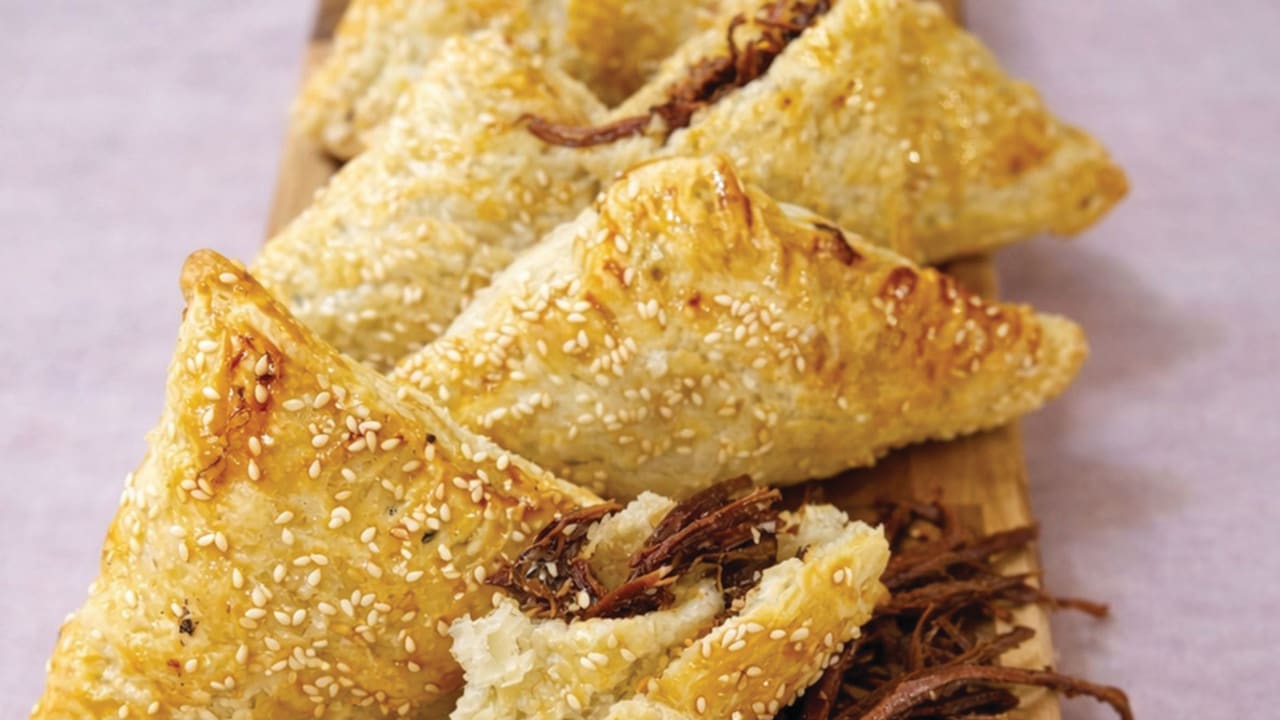
American Pulled Beef Hamantaschen
Pulled beef, especially when paired with a smoky BBQ flavor, is an American classic. It has become incredibly trendy lately; but let’s be honest, sometimes “pulled beef” is just another name for leftover brisket, although I would happily take either.
These days, we like to call it upcycling, which sounds slightly more impressive than repurposing. Either way, pulled beef has found its way into countless delicious dishes.
To give you a little background, before I began writing for the Magazine, I once posted a recipe for savory meat hamantaschen made with ground beef on Facebook. Our amazing editor, Erica Schachne, saw it and said, “I want that.” The next thing I knew, I was writing my first Passover article here, and the rest, as they say, is history.
So in the interest of keeping Erica and all of you happy, I decided not to reinvent the wheel. Instead, I upcycled the idea into a slightly sweet pulled beef BBQ hamantaschen that feels both playful and completely irresistible. It’s simple, and yes, obviously crazy delicious.
Yields a dozen hamantaschen.
2 cups brisket
½ cup sauce from the Chinese chicken (see next recipe)
1 roll of puff pastry dough
1 egg for sealing and brushing
Sesame seeds for sprinkling, optional
Preheat the oven to 190°C (375°F). Using soft-cooked beef such as brisket or ribs, shred the meat with two forks, pulling it apart, hence the name “pulled beef.” Line a large pan with baking paper and place the shredded beef inside. Add ½ cup of sauce from the Chinese chicken (see next recipe) and mix well to coat. You can use gloves to combine it by hand. Be careful not to add too much sauce; we want the beef coated but not overly liquidy.
Bake for about 15 minutes, until the edges are just lightly crispy. Remove from the oven and allow to cool before assembling.
Roll out the puff pastry and cut into 4” squares (10 cm.).
Rotate each square so it sits like a diamond. On one half of the diamond, place a spoonful of pulled beef, leaving space around the edges. Brush the edges with beaten egg, fold the clean half over to form a triangle, and press firmly to seal.
Place on a lined baking sheet, brush the tops with egg, and sprinkle with sesame seeds if desired. Bake at 180°C (350°F) for about 18 minutes, or until golden brown.
Serve warm. If making ahead, allow to cool completely before freezing or refrigerating.
Chinese Party Chicken
When it comes to parties, fried chicken is practically mandatory, and I like to mix it up with different flavors. Many of you may not know this, but I do not like ketchup. In fact, it’s a real no for me. So it’s a good thing I didn’t know there was ketchup in this dish when I happily devoured it at a family party years ago.
The next day, I called my sister for the recipe and was shocked to learn that ketchup was one of the ingredients. But I loved the dish so much that I decided not to care. Sometimes the best dishes are the ones that surprise us.
The sauce can be made ahead of time and stored in the refrigerator. Before adding the vegetables to the sauce, set aside ½ cup of the sauce for the pulled beef hamantaschen recipe (above).
Yields 6 servings.
Sauce base:
2 Tbsp. cornstarch (cornflour)
3/4 cup water
3/4 cup sugar
1/3 cup soy sauce
1/3 cup vinegar
2/3 cup ketchup
Vegetables:
3 Tbsp. olive oil
1 onion, sliced
2 peppers (any combination of green, red, or yellow), sliced
Chicken batter:
1 kilo chicken breast, cut into 2-inch (5 cm.) strips
1 cup flour
1 tsp. baking powder
1 tsp. salt
1 Tbsp. paprika
2 tsp. oil
2 eggs
½ cup water, or more if needed
Oil for frying
In a small pot, whisk together all the sauce ingredients. Bring to a boil over medium heat, stirring until thickened. Once thickened, shut off the heat. Remove ½ cup of the sauce and reserve for the pulled beef hamantaschen.
Meanwhile, in a small frying pan, heat the olive oil and sauté the onion and peppers until softened and lightly golden. Add the sautéed vegetables to the pot of sauce, mix until well coated and let cook together on low for 10 minutes. Set aside.
In a bowl, mix all the batter ingredients until smooth, add more water if too thick. Dip the chicken strips into the batter and fry in hot oil until golden and cooked through. Drain on paper towels.
Before serving, pour the warm sauce over the fried chicken and toss gently to coat, or serve the sauce on the side.
Mexican-Style Coffee Liqueur
Last year, my neighbor Deena and her husband brought over a sweet mishloach manot that included a small bottle of homemade coffee liqueur. Before I even had a chance to ask, she read my mind and told me how simple it is to make with a few ingredients. The only catch? It needs time for the flavors to deepen and become rich and smooth.
The good news is that we are more than a week away from Purim, which makes this the perfect moment to grab a glass jar and make your own. While it can be enjoyed after 24 hours, it is truly at its best after about a week in the refrigerator, when the flavors have had time to fully develop.
Yields 2 cups of coffee liqueur.
1 cup vodka
1 cup strong brewed coffee, cooled
3/4 cup sugar
1 tsp. vanilla extract
In a small saucepan, combine the brewed coffee and sugar. Heat gently over medium-low heat, stirring until the sugar fully dissolves. Do not boil.
Remove from the heat and allow the mixture to cool completely. Stir in the vodka and vanilla extract.
Pour into a clean glass jar or bottle, seal tightly, and refrigerate. It can be used after 24 hours, but for the best flavor allow it to rest for about one week before serving. Serve chilled, over ice, or use in desserts such as chocolate mousse.
Mocha Mousse Cups
My daughter has been begging me to let her make chocolate mousse for dessert. I kept thinking, I don’t have the time or patience for something that sounds so complicated. But after a little research, I realized there are some very doable shortcuts. And once I decided to stir in some of my homemade coffee liqueur, I was fully convinced. Mocha is, after all, one of the world’s greatest flavor combinations.
In the process, I was reminded that mousse is, of course, a classic French dessert, which fits perfectly into our international Purim party theme.
Yields 8 mousse cups.
200 grams of good-quality dark chocolate
1 tsp. coconut oil or vegetable oil
1/2 tsp. salt
2 cups sweet heavy cream (dessert whip)
1 tsp. icing sugar
1/4 cup coffee liqueur or Kahlua
Melt the chocolate with the oil either on the stovetop over very low heat or in the microwave in short intervals, stirring until smooth. Stir in the salt and set aside to cool slightly.
Using an electric mixer, whip the heavy cream until soft peaks form, about 4 minutes. Add the icing sugar and mix briefly to combine. Remove about 1½ cups of the whipped cream and refrigerate for topping.
To the remaining whipped cream, gently mix in the melted chocolate and coffee liqueur on low speed just until smooth and combined.
Divide into 8 small mousse cups and refrigerate for at least 2 hours, or until set.
Before serving, top with the reserved whipped cream. Garnish with chocolate shavings or drizzle with a few drops of coffee liqueur for an elegant finish.
AS THE Purim spirit continues to fill the air, let’s focus on being joyful and spreading that joy to others. Wherever you will be having your Purim meal this year, whether you are hosting or being hosted, chances are you will be surrounded by people from all parts of the world.
We may have been scattered across the globe, picking up different cultures, ideas, and cuisines along the way, but we all belong to one family.
Purim is unlike any other holiday. The miracles are hidden, yet when we look for them, they become clear as day. Dressing up in costumes allows us to show a different side of ourselves, and perhaps see a new side in someone we may not have noticed before.
When we are all dressed up, the lines that divide us blur just a little. The ones we agree with and the ones we don’t. The familiar and the unfamiliar.
Maybe Purim can be the day we choose unity. A day when different cultures and cuisines come together around one festive table. A reminder that there are no coincidences, that everything is orchestrated by God down to the smallest detail. And that behind the masks we wear, on Purim and throughout the year, we remain one nation with one heart.
Wishing you all a very
HAPPY PURIM!
The writer is a kitchen coach who teaches women how to meal plan and cook, so they get dinner on the table and prepare for Shabbat and chag on time. Learn more about coaching and workshops: https://inthekitchenwithhenny.com/