
Although they are all sold in the same refrigerator in the supermarket and are called “salads”, in practice this is a very diverse group of products. Some are closer to a fatty spread, some to a cooked vegetable side dish, and some are actually a good vegetable that has been loaded with a lot of mayonnaise, oil, sugar and salt.
There is almost no logic in talking about “store-bought salads” as one unit: Hummus, tahini, matbucha, eggplant in mayonnaise and red cabbage in mayonnaise are very different from each other in calorie value, fat composition, fiber amount, salt content and health contribution.
And one more thing to note: In many store-bought products, potassium sorbate repeatedly appears as a preservative, citric acid as an acidity regulator, and sometimes stabilizers such as xanthan gum or guar gum. These substances are intended to extend shelf life and maintain stability and texture, some of them (not all) are problematic for health – but in many cases the bigger nutritional problem is דווקא excess salt, oil, sugar, or a relatively low percentage of the original ingredient.
Let’s go salad by salad and examine the nutritional value:
Tahini
Tahini is an excellent example of a food that can be both excellent and less successful, depending on which version you choose.
High-quality raw tahini, especially from whole sesame, is considered a “superfood”:
Provides unsaturated fat, minerals such as calcium, magnesium and iron, as well as plant compounds such as lignans and phytosterols. A 2024 review in the Journal of Atherosclerosis Prevention and Treatment described tahini as a food rich in quality fatty acids, polyphenols and minerals, and even among people with type 2 diabetes, adding tahini for six weeks was associated with a reduction in triglycerides and improvement in some markers.
But here it is important to stop: All these benefits mainly refer to tahini itself, not necessarily to a store-bought “tahini salad”.
In ready-made products examined in retail chains, salt, soybean or canola oil, citric acid, stabilizers and potassium sorbate appeared.
Anyone who wants the truly good version should look for as short an ingredient list as possible and a high tahini percentage.
Hummus

A comprehensive review in Nutrients found that consuming hummus and chickpeas contributes to satiety, and to better control of blood sugar and lipid markers compared to less successful snacks or spreads.
In many store-bought hummus products, hummus and tahini do appear, but also acidity regulators, salt, sometimes vegetable oils, and sometimes a preservative such as potassium sorbate.
That is, it can still be a more successful salad than most mayonnaise salads, but it is not always “like homemade hummus”.
- A very flat tablespoon: About 50 calories.
- A heaping tablespoon (like the one that goes into a pita): About 300 calories.
- A plate of hummus for dipping: May also reach 1000 calories – without the pita, without the oil in the center of the plate.
<br>Matbucha
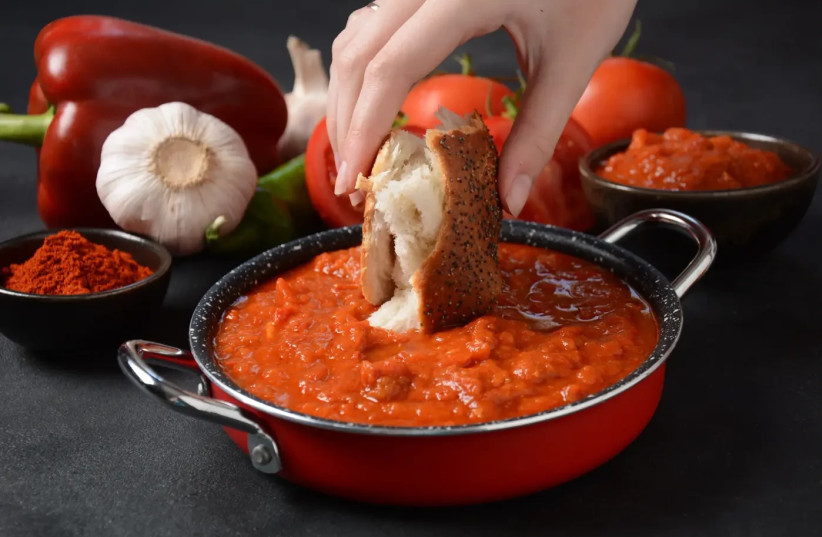
Its base is tomatoes and peppers, and sometimes also garlic, which provide lycopene, vitamin C and antioxidant compounds.
One of the nice advantages of matbucha is that cooking does not necessarily completely harm it, and in the case of tomatoes may even improve the availability of lycopene.
The problem begins when the store-bought product gets too much soybean or canola oil, too much sugar, and a lot of salt. In store-bought matbucha that were examined, potassium sorbate appeared as a preservative, and sometimes also xanthan gum and citric acid.
One tablespoon contains only about 20 calories.
Eggplant salads

Eggplant salads are perhaps the most confusing category on the shelf, because under the same name hide completely different products.
Simple roasted eggplant, or “grilled eggplant”, can be a not bad choice at all: Eggplant is a relatively low-calorie vegetable, rich in fiber and antioxidant compounds, and in mayonnaise versions you already get a completely different product, whose nutritional value mostly comes from the mayonnaise rather than the eggplant.
Therefore, among the three options, roasted eggplant or eggplant in tahini or in mayonnaise – the simple one is usually the better choice, eggplant in tahini can be reasonable if the ingredient list is relatively clean, and eggplant in mayonnaise is usually the less good option:
Nutritionally it is much more fat and much less vegetable. In some of the products examined, around 23%–24% mayonnaise appeared, and in the nutritional values a serving is obtained with significantly higher fat compared to simple roasted eggplant.
Natural, Romanian, grilled and Mediterranean eggplant – up to 8% fat, less than 20 calories per tablespoon
Eggplant in tahini, in mayonnaise, or “liver-style” – up to 20% fat, close to 50 calories per tablespoon
Red cabbage in mayonnaise

Red cabbage is an excellent raw ingredient. It belongs to the cruciferous family, contains dietary fiber, vitamin C and purple pigment compounds from the anthocyanin family that have antioxidant and anti-inflammatory potential. But all this is true for the cabbage itself. Once the red cabbage is swimming in mayonnaise, much of the advantage remains in the background.
In store-bought products that were examined, purple cabbage made up about 67% of the product, while the rest came from mayonnaise, water, sugar, salt, stabilizers and preservative.
That is, there is still a real vegetable here, but wrapped in fat, sugar and sodium. In simple words: It is much less healthy than the impressive purple color suggests.
Anyone who likes red cabbage is better off making such a salad at home, or looking for a simpler version, with less mayonnaise and less sugar. And if you do buy, it is worth remembering that this is more of a rich spread with cabbage rather than a light vegetable salad.
The bottom line for the Independence Day barbecue – If you want to choose correctly, it is better to be less alarmed by the mere presence of one preservative, and more to check how much salt is in the product, how much sugar was added, which oil appears on the list, and what the real percentage of the vegetable or legume is.
My salad ranking
First of all – in all store-bought ones there are preservatives and therefore in this respect none has an advantage, a homemade salad will always win by a large margin. And if still store-bought:
First place – salads with high nutritional value and quality fat
Hummus
Natural tahini salads – good fat, minerals, vitamins
Second place – salads with nutritional value and also low calorie value
Matbucha
Turkish salad
Spicy tomato salad
Natural, Romanian, grilled, Mediterranean eggplant
Third place – salads high in fat and calories and lower nutritional value
Eggplant in mayonnaise
Purple cabbage in mayonnaise