
In many families in Israel, the bond between grandparents and grandchildren passes through food. It happens around Friday dinners, a fixed afternoon in the middle of the week, or sometimes on a daily basis. The plate served there is not just a matter of a menu. It carries with it a desire to spoil, good intentions, memories, and sometimes silent gaps between the nutritional concepts of the parents' generation and the grandparents' generation.
In recent years, there has been a welcome increase in parents' awareness of children's nutrition. Less sugar, fewer snacks, more balance, and more thought about long–term habits. Within this reality, the encounter with food at Grandma and Grandpa's often raises questions. Is it an innocent, passing treat, or does it have a significant impact on the children's eating habits? And is interference even necessary.
It is no coincidence that this discussion arises specifically ahead of Family Day, which will fall this year on February 17. This is a day that invites reflection not only on the emotional bonds between generations, but also on the daily habits that pass between them. Food, perhaps more than any other area, is right at this intersection.
<br>Too big a spoon of love
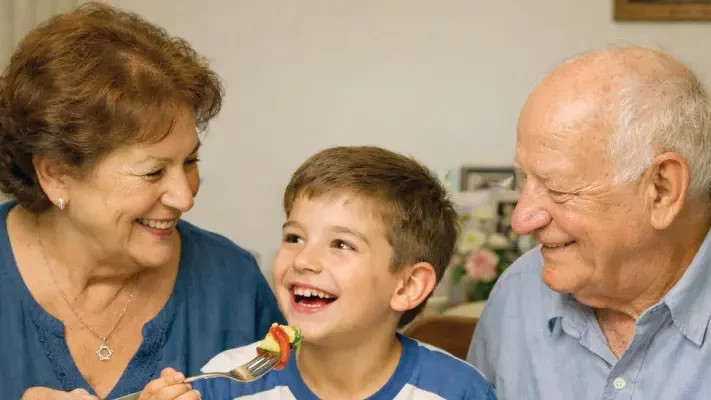
For many children, Grandma and Grandpa's food symbolizes security, belonging, and care, especially during days of illness, vacation, or shared time outside the routine. The meal is not only what is placed on the plate, but also sitting around the table, the slower pace, and the feeling that someone sees and cares. It is not surprising that children experience the food there as "tastier," perhaps also because the experience is no less emotional than it is nutritional.
But that same emotional envelope can also generate silent conflicts. Sometimes the meal at Grandma's reflects not only love, but also gaps in approaches, different life experiences, and even a sincere desire to "do good" in a way that does not always match the approach at home. In certain cases, the gap is not only stylistic but also substantive.
For example, a family that has chosen a vegetarian or vegan diet – facing a grandmother who is convinced that "a child needs meat to grow," or parents trying to manage a child's excess weight facing grandparents who express love through food or, alternatively, comment on the large amount of food being eaten.
In such situations, spoiling is not just a matter of taste, but also touches on values, health, and sometimes silent authority struggles. When food is consistently used as a means of soothing, comfort, or expressing care, it may exceed its nutritional role. A treat to make someone happy, or encouragement to eat even beyond satiety – all of these create a connection between food and emotion. Such patterns are not problematic when they are occasional, but daily repetition of them may affect the way children learn to identify hunger and satiety.
When does spoiling become a problem?
A broad systematic review published in 2021 in the journal Obesity Reviews examined dozens of studies dealing with the feeding patterns of grandparents to young children. The findings presented a complex and surprising picture.
On one hand, grandparents contribute to a calm, varied, and sometimes even healthier family eating experience (incorporating fruits and vegetables) – encouraging independent eating, sitting with the children, eating with them, and promoting a model of shared dining. They tend to create a less stressed atmosphere during the meal, an important component in developing a healthy relationship with food.
On the other hand, the same review found a tendency to serve children larger portions, to encourage frequent eating, and to use food as an emotional tool. The researchers emphasized that the question is not whether the involvement of Grandma and Grandpa is good or bad, but under what conditions it occurs. The problem is not the involvement itself, but the lack of coordination and the delivery of conflicting messages, which can create confusion and even hidden family tension.
The study offers a clear dividing line: When Grandma and Grandpa see the grandchildren once in a while, on holidays or occasional weekends, there is room for flexibility. The children know very well how to differentiate between the rules of the home and the rules at the grandparents' house, just as they understand that they are allowed to stay up a little later. But when Grandma and Grandpa are part of the daily routine, like a "family after–school care" or a permanent substitute for the parents, dialogue and genuine cooperation are required.
And what was found to be beneficial? Shared cooking between grandparents and grandchildren leads to an increase in children's willingness to taste new food, improvement in cooking skills, and a reduction in resistance around food. Beyond the food itself, it is about quality time, passing down tradition, and an opportunity for an experience that is not based on persuasion or pressure. From clinical experience, one of the most effective recommendations is creating clear but flexible agreements between the parents and Grandma and Grandpa. Not a list of prohibitions, but a shared distinction between what is daily and what is special. Dessert as part of an organized meal, and not as a random snack. And simultaneously, expanding the ways of spoiling, a game, a story, a short walk, or a shared activity that is not related to food.
Grandchildren's nutrition does not exist in a vacuum. Grandma and Grandpa are an integral part of this continuum, with a role that contains warmth, experience, and real influence. They possess experience and insights, and one can also learn quite a bit from them. When their involvement is based on coordination and clear boundaries, food returns to its natural place – not a means for emotional compensation and not a focus for tension, but a quiet, familiar, and safe part of family life.