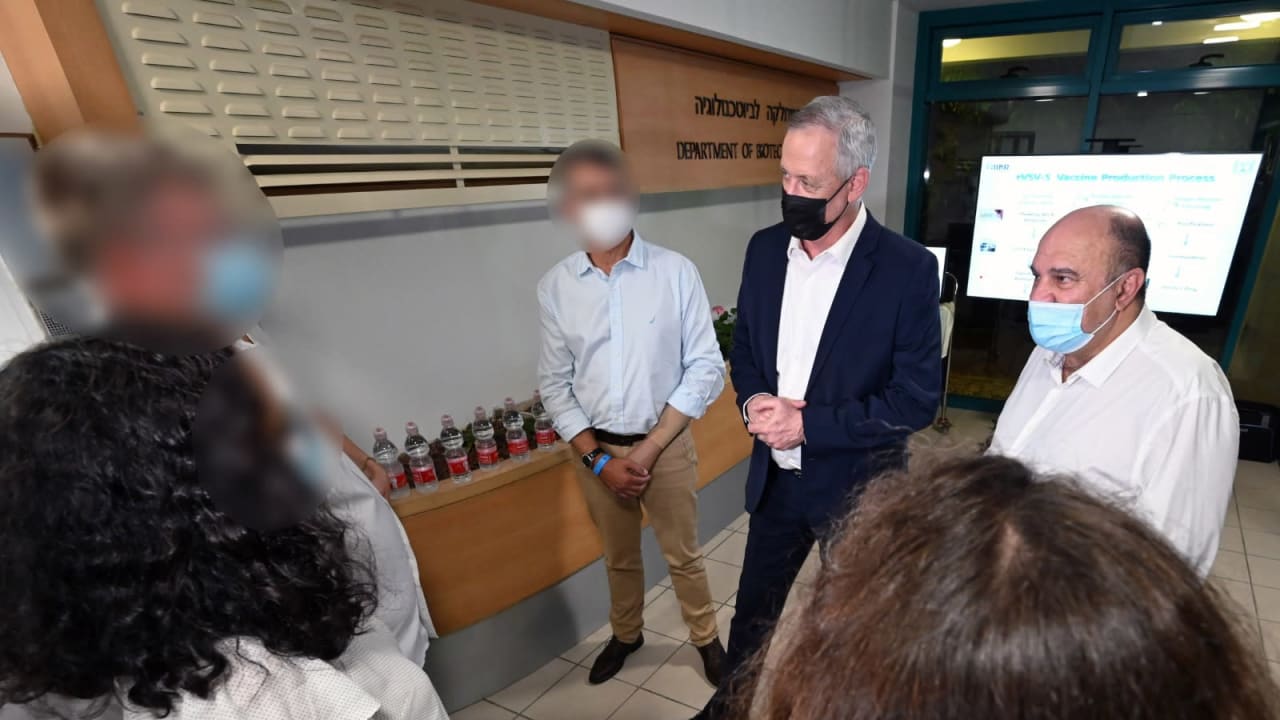
“Prof. Shmuel Shapira will end his term as director of the Biological Institute after eight years in his role, as was determined in advance,” the ministry said in a statement.
Shapira, 66, could have continued in his role at least until next year when he reaches the age of retirement. There would also have been options to extend his position.
The ministry said that Shapira’s successor has not yet been determined.
IIBR operates under the auspices of the Prime Minister’s Office and works closely with the Defense Ministry.
Originally, the goal was to have an Israeli vaccine by summer. However, various challenges have delayed Brilife’s clinical trials. Working with Sheba Medical Center and Hadassah-University Medical Center, IIBR completed Phase I in late November, showing that the vaccine had few side effects and no severe ones.
Speaking at the Knesset in late November, Shapira said that Brilife could have been further along if not for the “overregulation” that IIBR encountered.
“We should have been in Phase III,” Shapira said. “I think we have come a long and difficult way. When a [representative of a] prestigious regulatory institute saw what we went through, he said that what we experienced was ‘too complex a path.’
“I will not expand beyond that,” Shapira continued. “Those who understand it will understand.”
He also complained that IIBR was not given the same support as other vaccine development companies.
“We would be happy to receive the same support and sympathy that the huge companies do, which get 30 times what we do,” he told the Knesset.
The vaccine’s Phase II trial was approved and kicked off in December, around the time that the first vaccines arrived in Israel. The country’s mass vaccination campaign has made it difficult to recruit volunteers, some of whom would naturally be given a placebo instead of an active vaccine.
Prof. Yossi Karko, director of Hadassah’s clinical research unit, who is leading the Phase II trial of Brilife for the hospital, told The Jerusalem Post earlier this month that so far around 500 subjects have been enrolled in the study, which was designed to test safety, efficacy and dosing. He said the trial is expected to be completed by the end of April with 800 volunteers.
A Phase III trial with around 30,000 volunteers would need to be conducted with international partners. Karko said Israel is looking to possibly partner with Brazil.
Even if the Phase III trial commences in the next month or so and proves Brilife effective, it is unlikely that an Israeli vaccine would be ready before the end of 2021.
Once injected, it does not cause a disease by itself. VSV does not infect humans. Instead, the body recognizes the spike protein that is expressed on the envelope and begins to develop an immunological response.