
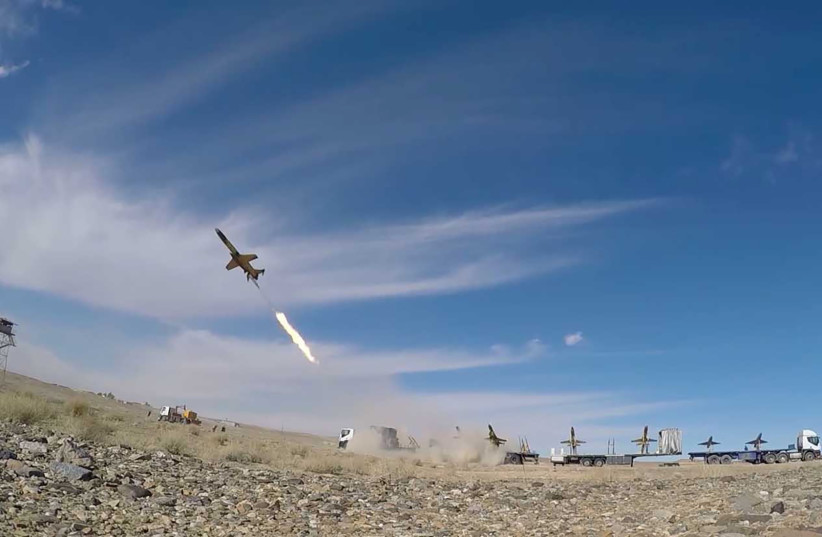
The US Embassy has condemned the latest drone attacks in Iraq, over three weeks after they began on June 24, as the Israel-Iran conflict was winding down. Drones strikes started by targeting radars at air bases in Camp Taji, north of Baghdad, and the Imam Ali air base near Nasiriyah.
Later, the drone attacks grew. Rockets were launched at Kikruk airport followed by drones being launched at the Sulimaniyeh area of the Kurdistan region in northern Iraq. The attacks expanded in the first two weeks of July, targeting Erbil, the capital of the Kurdistan region. It was not clear who was behind the attacks.
However, the Kurdistan region has condemned the Iranian-backed Popular Mobilization Forces (PMF) in Iraq. This group of militias includes a number of powerful armed militias with allegiance to Iran, including Kataib Hezbollah, a militia that targeted US forces in Jordan in January 2024, killing three Americans. It also targeted Israel with drones after the October 7 Hamas attacks.
On July 15, the US Embassy in Baghdad said that “the United States condemns the recent drone attacks throughout Iraq, including the July 14 and July 15 drone attacks on critical infrastructure at the Khormala and Sarsang oil fields in the Iraqi Kurdistan Region.”
The US statement went on to note, “The government of Iraq must exercise its authority to prevent armed actors from launching these attacks against sites within its own territory, including locations where Iraqi and international companies have invested in Iraq’s future.”
The American statement concluded that “these attacks are unacceptable, undermine Iraq’s sovereignty, and hurt Iraq’s efforts to attract foreign investment. We urge the government of Iraq to investigate who is behind these attacks and hold them accountable.”
The Iraqi government has failed to rein in the militias. After the Kurdistan Regional Government condemned the PMF earlier in July, Baghdad responded in anger. In addition, Iraq has not been able to free the Princeton researcher Elizabeth Tsurkov, kidnapped in March 2023 by Kataib Hezbollah, the Iranian-backed militia.
Iraq’s government has claimed it is trying to free her, and the US has sought to do so. Nevertheless, thus far, Baghdad has not been able to get the militias to free the Tsurkov.
The drone attacks have continued to concern Erbil and the Kurdistan regional authorities that run the Kurdish autonomous region in northern Iraq.
“Two explosive-laden drones targeting the Khurmala oil field, southwest of Erbil, were intercepted by US-led coalition forces on Monday night, a security source told Kurdish media network Rudaw. No casualties were reported,” Erbil-based Rudaw noted on July 15.
US ramps up defense against aerial threats in Middle East
“The Khurmala oil field is located in the Makhmour district, approximately 60 kilometers southwest of Erbil city,” the report said
The fact that the drones were downed indicates how the US-led coalition has improved its air defenses in recent years. Several years ago, for instance, in April 2021. The Washington Post reported that Iran-backed militias in Iraq had targeted a “secret CIA hangar” using a drone.
The Rudaw report said the recent drone attack included drones that entered the region’s airspace and were shot down. A third drone was also launched, but it is unclear where it crashed.
The Rudaw report said the third drone may have “returned to base.” This would be strange for a one-way attack drone, unless the third drone was an observation drone intended to do some kind of battle damage assessment for the militias.
The attack took place on the evening of July 14. Another attack also took place on Monday, according to the region’s Directorate General of Counter Terrorism (CTD).
The drone attacks come as there are disputes between Baghdad and Erbil over the payment of salaries – and energy deals. It’s possible the Iranian-backed militias are seeking to pressure Erbil by attacking energy sites.
It’s also possible that Iran has ordered these attacks to punish the Kurdish region for what Iran believes is the presence of Kurdish dissidents in the region. Many Iranian Kurds have fled to northern Iraq’s Kurdistan region over the years. Iran has been cracking down on Kurdish groups since the 12-day war with Israel ended.