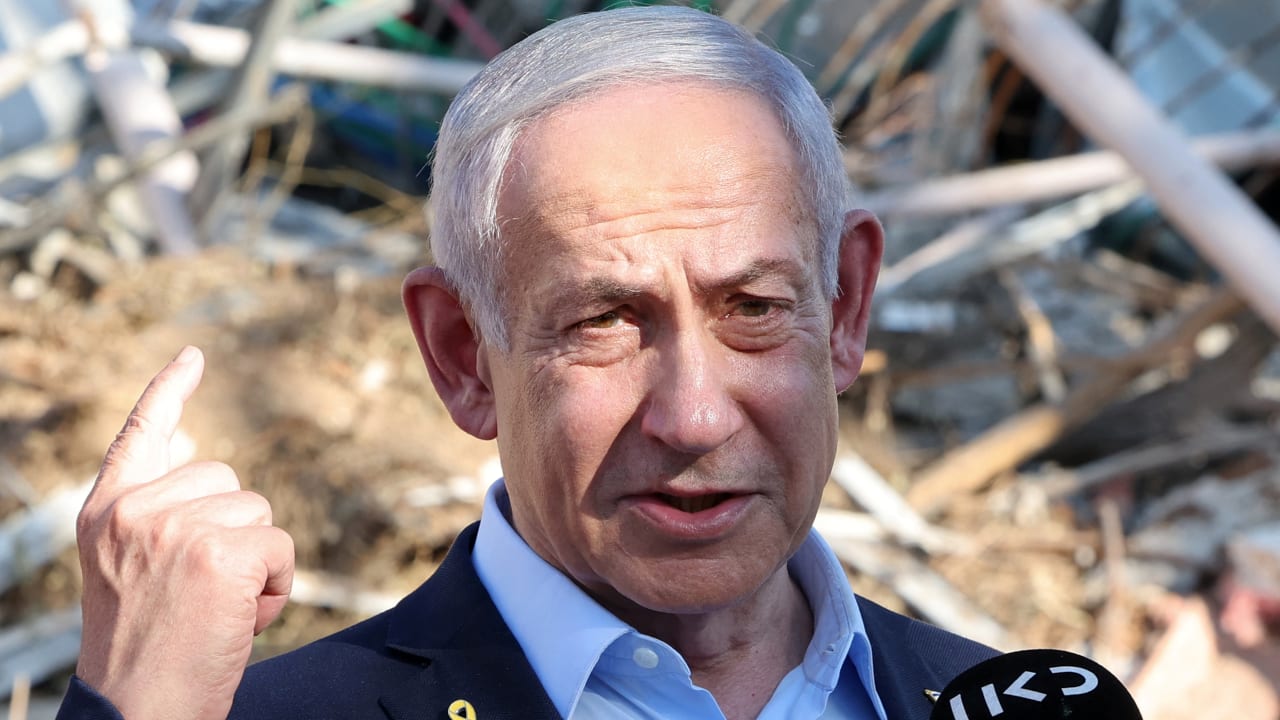
In a striking departure from his usual style, Prime Minister Benjamin Netanyahu opened his post-US attack press conference on Sunday evening by reciting Judaism’s cardinal declaration of faith: Shema Yisrael – “Hear O Israel, the Lord is our God, the Lord is one.”
Like many Israeli leaders, Netanyahu often peppers his speeches with biblical verses, usually used as cultural or historical touchstones, rather than as expressions of personal religiosity.
The most common include Psalm 29:11, “May the Lord grant strength to His people; may the Lord bless His people with peace,” and Isaiah 2:4, “They shall beat their swords into plowshares, and their spears into pruning hooks; nation shall not lift up sword against nation, neither shall they learn war any more.”
Another frequent choice is Psalm 121:4, “Behold, the guardian of Israel neither slumbers nor sleeps.”
Listen to enough speeches, and it can seem like there are only a few verses in the Bible, because the same ones are repeated over and over.

But Shema Yisrael is rarely among them. Israel’s leaders typically invoke it only in sacred or tragic moments, such as when quoting the last words of fallen soldiers or Holocaust victims.
It is usually reserved for speeches on Remembrance Day or Holocaust Remembrance Day.
Indeed, the context in which Netanyahu said the Shema on Sunday night was also Holocaust-related.
“Dear Israeli citizens,” Netanyahu said in his deep baritone voice, lending the words an added weight, “When I was first elected as the prime minister, I took part in the March of the Living at the Auschwitz concentration camp.”
“I felt a strong need to wrap myself in a tallit,” he continued. “So I did, and said: ‘Hear O Israel, the Lord is our God, the Lord is one.’”
He then recounted how 10 days earlier – just hours before Israel’s historic strike on Iran – he had gone to the Western Wall.
“And there, too, I felt a deep need to wrap myself in a tallit. I recited a prayer for the success of our heroic pilots, our great officers and soldiers, the security of our state, and peace for our people.”
This religious framing marked a departure for Netanyahu and was not the usual manner in which the prime minister, who is not an outwardly religious man, generally begins his orations.
It led some to ask, What is going on? Is Netanyahu finding God in the foxhole?
That very question came up a week earlier in an interview with Channel 14’s Yinon Magal.
“Is something religious coming over you lately?” Magal asked Netanyahu, noting the broader spiritual awakening some Israelis have reported since October 7.
The prime minister responded, “There are things that look like miracles, but we should not rely on a miracle. The American Evangelicals who help us a lot say: ‘God helps those who help themselves.’”
He went on: “In fateful moments, you are filled with questions of faith. In the end, either you have the faith or you don’t. Yes, that faith beats inside of me. The sense of shlichut (mission) beats within me.”
Netanyahu has long projected that sense of mission. For years, those who interacted with him came away with the impression that he believed he was placed in his position to stop Iran’s nuclear program.
In the same interview with Magal, he made that belief explicit, saying he inherited his sense of duty from his grandfather and his father, the historian Benzion Netanyahu.
“On his 100th birthday, they held a ceremony for him at the Menachem Begin Heritage Center. For a full day, people spoke about his scholarship and his history books. They praised him,” Netanyahu said.
“And then, at 100, he stood up – sharp as a razor – and said, ‘Thank you very much, but that is not what is important. What matters is that the people of Israel have the necessary powers needed to remove the threat of destruction from Iran. I am sure we can do that. That is what he chose to say after 100 years. Do you understand? I am on a mission,” Netanyahu said.
And this mission, at least judging by Netanyahu’s opening at that press conference, is now being cloaked in foundational Jewish language.
Is the prime minister, at age 75, undergoing a spiritual transition? Only he knows
Netanyahu has always exhibited a strong connection to Jewish peoplehood, history, and heritage, and has publicly expressed his connection to the Bible.
For years, he hosted Bible study sessions at his official residence. His father-in-law was a biblical scholar, and Netanyahu has spoken about how he studied the weekly Torah portion every Shabbat with his sons.
But quoting the Shema amid an existential military campaign marks a tonal shift. It is more than history or heritage;
it suggests that Netanyahu is spiritually internalizing the gravity of the moment, seeing it not just as a national mission, but as one infused with deeper meaning.
Netanyahu’s critics and just everyday cynics will say that this religious turn is tactical, that it's an effort to appeal to religious voters or to curry favor with the haredi (ultra-Orthodox) parties that are key to sustaining his coalition.
But that line of thinking overlooks an important point. If Netanyahu wanted to use faith for political gain, he has had countless opportunities over his four decades in the public eye to do so, but he never did.
That he is invoking this kind of language now is revealing.
Some might also connect Netanyahu’s turn to spiritual rhetoric with the example set by US President Donald Trump. Just a day earlier, Trump imbued his announcement regarding the US strike on Iran with a religious flourish.
“I want to just thank everybody. And, in particular, God. I want to just say, we love you, God, and we love our great military. Protect them. God bless the Middle East. God bless Israel and God bless America.”
If Trump can speak in overtly religious terms, perhaps Netanyahu feels empowered to do the same.
After all, this would not be the first time that the Israeli leader has adopted Trumpian language. Terms like “fake news” and “deep state” have already made their way into Netanyahu’s rhetorical playbook.
And yet, it’s worth noting the irony: Israel is a Jewish state where the boundaries between religion and state are often blurred, yet explicit references to God in political discourse are far more common in the United States than in Israel.
In the US, phrases like “in God we trust” and “God bless America” – popularized by US president Ronald Reagan and a staple of political speeches ever since – are commonplace.
So too are appeals for divine guidance and support. Religious language is part of the civic script.
In Israel, by contrast, leaders may quote biblical verses and say b’ezrat Hashem (“with God’s help”). Still, there is much more reluctance by politicians from non-religious parties to bring God into the political script.
The Bible is typically referenced for its historical or cultural resonance, not as an expression of personal faith.
Politicians often avoid overtly religious language to maintain a broad appeal and circumvent alienating secular voters.
In Israeli political speech, references to the Bible or to God are more about heritage than piety.
Which is precisely what made Netanyahu’s public declaration of Shema Yisrael so striking – and, given the timing, so significant. For one of the few times in his political career, Netanyahu revealed a spiritual side to his persona.