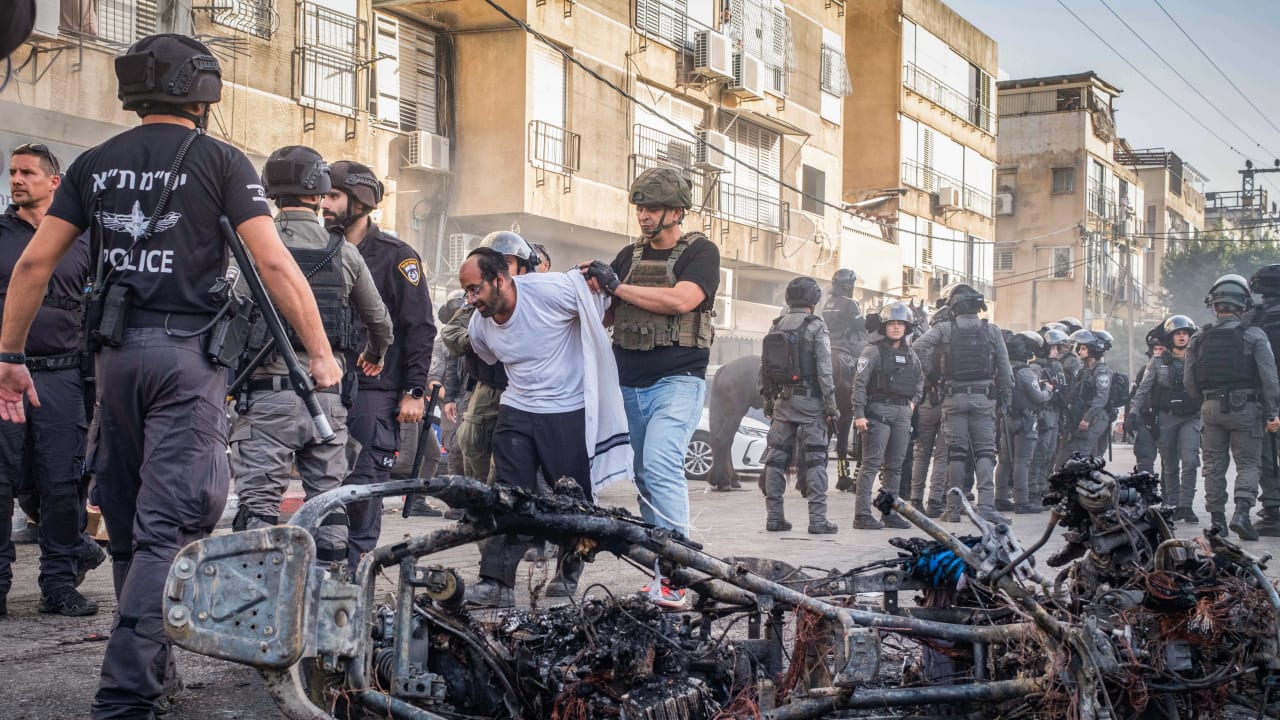
The violent scenes that unfolded this week in Bnei Brak, with police vehicles damaged, officers injured, fierce confrontations in the streets, and mass arrests, shocked many Israelis. But for Eliyahu Berkovits, a researcher at the Israel Democracy Institute’s Ultra-Orthodox in Israel Program, the eruption did not come out of nowhere.
“There is a lot of tension between the police, the state, and parts of the haredi community,” Berkovits said in an interview with The Jerusalem Post following the clashes. “And it is growing by the day.”
The demonstration, which escalated into running street battles between protesters and police, was sparked by efforts to detain draft-eligible haredi youth. Such protests have become increasingly frequent in recent months, particularly in the wake of renewed enforcement against those who ignore IDF conscription orders.
To understand what happened in Bnei Brak, Berkovits argues, one must look beyond a single night of violence and instead trace the internal evolution of haredi (ultra-Orthodox) society over decades.
Broadly speaking, mainstream haredi society in Israel can be divided into three main factions: Lithuanian (Ashkenazi) haredim, Sephardic haredim, and various hassidic courts. These groups, while often critical of state policies, generally acknowledge the state's authority and operate within Israel’s political and civic frameworks.

Alongside them, however, are more hardline anti-Zionist factions, such as the Eda HaHaredit and Neturei Karta, which reject the state's legitimacy and have historically led confrontational protests on issues ranging from Shabbat observance to military conscription.
In the 1960s and 1970s, clashes between religious and state matters were typically spearheaded by explicitly anti-Zionist groups. Every so often, elements of the mainstream would join in, but the leadership largely maintained institutional engagement with the state.
A significant turning point came in 1998: A court ruling that eventually led to the passage of the Tal Law in 2002, which sought to regulate and gradually increase haredi enlistment into the IDF by formalizing deferments for yeshiva students. The law – later struck down and replaced – exposed deep fault lines within the haredi public. Some rabbinic leaders believed engagement with the legislation was necessary in order to mitigate its impact; others rejected any cooperation outright.
Peleg Yerushalmi's hardline anti-draft rhetoric, activism
That internal debate intensified in 2012, when a faction within the Lithuanian haredi community broke away over how to respond to draft legislation. The splinter group, known as Peleg Yerushalmi (the “Jerusalem Faction”), adopted a far more uncompromising stance against enlistment and state enforcement.
Unlike Eda HaHaredit or Neturei Karta, Peleg Yerushalmi is not a separate anti-Zionist stream. Its members come from the same families, yeshivot, and neighborhoods as the mainstream Lithuanian haredim. “They’re growing from within,” Berkovits said. “The same community, the same schools, the same shoes – but a different approach.”
The October 7, 2023, Hamas massacre and the subsequent war reshaped public discourse around military service. For many Israelis, broad draft exemptions became harder to justify amid prolonged fighting and mounting casualties.
Within haredi society, tensions rose as enforcement efforts resumed. Mainstream rabbinic leaders largely refrained from endorsing street confrontations. Just weeks ago, a senior Lithuanian haredi leader, Rabbi Dovid Landau, publicly opposed demonstrations, warning they were harmful.
Yet on Monday, according to Berkovits, two of those arrested in Bnei Brak were affiliated with his yeshiva – an indication, he suggests, that rabbinic authority may be weakening among segments of younger haredim.
Peleg Yerushalmi activists have established hotlines to alert supporters when authorities attempt to detain draft evaders, enabling rapid mobilization. “All of a sudden, you can see tens or even hundreds of people come to confront and try to stop an arrest,” Berkovits said.
The result is a cycle of confrontation: Police arrive to enforce conscription orders, protesters gather quickly, clashes escalate, and images of forceful policing circulate widely.
Haredi society's relationship with the police
Complicating matters further are conflicting perceptions of law enforcement within haredi society itself.
An Israel Democracy Institute (IDI) policy study published in 2024 found that trust in police among haredi citizens is lower than among non-haredi Jews, and perceptions of fairness vary across sub-groups.
Some, particularly more modern haredim, complain of “under-policing,” insufficient response to crime within their communities. Others, especially in more insular circles, argue that police use excessive force and target haredi neighborhoods disproportionately.
“In a way, both groups feel they’re on the same battleground [as both are unhappy with the police],” Berkovits said. “Some think there is too much policing, some think there is not enough.”
Recent incidents illustrate the dilemma. In December, an attempted detention of draft-eligible youths escalated into violence that left police officers wounded and vehicles damaged. About a month ago, a protest near the Bar-Ilan junction turned deadly when a boy was struck and killed by a bus driver, amid confusion over whether police should intervene at all.
“They don’t know what to do,” Berkovits said of law enforcement. “On the one hand, they are not equipped to handle this kind of violence. On the other hand, when they respond strongly, it can make things worse.”
In the hours after the Bnei Brak clashes, political leaders emphasized that the violence does not represent the haredi public as a whole. Berkovits agreed that such scenes run counter to core haredi values, which traditionally stress communal discipline and deference to rabbinic authority.
“I believe the main leaders were shocked,” he said.
But he cautioned against dismissing the unrest as purely marginal. “A lot of people feel really distressed,” he said. “They feel the political system is letting them down, and they have no answers. Maybe it’s too violent, but the frustration is there.”
For Berkovits, what unfolded in Bnei Brak was not a sudden rupture but the visible crest of a long-building wave: internal fragmentation within haredi society, growing pressure from the broader Israeli public over military service, and a police force struggling to navigate between enforcement and restraint.
Whether the events mark a temporary spike in unrest or a deeper transformation in the relationship between the haredi community and the state, he said, will depend on what happens next.