
In easily comprehensible form, Israeli-American attorney Yonatan Green has produced a closely reasoned work on one of the most divisive domestic issues facing contemporary Israel: the appropriate balance of power between the Knesset and the Supreme Court.
Green believes that for some 40 years, power in the State of Israel has been deliberately, consistently, and illegally usurped by the judiciary.
In his detailed, rigorous, meticulous, and insightful work, Rogue Justice: The Rise of Judicial Supremacy in Israel, he scrutinizes how the Supreme Court has misled itself into unbalancing the proper relationship between the judiciary and the government.
Green explains, issue by issue, how Israel’s judiciary has, as he puts it, “gone rogue,” with judges and courts “abandoning law in the most profound, systematic and comprehensive way… The Supreme Court’s experiment with unbridled judicial supremacy has yielded results which can only be described as catastrophic.”
When Hamas launched its bloody attack on Israel on October 7, 2023, it struck a nation torn apart politically by a domestic issue that had tens of thousands participating in anti-government street protests, day after day.
'Reasonableness' doctrine used to overturn government decisions
The Supreme Court had been using a “reasonableness” doctrine to review and, in some cases, overturn decisions of the government and its ministers. As a result, the Knesset had passed an amendment to limit the Court’s use of “reasonableness” in reviewing government decisions.
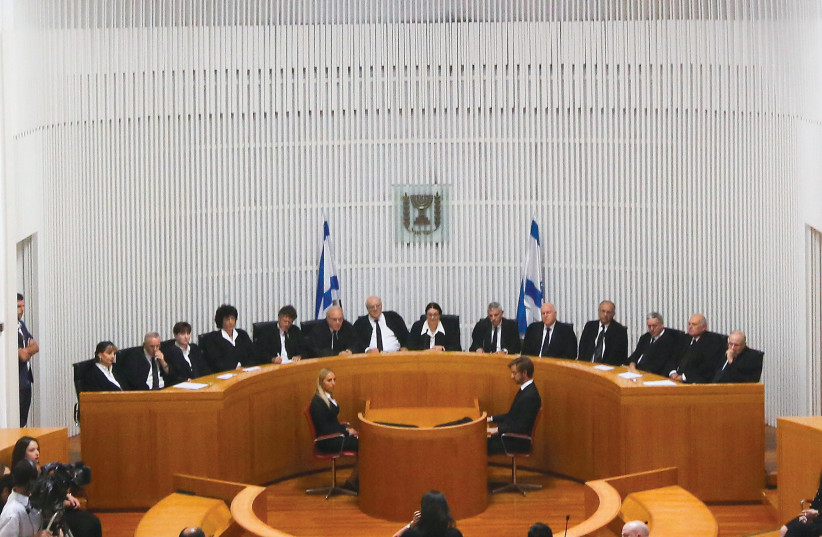
Green begins his analysis of Israel’s judicial system with the meeting of the full Supreme Court in September 2023 to consider whether it would invalidate the legislation explicitly designed to curtail its powers. By an admittedly narrow majority (8-7), the Court did strike it down. For Green, this episode was the clearest proof that the Court now believed that its power over Israel’s governance was absolute and could not be challenged.
In his book, he demonstrates, step-by-step, how, over the last 40 years, the Supreme Court slowly turned itself into the most powerful court in any democracy in the world, usurping powers that were never given to it.
He demonstrates how the Court has methodically taken more and more political power from the Knesset and the government until now, he says, it is “the central arbiter” of almost all important political and social disputes in Israel.
He describes this as “judicial supremacy,” with unelected judges having the final say over many questions that in other democracies are decided by elected bodies.
The author also points out that Israel is one of a small number of Western-type democracies in which trial by jury is completely absent. Instead of being judged by one’s peers, defendants in criminal and civil cases are declared innocent or guilty by professional judges.
This structure, inherited from the courts of the British Mandate, handed more power to the judiciary at the birth of the state than judges exercised elsewhere – a first step on the road to virtually unlimited judicial power.
Green’s purpose in writing Rogue Justice is both to recount how this happened and to warn that such a concentration of power in judges is unhealthy for a democracy, especially one without a formal written constitution.
Instead of a constitution, Israel has “Basic Laws” passed at different times. But without a constitution, there is no clear public agreement on the powers of the Supreme Court.
Green points out that while the UK also lacks a written constitution, “parliamentary supremacy” is its basic constitutional premise. The fundamental principle is that parliament makes law and the courts administer it. In Israel, the courts can overturn it.
The fact that Israel’s Supreme Court and senior judges are chosen by a committee in which sitting judges play a strong role is, says Green, also an affront to democracy. Sitting judges have an effective veto power over new appointments.
When a small group of judges chooses their own successors, thus keeping control of the system, the result, says Green, is a “judicial oligarchy.”
These structural “oddities” have allowed the Supreme Court, once it chose to expand its role, to do so without any serious checks.
The key period of change began mainly in the 1980s and was associated above all with Chief Justice Aharon Barak, whom the author dubs “the indomitable driving force behind judicial supremacy.” Green quotes Barak’s official biographer, Nomi Levitsky: “From the moment he set foot in the Supreme Court, he began leading a profound transformation of Israel’s legal landscape.”
Green argues that the Court presided over a constitutional revolution without any democratically adopted constitution to justify it.
The judges used the Basic Laws to give themselves a strong power of judicial review over Knesset laws.
In most developed countries, Green points out, either courts cannot strike down laws at all, or the judges who can do so are clearly chosen by elected representatives. Israel, however, combines very strong judicial review with weak democratic control over who sits on the Court.
The “reasonableness” doctrine gave the Court enormous discretion. It allowed judges to cancel government decisions they consider extremely unreasonable, even when those decisions were lawful and within the government’s authority. It also gave the Court the power to administer what Green calls “judicial impeachment,” forcing ministers out of office by ruling that their appointments were unreasonable.
Green suggests that these doctrines turned the Court into a kind of “super-legislature” or “constitutional overlord,” able to second-guess almost any decision by elected officials on open-ended grounds. He points to interventions in fields such as welfare policy, military operations, and appointments of senior officials, arguing that the Court now has the final word on questions that in other systems would be mainly political.
He stresses that many Israeli judges and prosecutors are competent and patriotic, and that the Court did important work in earlier decades. However, taken together, the changes he describes have produced a form of “rogue justice” – a court that has left the classic judicial role and assumed a dominant, political one, with too little democratic control.
Green ends on a positive note, providing a range of what he terms “potential avenues for reconciliation and progress.” One is to foster a much wider understanding of the proper function of a judiciary in a Western-style democracy. Another is to revive an idea that existed briefly in Israel’s early days – a constitutional assembly.
Green is a law graduate of the Hebrew University of Jerusalem, and has practiced in Israel and in the United States, privately and for a major American tech firm. His published work on legal issues has been cited by the Supreme Court. Rogue Justice is required reading for as broad a public as possible and will surely have a profound effect on the nation’s perception of the issue.
ROGUE JUSTICE
THE RISE OF JUDICIAL SUPREMACY IN ISRAEL
By Yonatan Green
Academica Press
698 pages; $38