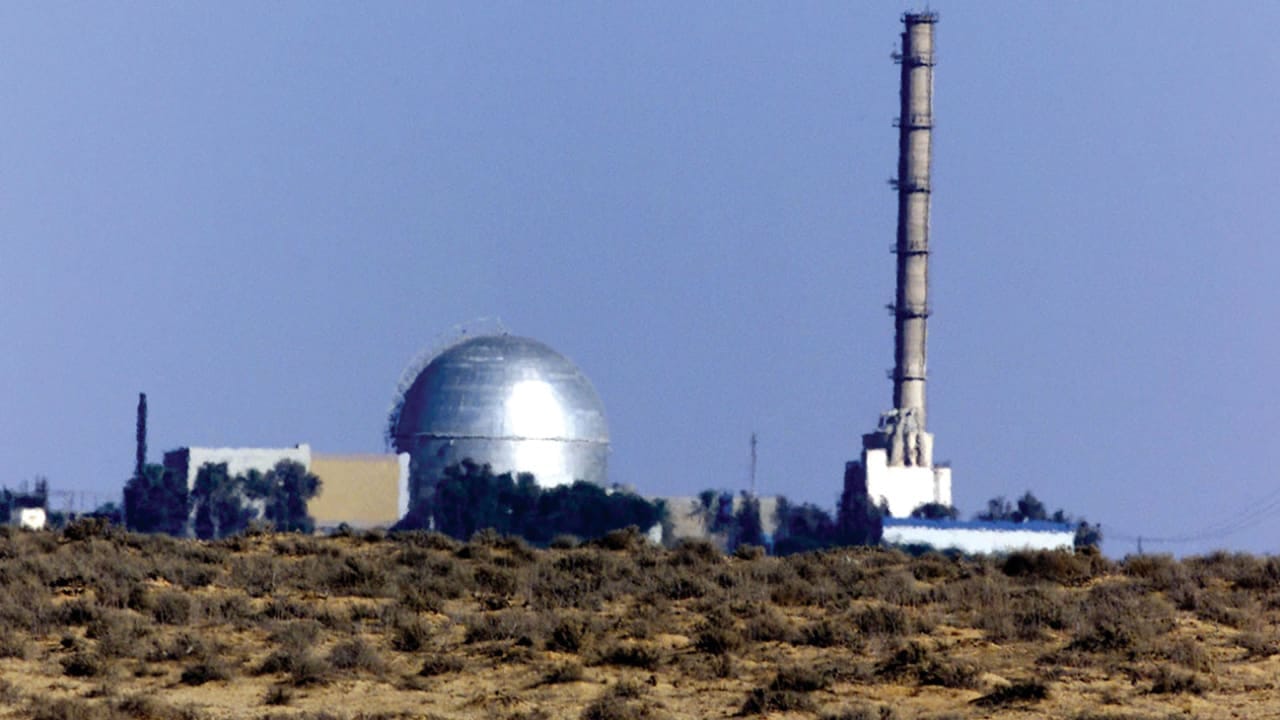
As Iranian missile barrages targeted Israel's southern city of Dimona over the weekend, attention turned to the facility at the Negev Nuclear Research Center, long at the center of one of Israel’s most closely guarded policies.
While Israel’s official position is that the facility is used for civilian and research purposes, it holds a policy of treating its alleged nuclear arsenal with deliberate ambiguity, neither confirming nor denying its existence. Nevertheless, that Israel does indeed possess nuclear armaments is widely viewed as an open secret.
The facility at the Shimon Peres Negev Nuclear Research Center, located roughly 10 kilometers outside the Dimona municipality, is widely regarded as central to Israel’s development of these alleged weapons.
A 2013 report from the International Panel on Fissile Materials noted that it is generally accepted that the facility produced plutonium for the alleged nuclear arsenal.
Further, according to the report, the plutonium is likely generated by irradiating natural uranium fuel in a heavy-water moderated reactor.

Assessments today, such as a 2025 report from the Stockholm International Peace Research Institute, estimated that Israel has a stockpile of around 90 nuclear warheads.
Construction of the nuclear facility began in the late 1950s, reportedly with significant French assistance, which sold Israel a nuclear reactor as part of a broader strategic relationship between the two countries at the time.
Additionally, according to a Norwegian document, Norway sold Israel 20 tons of heavy water in 1959.
Then, in September of 1960, the then-US ambassador to Israel, Ogden Reid, was in a helicopter returning from a tour in the Dead Sea area alongside Finance Ministry official Addy Cohen, when he noticed the construction.
In response to a question from Reid on what it was, Cohen famously replied that it was a “textile plant.”
Although it wasn’t until that year that the US identified the site as a nuclear facility, it wasn’t the first time the US had noticed it. Two years prior, shortly after the start of the site's construction, American intelligence was reportedly made aware of the site when U-2 spyplanes flew over the facility.
Some twenty years later, the Sunday Times published a bombshell report in which then 31-year-old Mordechai Vanunu, a nuclear technician at the facility, shared photographs he had taken of the research center.
The images were examined by nuclear experts, who assessed that they proved Israel had possessed a nuclear bomb production facility for two decades and that the facility produced enough material for the construction of 10 bombs a year.
Among the experts consulted by the Times was Theodore Taylor, a student of J. Robert Oppenheimer, the man considered “The father of the atomic bomb.”
“There should no longer be any doubt that Israel is and for at least a decade has been a fully fledged nuclear weapons state,” Taylor told the paper after reviewing Vanunu’s pictures. “The Israeli nuclear weapons program is considerably more advanced than indicated by any previous report or conjectures of which I am aware.”
Israeli officials’ comments on Israel’s nuclear ability
Nevertheless, the Sunday Times report did not change Israeli policy. The official Israeli position on the matter, both before and after the piece’s publication, has been neither confirmation nor denial.
In the 1960’s, then-prime minister Levi Eshkol vowed that “Israel will not be the first state to introduce nuclear weapons into the region.”
The sentiment has been repeated by Israeli officials in the decades since.
Speaking to Piers Morgan in 2011, Prime Minister Benjamin Netanyahu told Morgan, “We have a long-standing policy that we won't be the first to introduce nuclear weapons into the Middle East, and that hasn't changed.”
Years later, in remarks made during a visit to the facility, Netanyahu asserted, "Those who threaten to wipe us out put themselves in a similar danger, and in any event will not achieve their goal."
Then, at a 2020 Cabinet meeting, in prepared Hebrew remarks on an underwater gas pipeline deal with Greece and Cyprus, Netanyahu said, “The significance of this project is that we are turning Israel into a nuclear power,” before correcting himself to say “energy power.”
Former prime minister Shimon Peres, in 1998, also hinted at Israel’s nuclear abilities.
"We built a nuclear option, not in order to have a Hiroshima but an Oslo," Peres said. In other comments that year, he asserted, “We managed to create sufficient suspicion for there to be deterrent, without having gotten to a status of clarity which would behoove sanctions against us.”
In 2006, in comments his office later walked back, then prime minister Ehud Olmert told German television that Iran was “aspiring to have nuclear weapons, as America, France, Israel, and Russia?"