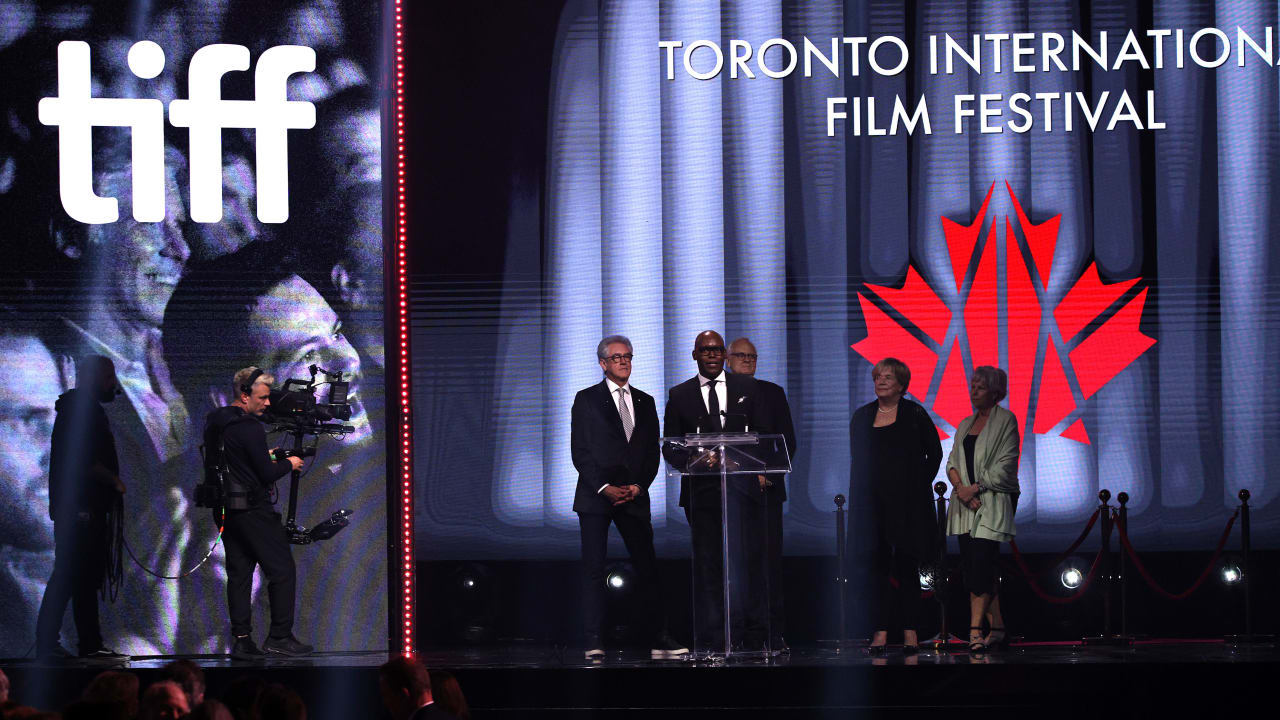
Security was stringent on Wednesday in anticipation of the screening of the October 7-related documentary The Road Between Us at the Toronto International Film Festival. Director Barry Avrich told Deadline he planned to bring his own security team to supplement the festival’s, and Toronto Police told AFP that they had a “strong presence across [the festival].”
The documentary tells the story of Maj.-Gen (Ret.) Noam Tibon, a retired IDF general, who headed south as soon as he heard about the attack from his son, Haaretz reporter Amir Tibon, who was hiding from terrorists with his wife and daughters in their home on Kibbutz Nahal Oz. Tibon helped subdue the terrorists on the kibbutz, and his family survived.
Initial screening canceled then reinstated
TIFF management initially canceled the screening, citing concerns about the filmmakers not getting permission for all the clips shown in the film, which Kan News said referred to obtaining permission from Hamas to include clips of the massacre that the terror group filmed and broadcast widely.
The initial decision to pull the film from the lineup sparked worldwide outrage, including from Jewish groups and filmmakers around the world, and resultant negotiations between the filmmakers and the festival led TIFF to reinstate the film.
“It’s something that I know caused a lot of pain and hurt in the Jewish community in particular, and I apologize for that,” TIFF director Cameron Bailey told Toronto’s The Globe and Mail this week. “So we worked quickly to resolve things with Barry and his team and were able to come to a resolution. But in that time a lot of harm had been done, and a lot of misinformation was out there.”
Avrich told Deadline that the saga of the cancellation and reinstatement was emotionally stressful.
“Did I anticipate that certainly there would be some controversy with the film, debate, and dialogue, because we filmed in Israel? Yes, but that to me was just noise, because again, anybody that would have an issue with the film hasn’t seen it. And so I always hoped… that the takeaway was going to be the family and not the politics. If that’s naive, so be it. But I cared about what [Tibon] accomplished on that day,” he said.
“If you want to protest what’s going on, protest. I believe in protest. I believe in freedom of speech. But if you’re protesting art, what is the point? Where does it stop? Where does it start? Don’t buy a ticket. Don’t go see this film if you don’t like the subject matter.”
On Saturday, a small group gathered near a main TIFF intersection to register its objection to the film’s inclusion, while a general pro-Palestine rally unfolded outside a screening late Sunday evening of an unrelated film, according to The Globe and Mail. A number of films spotlighting the other side of the Palestinian-Israeli conflict, including historical drama Palestine 36 and The Voice of Hind Rajab, are being shown with no comparable objection.
TIFF’s Bailey told The Globe and Mail that he was happy to screen The Road Between Us at the festival.
“I’m very aware and sensitive to the absolute humanitarian crisis that’s going on in Gaza right now. We also have films at the festival that deal with that. We want to make sure that, as a film festival, we are responsibly presenting films that reflect what is one of the worst crises in our world right now, and we’ll continue to do that.”