
Security threats from the West Bank, Syria, and Jordan require a systematic response at the national level and cannot be solved by isolated operations, a senior security official told Walla on Thursday.
The first challenge: The Jordanian border
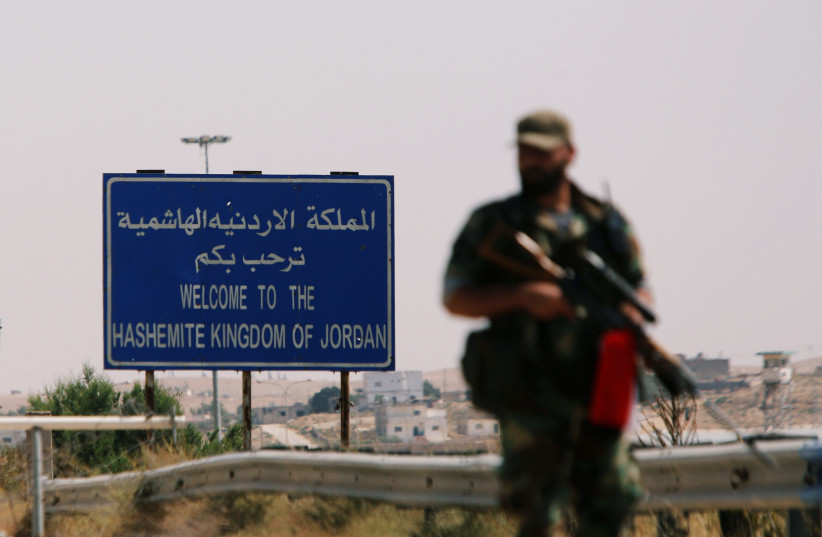
At the Jordanian border, there have been mass cases of smuggling weapons, drugs, and money, some of which end up in the hands of terrorists, arms dealers, or criminal organizations within Israel.
The situation at the border won't improve until the IDF completes the establishment of the Eastern Division under the command of Brigadier General Oren Simcha, with cooperation with the Jordanian side, the security official said.
There is, however, concern about Palestinian cells from Syria and Jordan exploiting the border to infiltrate Israel and carry out attacks.
The security official stated that while there has been a decrease in weapons smuggling along the Jordanian border, "there are still smuggled weapons, and they are being transferred to the West Bank."
The second challenge: The seam line
The security barrier along the West Bank spans approximately 500 km, combined with several border crossings.
"There are quite a few gaps along the Seam Line. Why? Because there is still no fence or wall covering the entire area. There are not enough soldiers to secure the Seam Line and prevent or disrupt Palestinian infiltration into Israeli territory," the security official said.
"The crossings themselves are a weak point because the checks are done when exiting the West Bank areas. If a person is carrying a crate of fragmentation grenades from the Gaza Strip to the West Bank, there is no system or personnel to check them. There is no infrastructure there, and not enough people," the official added.
In the official’s estimation, several billion shekels would be needed to close these gaps and provide proper security checks and infrastructure.
Before the war, a fragmentation grenade in Israel cost 3,000 shekels, and now it costs 400 shekels due to how readily available they are, he said, adding that a taxi entering the West Bank last month was found with 8,000 rounds of 5.56 mm ammunition, each costing ten shekels.
The third challenge: Building terrorist infrastructure
The intentions of terrorist command centers are to build infrastructure, recruit terror operatives, and carry out attacks against Israel.
"There are also regional directives by people who once lived in the West Bank, left abroad, or were expelled, and now they’re directing terrorism,” the official said.
“They are transferring money in various ways: digital wallets, Bitcoin, through various manipulations, including fake companies, and we are fighting against all these phenomena."
The official clarified that addressing these three challenges requires, in addition to the efforts of the division, the Shin Bet, and the General Staff, a systemic response at the national level that will address each of them. He estimated that it would take years to effectively address these three challenges.
"The field is always filled with money that buys weapons, recruits people for terrorist activities, and builds such infrastructure. And if it's not a terrorist battalion, then it's a cell, and if there’s no cell, it's a lone attacker,” he said.
“There’s no shortage of energy of this kind, and therefore, we need to keep operating constantly in the field and create operational freedom of action, with a focus on refugee camps."