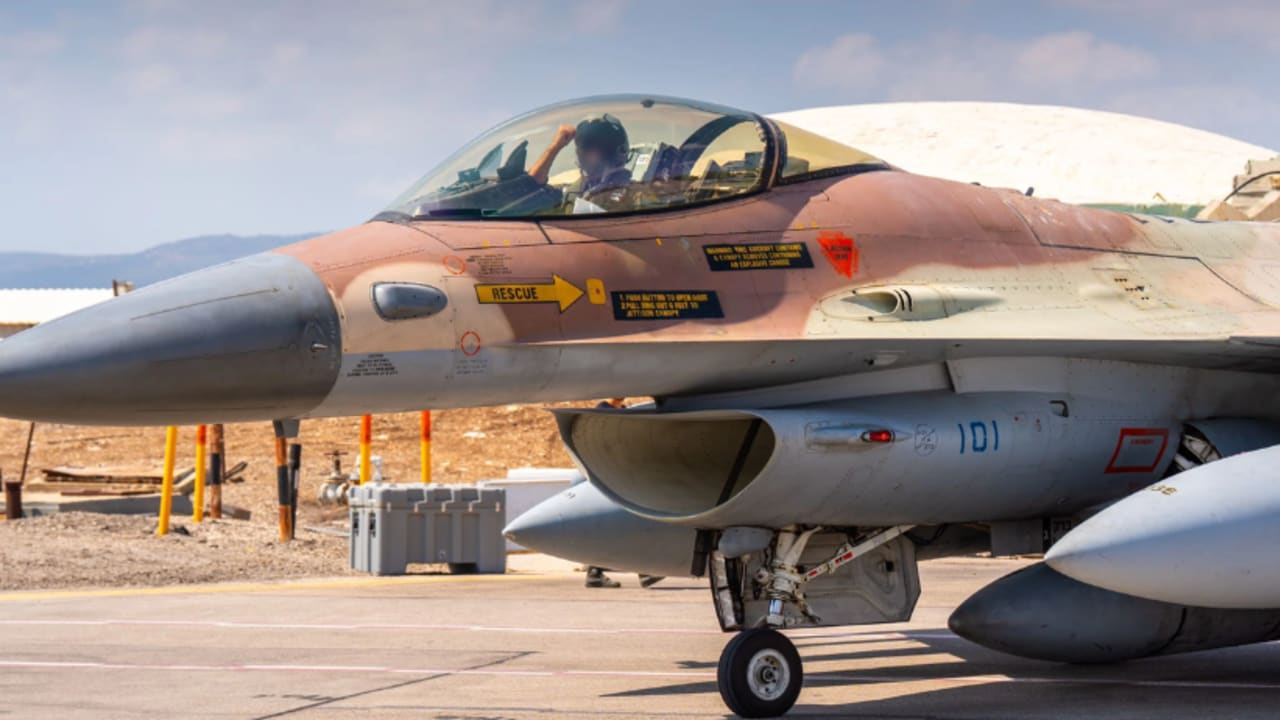
The IDF reported on Monday that it has hit 600 Iranian targets with 2,500 bombs since the start of the conflict on Saturday morning.
It said the pace and effectiveness of the operation were increasing as the air force broadens its air supremacy from Tehran to Western Iran and other areas.
Military sources added that they hoped to have a period of some weeks to strike regime institutions that have oppressed Iranian protesters, to provide the potential conditions for the demonstrators to topple the regime.
Although the army initially was most focused on reducing Iran’s ballistic missile firing capabilities, significant aspects of its targeting have shifted to harming the Islamic regime itself.

The IDF’s 1,000 aerial sorties destroyed hundreds of ballistic missiles and potentially a decisive number of missile launchers, as well as 200 air defense targets, and 20 Iranian leadership targets, each of which included many senior officials.
Two senior members of Iran’s Intelligence Ministry were among those killed, as the Israel Air Force attacked the ministry’s Tehran headquarters.
The ministry serves as the Islamic regime’s main intelligence body, the IDF said.
High-value targets eliminated
Those killed in the strike included Sayed Yahya Hamidi, deputy intelligence minister for “Israel affairs,” and Jalal Pour Hossein, head of the ministry’s espionage division.
Hamidi has, in recent years, led Iran’s terrorist activities targeting Jews, Western officials, and regime opponents in Iran and abroad, the army noted.
While the IDF referred to having killed several hundred regime supporters, an Israeli source told The Jerusalem Post that between 1,000 and 1,500 members of the Islamic Revolutionary Guard Corps had been killed. Questioned about the higher numbers, military sources had not responded by press time.
There were also reports of aerial assaults on Iranian regime forces near the Kurdish area on the Iran-Iraq border.
This area has previously contained large segments of armed and organized Iranian-Kurds who view the regime as a hated occupier. IDF sources refused to address the issue, but notably did not deny the reports.
The US hadn’t released as thorough updates by press time, though on the first day of the war, it said it had hit 900 targets, nearly twice the number struck by Israel.
Israeli officials continue to credit American forces with an incredible volume of attacks.
Whereas US President Donald Trump has played with ending the operation much sooner, or at most shutting it down within about four weeks, IDF sources want the operation to go on as long as possible to harm the ballistic missile capabilities and weaken the regime even more in favor of the Iranian protest movement.
Nineteen Israelis were wounded after an Iranian ballistic missile made a direct hit on Beersheba on Monday. All of them were evacuated to Soroka Medical Center, with one in moderate condition and a further 18 lightly wounded.
The local municipality said scans were taking place for further casualties within the wreckage caused by the missile, which was said to have destroyed several homes in the area.
Meanwhile, the Home Front Command on Monday said that it was leaning toward reopening Ben-Gurion Airport and Israeli airspace late Monday evening or Tuesday morning.
This appeared overly optimistic, however, as other Israeli officials later on Monday suggested that more open skies would not happen for several days, possibly until early next week.
The situation is dynamic, the IDF emphasized, and could evolve depending on threats from Iran and Hezbollah, and whether Yemen’s Houthis get involved, although they have not yet.
As of Monday morning, the Home Front Command reported fewer missile siren warnings, but said those salvos of missiles that Iran did fire were more synchronized.
Whereas, on Saturday, ballistic missiles were fired from all over Iran, now they were more organized around a few specific locations.
Most salvos have ranged from 9 to 30 missiles at a time, a pattern more similar to the later days of the June 12 Day War.
There are indications that Iran would have liked to have fired more missiles at Israel, the IDF said, but there are also indications that it has split its missile forces this time, firing several hundred rockets at other countries, attempting to pressure the US into a ceasefire.
By Monday night, much of the country had not been fired on by Iran since early afternoon.
Regarding the direct hit in Beit Shemesh on Sunday, the IDF revealed that most of the people in the safe room one level below the synagogue’s main floor were not killed.
According to the IDF, more people in the safe room survived and were less harmed than those outside the safe room.
The IDF complimented rescue workers for pulling out many people from the wreckage and saving many lives.
An initial probe indicated that part of the reason for the Iranian missile’s hit on Beit Shemesh was that its trajectory changed or it otherwise had a defect that led it to strike earlier than when Israel’s air defenses had projected.