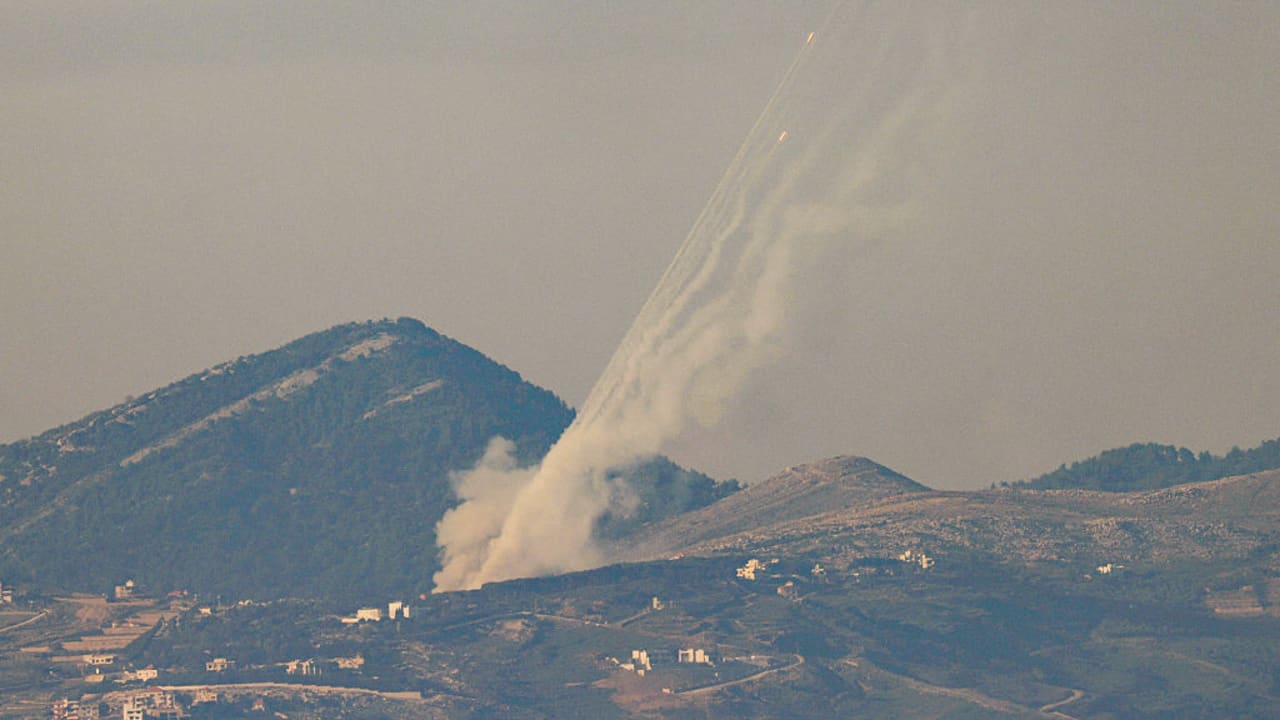
Israel needs to either completely destroy Hezbollah or create a buffer zone up to the Litani River, according to Golan Regional Council deputy chairman Ya’acov Selevan and Kfar Giladi resident Nissan Ze’evi.
They spoke on Thursday after a night of intense missile fire from both Hezbollah and Iran.
Hezbollah terrorists launched about 200 rockets against northern Israel in a single barrage on Wednesday night, KAN News reported.
The buffer zone created by the IDF in Syria had largely protected Israel from an attack on this front, but the danger coming from Lebanon is still very real, Selevan said.
United Hatzalah treated five people on Wednesday when a residence was hit in a Hezbollah attack. Since the Iran War began, there have been no civilian fatalities in the north.

“These things [Hezbollah missiles] can kill people,” Selevan said, adding that unlike the missiles fired from Iran, “The warning time is zero… you duck and cover your heads.”
Life could not continue as normal under Hezbollah fire, and the well-being of children, civilians, and the economy would continue to suffer after only just now beginning to recover from the Israel-Hamas War, Selevan and Ze’evi said. Nevertheless, they said they would be willing to spend a month under fire, stuck in a bomb shelter, if the IDF could “get the job done.”
Hezbollah initially began attacking Israel on October 8, 2023, a day after the October 7 massacre.
Golan Regional Council head calls for returning Lebanon to the Stone Age
The latest round of attacks from the Iran-backed Lebanese terrorist group came in response to the targeted assassination of Iranian supreme leader Ayatollah Ali Khamenei, whom the group had sworn its allegiance to.
It was time for Israel to follow through on its threat to return Lebanon to the Stone Age if Hezbollah continued to attack, Selevan said.
Former defense minister Yoav Gallant had warned former Hezbollah leader Hassan Nasrallah, who also died in a targeted assassination: If “an escalation or conflict develops here, we will return Lebanon to the Stone Age. We will not hesitate to use all our power and erode every inch of Hezbollah and Lebanon if we have to” in 2023.
The operations against Hezbollah proved largely successful, and most the its senior leadership was wiped out.
Nevertheless, Hezbollah still has an arsenal of about 25,000 mostly short- and medium-range rockets and missiles, at least 1,000 suicide drones, and 40,000 to 50,000 personnel on active duty, with another 30,000 to 50,000 reservists, Dr. Zoe Levornik, a nuclear-policy and security researcher and analyst at the Alma Research and Education Center, previously had told The Jerusalem Post.
Selevan said: “We expect the Israeli army and the Israeli government to finish it… Bring [Lebanon] back to the Stone Age.” Everyone understood that Israel is “not trying to occupy land; we are trying to survive,” he added.
Selevan, an IDF major who served in Gaza, contextualized the level of damage Hezbollah is capable of doing. In one small village on the border, his unit found more advanced, high-quality missiles stored in civilian homes than there were in Hamas’s entire arsenal, he said.
Northern border residents determined not to leave after October 7
Despite the apparent risks, and acknowledging Hezbollah may still be capable of carrying out an invasion, even though it now prefers guerrilla warfare, “We are here to stay,” Selevan said.

Ze’evi, a father of four, said he was frustrated that Hezbollah has been allowed to become a significant threat, and that Jews were “made refugees in their own homeland” after being evacuated from their communities.
Residents in the North were determined not to leave again, he said, adding: “This time, we need to make sure this threat is eliminated.”
“We have a second chance after what happened on October 7... We will not allow this threat to be here right next to us,” Ze’evi said, adding that Hezbollah is undoubtedly stronger than the Lebanese government’s forces, and thus, the responsibility remains Israel’s.
“After October 7, everyone learned that when your enemy says he wants to wipe you out, he really means it,” he said.
Ze’evi spoke about the difficulty he faces as a father, knowing he cannot keep his children locked in the bomb shelter 24 hours a day, despite the threat posed by anti-tank missiles only a stone’s throw from the border communities.