
Trouble is brewing in the governing coalition as MKs are split over where to place their legislative support.
N12 reported on Tuesday evening that the haredi (ultra-Orthodox) parties made clear there will be no movement on judicial reform until the Conscription Law passed. “We unequivocally conveyed that no law will pass until the draft exemption law is approved… we are not interested in judicial reform,” it was reported to have been said by United Torah Judaism.
Earlier on Tuesday, other coalition MKs spoke about the Conscription Law as it has been floated to contain. MK Eli Dalal (Likud) told Army Radio that they do not want a situation “where 170,000 people are exempt.”
Dalal added that “Everyone should be recruited, including the ultra-Orthodox.”
MK Ohad Tal (Religious Zionism) told The Jerusalem Post that "not looking to force conscription.” He lamented the banter, as he said it is impossible to be for or against the passage without anything concrete on the table. “Everyone has their own ideas,” he said.
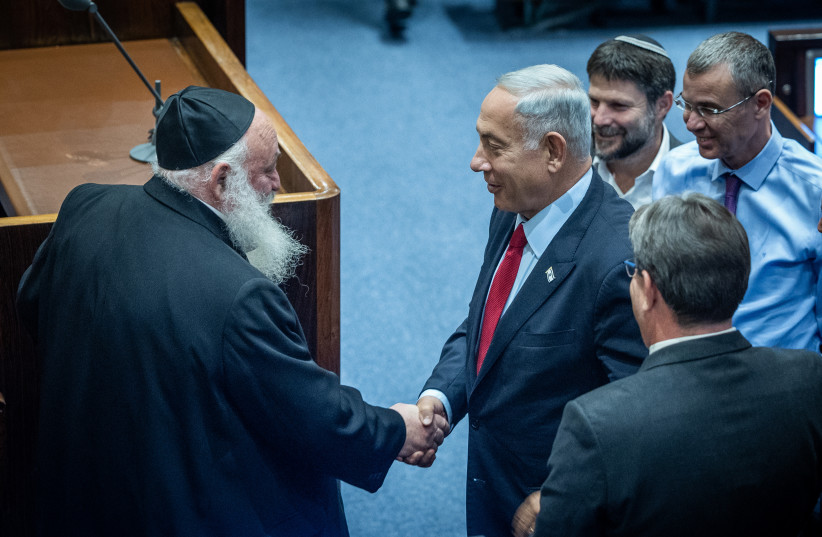
Yesterday it was reported that Prime Minister Benjamin Netanyahu spoke to the haredi parties, United Torah Judaism and Shas, and asked them to cancel or severely soften their requests for the new bill. Netanyahu reiterated warnings that such a bill could severely harm the IDF’s status as a People’s Army.
Hebrew media reported that the haredi parties rejected the premier’s pleas, and the Likud for their sake released a statement denying the reports.
Haredi parties threaten to dissolve government
The haredi parties have said they wish to pass the bill as soon as the Knesset reconvenes after the Jewish High Holidays in mid October. If not, they warned, they will dissolve the government.
The new draft bill they hope will offer a blanket exemption to all students studying full time in yeshivot.
Within their request for a new bill, they want to include a clause that would make the bill exempt from judicial review by the High Court of Justice. This is in response to the fact that the High Court struck down the most recent incarnation of a haredi draft bill, National Service Law, which they said was too sweeping and violated equality. The bill has since been delayed more than a dozen times, with the most recent deadline for a new law set for March 31, 2024.
If a new bill is not passed by then, the IDF can begin to send out draft notices to all 18 year old’s in the ultra-Orthodox sector - as is done to all other Israelis.
The proposed Conscription Law seeks to lower the age of permanent exemption from 26 to 22, with a focus on promoting engagement in national service and employment within the haredi sector. To offset potential backlash, the bill is set to include an increase in benefits for those who are drafted or serving in the reserves.
Critics have said this bill, like the previous one, is too sweeping. Opposition MKs have spoken out about this, with Yisrael Beytenu head Avigdor Liberman essentially making his entire party platform about drafting the ultra-Orthodox. More so, it could have long-term effects on the IDF’s readiness as the haredi sector continues to grow and take up a sizable percentage of Israel’s population. This much was reiterated by terrorist group Hezbollah’s leader Secretary-General Hassan Nasrallah, who said a “major blow to [the IDF] will be if the Knesset approves the new Conscription Law.”
As it pertains to opposition criticisms, Tal mentioned that even when opposition MKs speak out about drafting all members of the haredi population, it is not actually what they want. “It is clear they don’t. The IDF does not want it either,” he said.
There is a fear as well that the bill in its proposed form will lead to a new string of protests throughout the country - and even coalition voters will speak out.
Haredi leaders have said that Torah study is an essential service to the country - and proposed a Basic Law to that effect - and that military service is not needed. This is not a universally held religious belief, as religious Zionism leaders heavily promote military service in their communities as a Biblical commandment, and even today a large percentage of them serve as officers in the military while completing complementary yeshiva studies.
He also said any plan must be made with all security implications in mind. The law is currently being formulated in part with coalition leaders, the IDF, and the Defense Ministry.
Hebrew media has reported that there are not currently the votes or support to pass the law as it has been floated, and a UTJ source told ultra-Orthodox media outlet Behadrei Haredim that “There will be a majority in the Knesset for the Conscription Law formulated with the Defense Ministry, because otherwise, there won't be a majority for anything in the Knesset,” again reiterating the threat of disbanding the government if the bill is not passed.