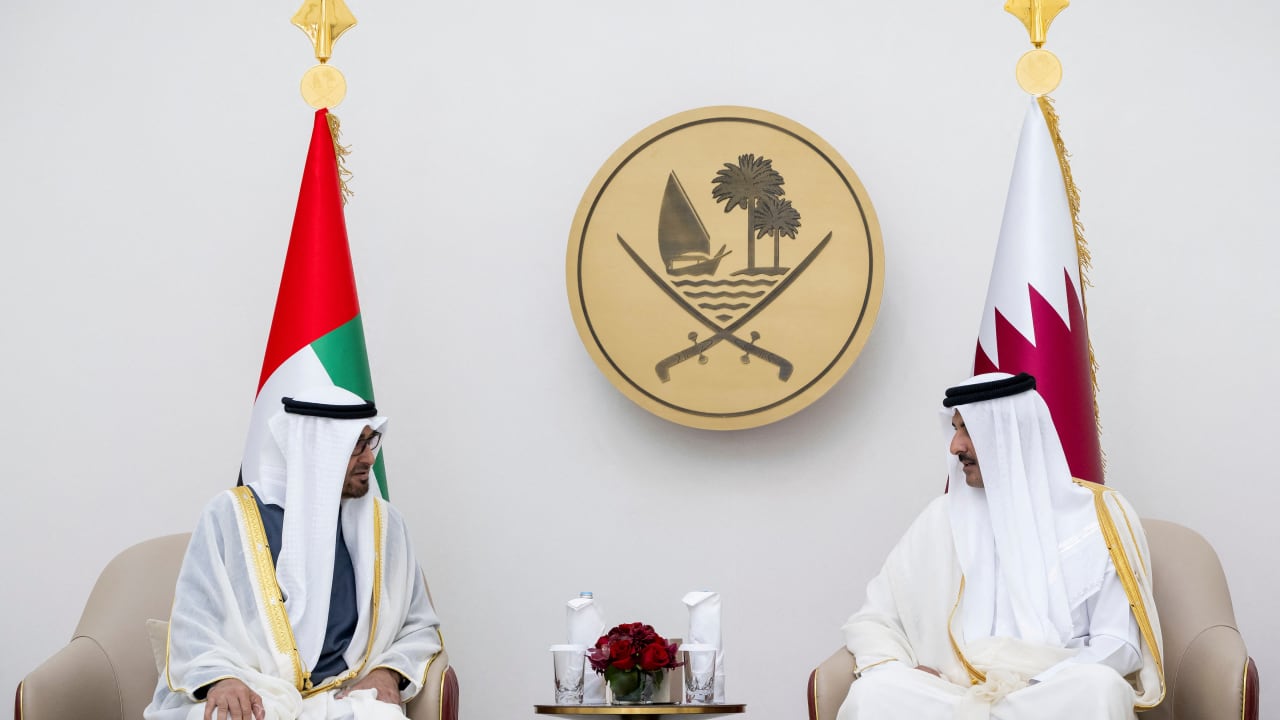
UAE President Sheikh Mohamed bin Zayed Al Nahyan spoke with several regional leaders about the current Israel-Iran conflict in the wake of the US airstrikes on Iran.
According to reports, he corresponded with Kuwait’s Emir Sheikh Meshal al-Ahmad al-Sabah, Qatari Emir Tamim bin Hamad Al Thani, and Saudi Arabia’s Crown Prince Mohammed bin Salman.
The UAE is seeking to de-escalate the situation and is working on multiple tracks to achieve this goal. Per the United Arab Emirates’ Al-Ain media outlet, the country has been working on a diplomatic track, with the president leading these efforts.
The second track is humanitarian. Abu Dhabi has evacuated its nationals from Iran in coordination with local authorities. It has also exempted Iranian nationals in the UAE from specific fees.
A third track is what the UAE described as an environmental track. “In coordination with international partners, [this included] monitoring developments related to the situation surrounding Iran’s nuclear facilities after their bombing, to ensure there are no repercussions for the UAE and the region,” Al-Ain reported.

“The UAE is the voice of reason and a pillar of peace, stability, and prosperity,” Dr. Anwar Mohammed Gargash, the diplomatic adviser to the UAE’s president, said in a blog post.
“In light of these exceptional regional circumstances,” he continued, “we have absolute confidence in the wisdom of our leadership, led by [Sheikh Mohamed bin Zayed Al Nahyan] to steer the country with insight and steadfastness.”
Abu Dhabi is concerned about the conflict in the region. It has called for an end to the escalation and warned of repercussions.
In a statement, the UAE’s Foreign Affairs Ministry said that it was important to prioritize diplomacy and dialogue to resolve disputes within comprehensive approaches that achieve stability, prosperity, and justice.
“It reiterated its call for the international community to mobilize efforts to reach a comprehensive solution to these sensitive and dangerous developments that will protect the region and its peoples from the scourge of conflict,” Al-Ain said.
Regional outreach
The UAE has reached out to at least 36 countries in its efforts to reduce tensions and bring peace, the report added.
This move reflects “the UAE’s belief that the situation in the region necessitates coordinated regional and international action to de-escalate the situation,” Al-Ain went on to say.
“Since the outbreak of the military confrontation between Iran and Israel 10 days ago, hardly a day goes by” without the UAE’s president and his Deputy Prime Minister and Foreign Affairs Minister “Sheikh Abdullah bin Zayed Al Nahyan conducting diplomatic contacts with leaders and officials around the world to discuss de-escalation,” the report added.
Abu Dhabi believes that a diplomatic approach can work. “We must move quickly toward a clear goal, which is to immediately stop what is happening before things get out of control,” a statement from the UAE noted. This could involve regional countries as well as the UN.
Meanwhile, The National in the UAE noted that Gargash slammed Finance Minister Bezalel Smotrich.
Smotrich’s audacity “has reached the point of calling for Gulf (and German, French, and British) funding for Israel’s war on Iran,” Gargash wrote in a post on X/Twitter.
“Such a proposal is nothing but moral bankruptcy from an extremist who fails to grasp the consequences of escalation,” Gargash continued.
He was responding to comments that Smotrich had made on Channel 14. The reports regarding these comments on Channel 14 have indeed raised eyebrows in the Gulf and around the region.