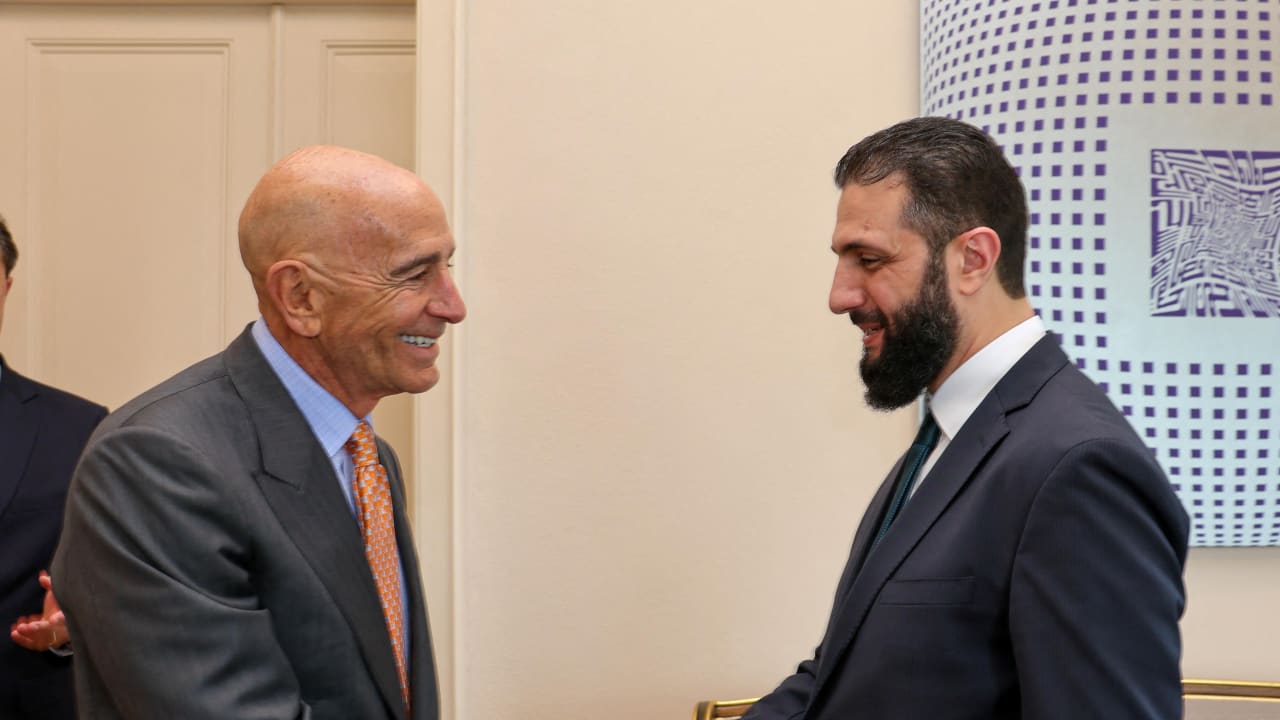
US Envoy to Syria Tom Barrack has a clear message for the US-backed Syrian Democratic Forces (SDF).
“So there’s a big sentiment that because they were our partners, we owe them. The question is what do we owe them? We don’t owe them the ability to have their own independent government within a government,” he said on Friday.
Barrack’s latest comments come as part of a greater context which is that the policy of the United States is to have a single Syria and a single army and not to support federalism.
Barrack has tried to work with the Syrian government to encourage the integration of the SDF with the backing of the US military. This process began in March when SDF leader Mazloum Abdi flew to Damascus and signed a deal with Syrian President Ahmed al-Sharaa.
The US role in Syria comes under the umbrella of Operation Inherent Resolve, conducted by the Combined Joint Task Force that was established to defeat ISIS. This comes under CENTCOM’s area of operations.

State Department skeptical of SDF
While the Pentagon has worked closely with the SDF, the US State Department and diplomats have been more skeptical of this relationship dating back to the era of the Obama administration with John Kerry seemingly skeptical of the US role in Syria.
During President Donald Trump’s first term, US envoy James Jeffrey was also skeptical of the SDF, calling the arrangement with them “temporary, tactical, and transactional.”
In essence, US diplomats have historically preferred that the United States work directly with Damascus. During the Assad regime era that wasn’t possible. As such, they preferred to keep any other group at arm’s length.
Now, Barrack is the main US official working on Syria.
Barrack has reached out to Gulf countries regarding Syria. He has also reached out to Israel and Lebanon. As such, his role appears to go beyond just Syria.
He is not only working to engage with Damascus, he is also the American ambassador to Turkey.
His comments about the SDF are therefore raising eyebrows. The US appears keen to move faster. That means US troops could leave, or their role could shift. The US has reportedly repositioned troops from some areas on the Euphrates River to consolidate them in eastern Syria.
There are security concerns regarding ISIS and the ISIS detainees in Al-Hol in eastern Syria. Eastern Syria is still controlled by the SDF. However, integration would see the Syrian army deployed there.
Some voices in eastern Syria, particularly Kurds, are concerned that the new Syrian army has officers who were involved in crimes against Kurdish civilians dating back to 2018-2019. They are therefore wary of a different force in eastern Syria.
The context of Barrack’s comments is that the US is not backing an autonomous region in eastern Syria.
The US isn’t backing an “independent” region, he said. “We owe them to usher an on-ramp to a new regime in which there’s going to be reasonableness in how they integrate with one Syrian government.”
These seem like tough comments for the SDF after they sacrificed greatly to defeat ISIS alongside US forces.
Supporters of the SDF feel they should receive more for their efforts, and not be cast aside as if they were just any other area of Syria. They have worked with the US for a decade in eastern Syria.
However, there are other contexts.
The Kurdistan Workers Party or PKK is disbanding and laying down its arms. This is seen as a positive development for Turkey. The PKK has been linked to the People’s Protection Units (YPG) in eastern Syria. The YPG formed the backbone of the SDF when it was founded in 2015.
As such, Ankara sees the SDF as linked to the PKK.
Ankara wants the SDF to integrate or disappear. Ankara has been against any kind of SDF-run entity in eastern Syria.
Barrack, as ambassador to Turkey, understands Ankara’s concerns.
“Kurds, however, are concerned about centralization of power and the prominence of Islamic law in the transitional constitution adopted by the interim government. Kurds have called for federalism and repeatedly denied that they seek to divide Syria,” Kurdish media outlet Rudaw, in Erbil, noted.
Barrack has said that while the US will help mediate between Damascus and the SDF, “We’re not going to stick around. If you guys don’t agree, don’t agree. But we’re not going to be here forever as the babysitter and the mediator.”
He is clear, there isn’t going to be an SDF “state.”
Barrack is trying to lower expectations and be realistic in his comments. However, the question is whether this will weaken the position of the SDF and make Damascus feel it can wait a bit longer and then force the SDF into a worse deal.
On the other hand, Damascus should want the SDF’s competence in its ranks. The SDF was trained by the US and has proven itself as a force of stability in Syria. The region is watching.
Al-Arabiya reported on Barrack’s comments, noting that the US military “does not plan to stay in Syria forever.”
Gulf countries want to see what the US commitment will be in the future. They are wary of a power vacuum. They also know that Turkey and Iran may enter that vacuum.