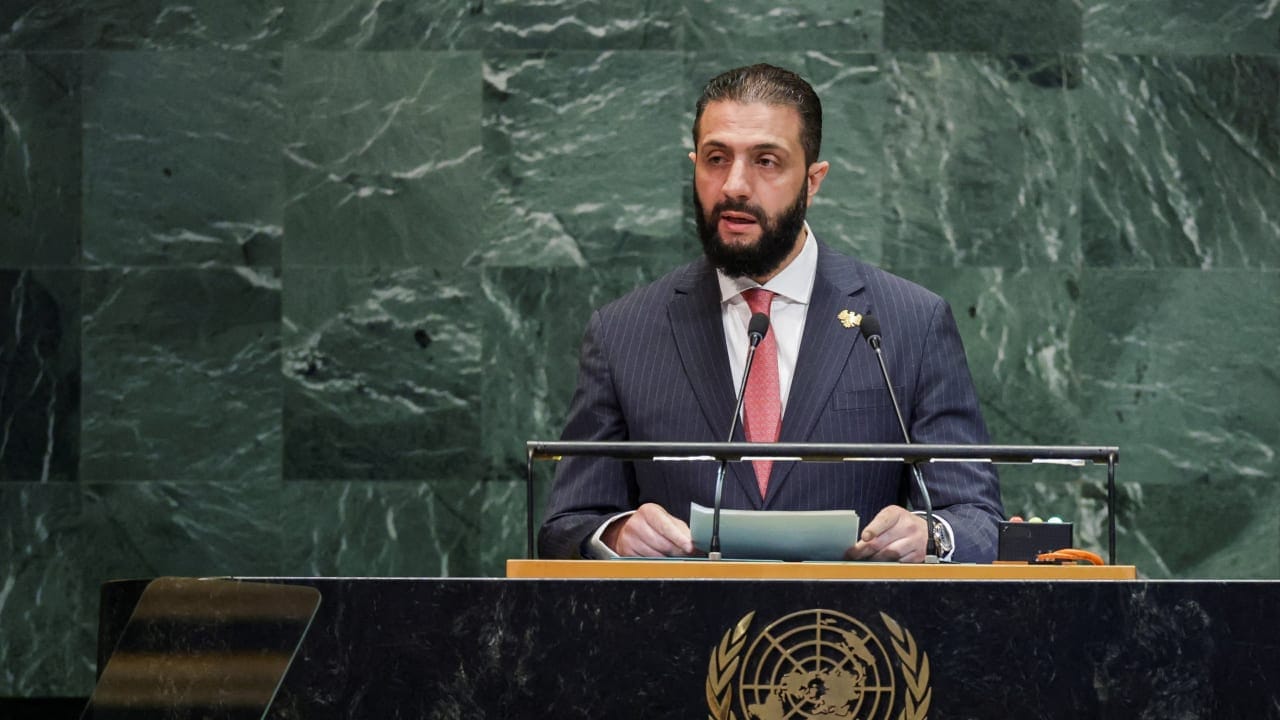
Syrian President Ahmed al-Sharaa spoke at the UN General Assembly this week. He has become the star of the meetings on the sidelines of the UN.
In some ways, this makes sense because he represents how Syria is coming in from the cold after decades in which it was often seen as a pariah in the international community.
High-level Syrian officials had not visited Washington or New York in decades. This has all changed now.
The mere fact that a government changed and transitioned from a dictatorship to a fledgling, struggling democracy, however, isn’t usually enough to get star power at the UN.
First of all, the UN is not primarily composed of democracies, so being a new young leader isn’t particularly interesting to some of the member states. Secondly, leaders come and go. So, why is Sharaa different?

Many Arab states and other countries feel that Sharaa represents a new form of leader, one that people want to meet. One of the highlights of his trip to New York was a meeting with Ukrainian President Volodymyr Zelensky.
They met at UN headquarters on the sidelines of the General Assembly. Syrian Foreign Minister Asaad Hassan al-Shaibani and members of the official delegation attended the meeting, according to Syrian state media.
The Zelensky meeting is important, being that both countries have suffered under Russian attacks. Russia backed the former Assad regime, and Russia invaded Ukraine in 2022.
Russia's Syria intervention emboldened Putin in Ukraine
In fact, Russia’s decision to intervene in Syria in 2015 may have paved the way for Russian President Vladimir Putin’s more aggressive stance on Ukraine. Once Moscow believed it was winning in Syria, it felt it could do the same in Ukraine.
Russia invaded Ukraine initially in 2014 to pry loose Crimea and two provinces in the Donbas region of eastern Ukraine. As such, the Russian aggression in Ukraine and Syria has been linked.
Sharaa has held many other important meetings. He met with the Turkish delegation. He met with US President Donald Trump, which was their second meeting this year after Saudi Arabia brought the two men together in the spring. He also met with Greek Prime Minister Kyriakos Mitsotakis.
It’s clear that Sharaa has a presence, and that everyone seems to want to meet him. This illustrates how hungry many countries were for new leadership in Syria.
Syria had plunged the Middle East into chaos during its civil war from 2011-2023. The civil war created a power vacuum, and ISIS emerged in that vacuum.
ISIS then took over part of Syria and Iraq in 2014, committing a genocide of the Yazidi people in Iraq that year. Russia and Iran intervened in Syria. Israel also did, and the US sent troops to fight ISIS.
Most Middle Eastern countries felt their foundations shake because of the intervention of countries in Syria and the rise of extremism. They were happy to contain ISIS and then see it defeated.
The Assad regime had created a weak state that invited other states to take over parts of Syria. This represented a low point for the Arab world because it meant that most Arab states were no longer masters of their destiny.
The shift in Syria comes at a time when many Arab states also feel a shift in their fortunes. As such, Sharaa and his trip to the US may represent a new era for these countries. For that reason, he has achieved star power in New York.