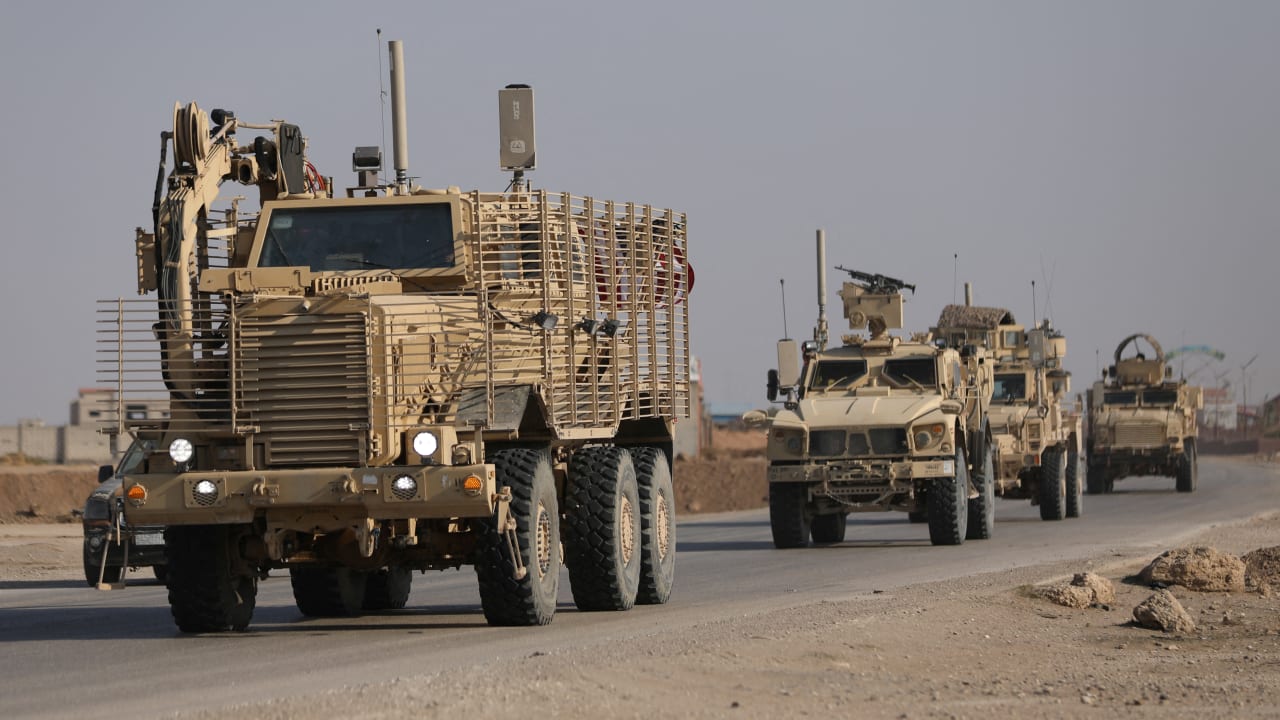
In 2018, the head of US Central Command made a surprise visit to a lonely outpost of America’s war against ISIS. General Joseph Votel visited the Tanf garrison in southern Syria. This was a base where several hundred American troops were training Arab fighters against ISIS. At the time, many people hadn’t heard of Tanf and didn’t know what the US was doing there, or how US troops ended up in southern Syria in the first place.
Reports at Reuters and other outlets on February 11 said that the US is now leaving Tanf. Confirmation of the redeployment has not been received, but the possible withdrawal was largely expected. This is because the US role in Syria is changing. The US ended up at Tanf as part of the war on ISIS. ISIS is mostly defeated. The Arab troops that the Americans were working with have now become part of the Syrian Interior Ministry forces, after briefly serving with Syria’s 70th Division.
This leads to the question of whether this change in control may affect the region. Will a reduction in US forces in Tanf and in other areas in Syria lead to a power vacuum? Is the new Syrian army prepared to assume the security responsibilities necessary in the desert area where Tanf is located? To answer this, it is worth understanding how the US came to be at Tanf and what role it played.
To understand Tanf, we need to go back to the first years of the Syrian civil war. After the revolution against Assad broke out in 2011, a number of Syrian rebel groups emerged in southern Syria’s Dara’a. At the same time large numbers of Syrians, eventually hundreds of thousands, fled to Jordan. Dara’a is a Syrian province bordering Jordan. It is also near the Druze area of Suwayda and near the Golan.
After the rebellion began in 2012, the Jordanians and some Western governments began supporting Syrian rebel groups. There was an operations room in Jordan tailored for this support. While the Dara’a rebels were relatively easy to work with and came from large clans that often had links to clans in northern Jordan, the situation further east was more complex. In the Syrian desert that stretches from Suwayda to the Middle Euphrates River Valley, there was basically an ungoverned space. Into this space came a variety of groups over the years. Syrian rebels, ISIS, Syrian regime forces, and also Iranian-backed militias.

The origins of Tanf
Tanf was originally an agricultural station during the Syrian regime. In the desert near the Jordanian border, a large displaced persons camp named Rukban grew. The US-led Coalition has been fighting ISIS since 2014, and it has partnered in Syria with the Syrian Democratic Forces, a mostly Kurdish-led group in eastern Syria. At Tanf, the US partnered with local Arabs who formed a group called the Maghawir al-Thawra. As the fortunes of the Syrian rebels ebbed and flowed from 2016 to 2017, the Syrian regime crept closer to Tanf. Eventually, in 2018, the Syrian rebels in Dara’a surrendered to the regime, and Tanf was essentially alone, a small outpost in southern Syria, surrounded by the regime. The US demanded a 55-km exclusion zone around the garrison, warning the Syrian regime to stay away. Syrian regime and Iranian-backed militia drones were shot down.
Meanwhile, ISIS was largely defeated in Syria by 2019. That meant the US role at Tanf wasn’t clear. The Maghawir al-Thawra, who soon changed their name to the Syrian Free Army, weren’t fighting ISIS. The US role at Tanf did not include fighting the regime. Meanwhile, Iranian-backed militias were now operating in the desert nearby.
When journalists had a brief view of Tanf in 2018 during the Votel visit, they found the place to be a forlorn outpost that conjured up images of an Old Western. “The roads are unpaved. Many of the buildings still standing are riddled with bullet holes. But this secretive US base, located near Syria's eastern border with Jordan and visited by journalists for the first time, is now seen as a crucial bulwark against Iran,” NBC noted at the time. “We don't have a counter-Iranian mission here. We have a defeat ISIS mission," Votel said in 2018. "But I do recognize that our presence, our development of partners and relationships down here does have an indirect effect on some malign activities that Iran and their various proxies and surrogates would like to pursue down here."
There were a few hundred Arab fighters at the base at the time. NBC also said the Rukban camp nearby had some 100,000 displaced people. All this began to change on December 8, 2024. As the Syrian regime fell, the forces at Tanf finally got a mission. The group, rebranded as the SFA, began to carry out missions in the desert, reaching as far as the ancient desert city of Palmyra. Even though the garrison was small, the exclusion zone of some 55 kilometers meant it controlled an area larger than the US state of Rhode Island. Now the forces at Tanf were operating even further afield. They helped with security, helped the Rukban refugees return home, secured an airfield, and enabled de-mining operations. There was much to be done in the first months of 2025. US forces from the 10th Mountain Division's Task Force Armadillo were stationed at Tanf to support the SFA.
By the summer of 2025, the SFA had become part of the 70th Division of the new Syrian transitional government. By October, North Press said it had transferred to the Ministry of Interior. The Ministry of Interior was playing a larger role in anti-ISIS operations and also in southern Syria. In November, the new Syrian government joined the anti-ISIS coalition. US troops began to work with the new Syrian government. US CENTCOM commander Brad Cooper had visited Damascus several times by this point.
However, tragedy struck in December when two members of the Iowa National Guard and an American interpreter were killed by a terrorist near Palmyra while working with the Syrian security forces. “Two Iowa Army National Guard Soldiers and one US civilian were killed, and three others were injured in an enemy attack Saturday, Dec. 13, 2025, in Palmyra, Syria. The attack occurred while the Soldiers were conducting a key leader engagement as part of their assigned mission in the ongoing counter-ISIS and counter-terrorism efforts in the region,” the Governor of Iowa’s website said. The US Army said, “Sgt. Edgar Brian Torres-Tovar, 25, of Des Moines, Iowa, and Sgt. William Nathaniel Howard, 29, of Marshalltown, Iowa, died December 13, 2025, in Palmyra, Syria, of injuries sustained while engaged with hostile forces.”
In January 2026, Iowa Governor Kim Reynolds and Iowa National Guard Adjutant General, Major General Stephen Osborn, visited the region and met with Iowa National Guard soldiers deployed in support of Operation Inherent Resolve. There are 1,800 Iowa National Guard members currently deployed throughout the region, the governor’s website said.
According to the Governor’s website, “the delegation first traveled to Al Tanf Garrison, Syria, a strategic U.S. outpost, where they met with Soldiers assigned to Task Force Armadillo (1st Squadron, 113th Cavalry Regiment). During the visit, the Governor presented the Purple Heart to an Iowa Soldier wounded during the Dec. 13 attack that claimed the lives of two Iowa National Guardsmen. The Purple Heart is awarded to service members who are wounded or killed in action against an enemy, recognizing their sacrifice and courage in combat. Governor Reynolds also administered the oath of reenlistment to two Soldiers, reaffirming their continued service while deployed.”
Reports that the US is leaving are circulating in Syrian media as well. They say that Interior Ministry troops may take over the area, or elements of the 54th Division. This will leave very few American personnel in Syria. The remaining US forces are in eastern Syria, unless the US begins to deploy in new locations or work closely with Damascus. Because US forces at Tanf had largely completed their mission, it’s unlikely the withdrawal will have a major immediate effect. However, Jordan and Iraq will both be watching closely to see what happens along their border, now that the US presence is changing.